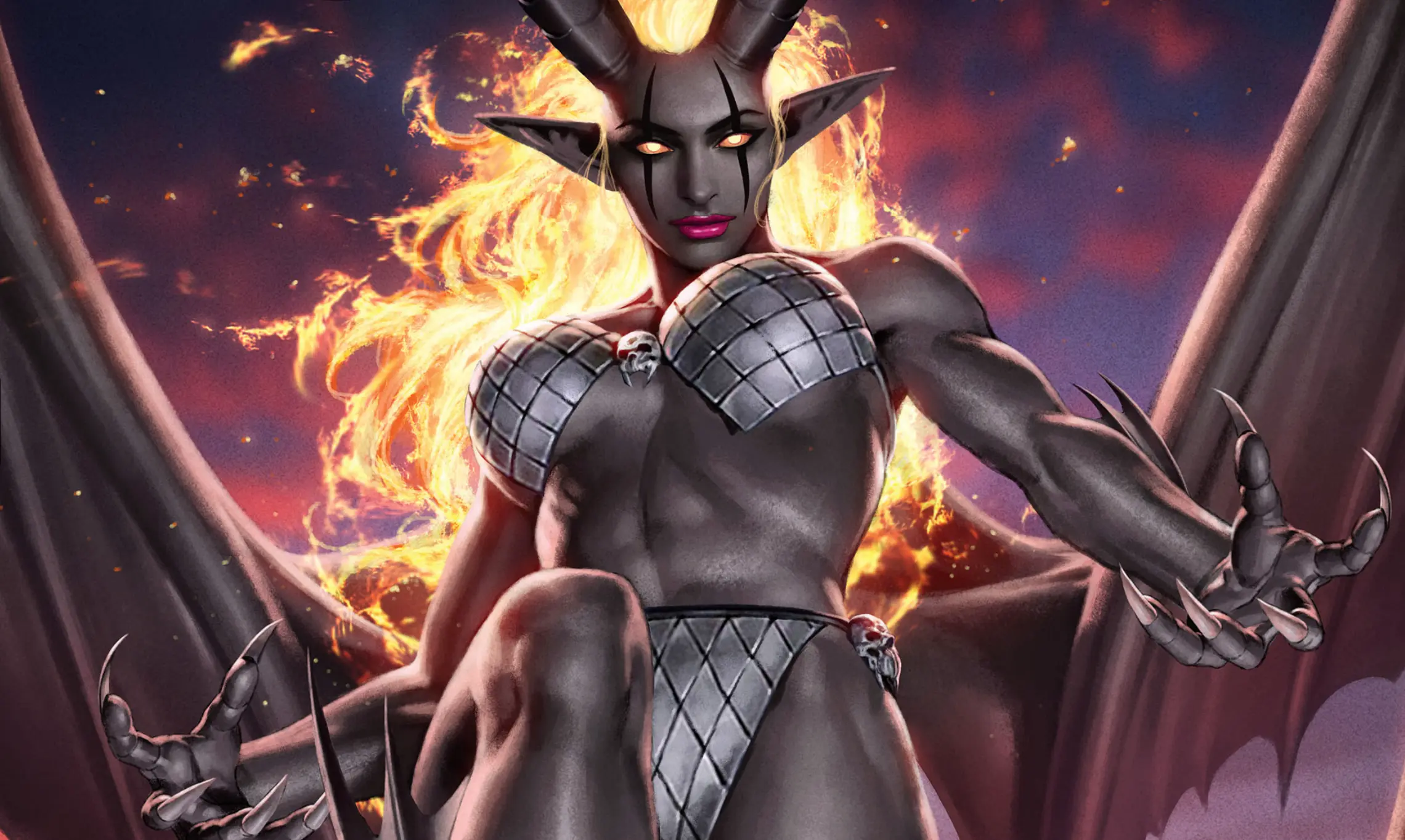
Issue One. Issue Two. Issue Three. Issue Four. Issue Five.
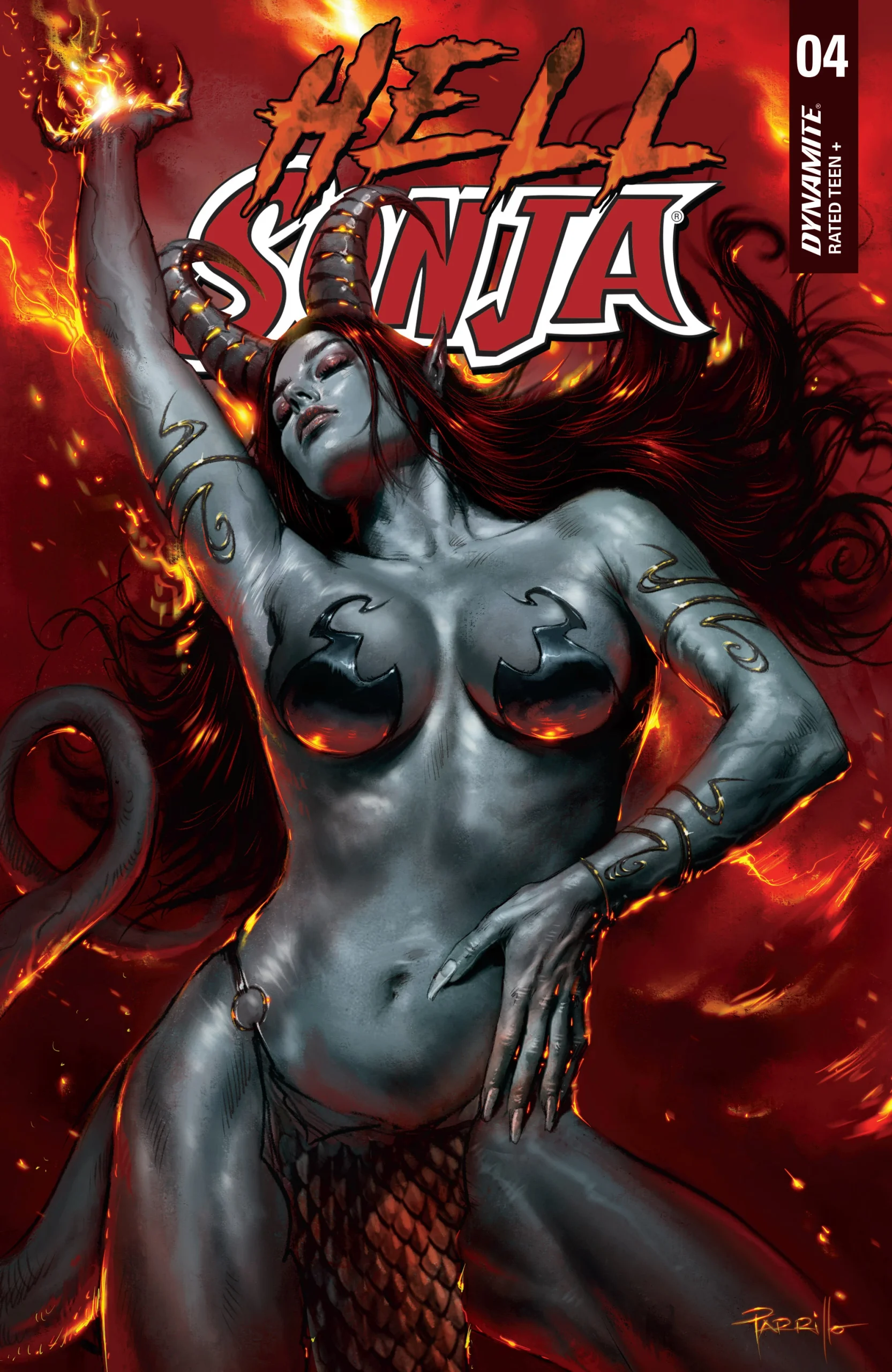
Issue Four
The penultimate issue significantly raises the quality of the miniseries. First of all, it reveals more about the cosmology of the Sonjaverse. The comic presents the history of the universe as a succession of forces displacing those that came before them. The gods killed the Titans, heroes displaced the gods, and biological cells kill the heroes. In Hastings’s vision, everything larger eventually falls under pressure from something smaller. Revolution begins at the bottom.
The fall of the gods does not, however, mean their complete disappearance. Quite the opposite: they have become a kind of cosmic parasite, living off energy derived from human beings. In this context, Hell exists entirely outside morality and functions as a refinery converting souls into fuel for the gods.
What matters in this world is not so much sin itself as the belief that one has sinned. If people can be convinced that they are sinners, they can also be made to believe that they deserve Hell. In other words, religious guilt is instilled so effectively that people willingly deliver themselves into the system that consumes them. It is quite an interesting approach to religion. Hastings punctuates it with grotesque humour, but this time the comedy fits the increasingly surreal nature of the world, which at moments recalls Grant Morrison’s famous run on Doom Patrol.
The Sonjas appear here aboard an aeroplane controlled by Asmodeus, whose passengers are his worshippers. The plane evokes Charon’s barge, although it is even more a grotesquely unreal gathering of cheerful murderers planning a collective ritual sacrifice.
Hastings also lists the rulers of Hell in this issue and slips several small Easter eggs into the enumeration. His list includes Anubis, Pluto, Hel, Lucifer, Hastur, Asmodeus, Nameless Godhead and Hell Sonja.
Hel—from Norse mythology—is both the name of the realm of the dead and its ruler. Within the broader mythology of Dynamite’s comic-book worlds, however, the name may also remind readers of Lady Hel, the ruler of Hell modelled upon Lady Death from Chaos! Comics.
Hastur, meanwhile, was a god of shepherds in Ambrose Bierce’s Haïta the Shepherd. Robert W. Chambers borrowed the name and used it in The King in Yellow, after which Howard Phillips Lovecraft picked it up from Chambers. Hastings therefore throws ancient mythology, Christian demonology and Lovecraftian motifs into a single cosmology, while simultaneously leaving the door open for further comic-book connections.
Like the previous issues, this one also suffers from an excess of ideas—enough material for two or three instalments is crammed into a single issue. It is fast and chaotic, but these are the same criticisms I have repeated every time I have encountered Hell Sonja, so let us move on to the art.
Art
Qualano makes very effective use of the confined space inside the aeroplane. Narrow panels and rows of seats create a claustrophobic impression, after which the comic suddenly opens into an enormous image of cosmic gods and Hell. The scale literally leaps from several dozen people trapped inside a metal fuselage to the entire dying multiverse.
The page showing the conversation between Red Sonja and Hell Sonja is also particularly attractive: diagonal panels cut through the ordinary space of the aeroplane with demonic imagery. The supernatural literally intrudes into reality.
Meanwhile, the final image of the aeroplane crashing into the mountain is exceptionally simple, but precisely for that reason it works better than some of the more crowded sequences.

Author of “Panorama of Hong Kong and Taiwan Cinema”, a lover of Asian cinema, action films, and space voyages aboard the starship Enterprise. He once studied Polish philology, and later became a citizen of the NSK State in Time. He has published in Kinomisja, Ekrany, Kultura Liberalna, Torii, Dwutygodnik Kulturalny, and others.