Issue One. Issue Two. Issue Three. Issue Four. Issue Five.
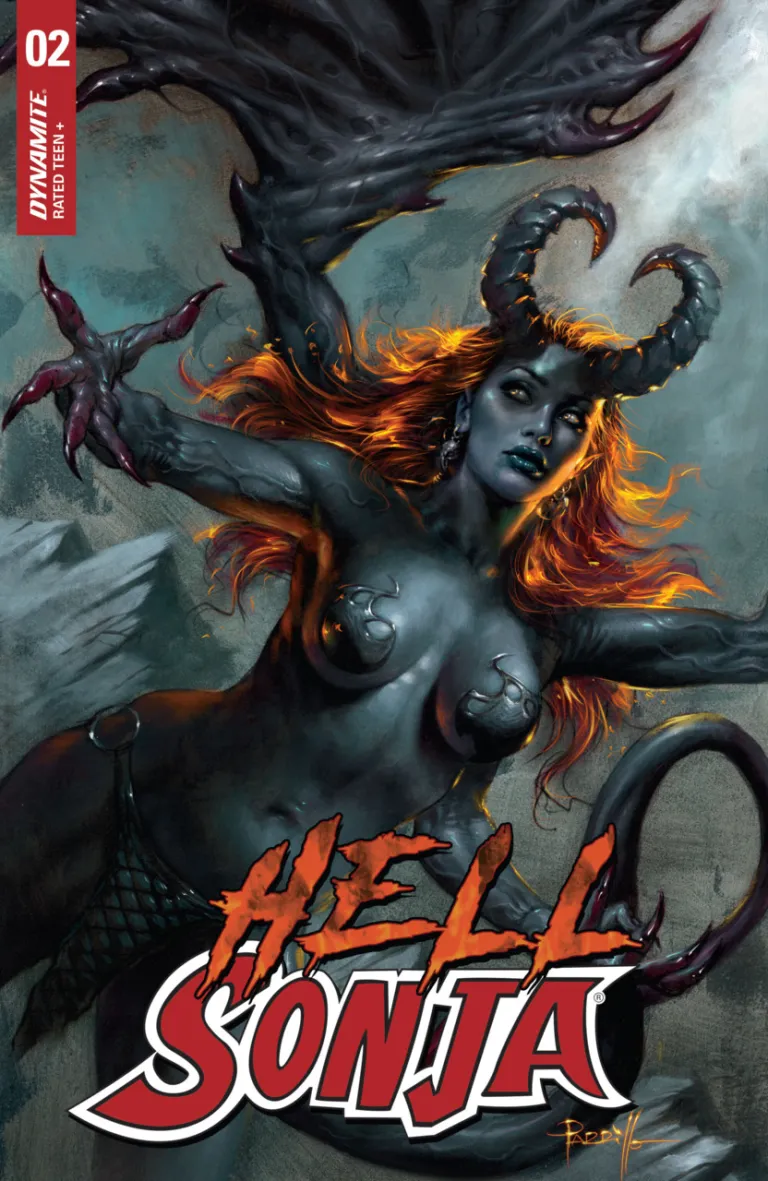
Issue Two
In our second encounter with the Sonja strike team, we travel with them to another Earth, whose highly advanced civilisation experimented with interdimensional travel. Naturally, the experiments went wrong. As a result, the world was flooded, and the remnants of humanity now live on the ocean above the ruins of the old civilisation. A mysterious ghost ship also roams the surface of the endless sea, driving those who encounter it insane. We therefore get a fine pulp mixture: post-apocalypse, ghost ship, interdimensional portals, Hell and body horror.
The ghost ship turns out to be more than just another haunted vessel. In reality, it is a colony of intelligent fungus whose spores cause psychological disturbances and can subsequently use human beings as hosts. Interestingly, the fungus refers to them as ‘wombs’, creating the impression that it does not regard them as victims so much as reproductive organs. Did Hastings actually intend to invoke the horror motif of the human—usually female—body as a site of monstrous reproduction and invert it by assigning that function to people regardless of sex, or did he simply think the word sounded cool? Unfortunately, I do not know.
What I do know is that the fungus is a more interesting antagonist than Hrodulf. It is a monster that cannot simply be shot or hacked apart, because every fragment of it contains spores. The heroines’ usual skills therefore become a threat to their own survival. This gives Moon Sonja more room to shine, as the problem requires analysis and a technological solution rather than yet another demonstration of brute force.
The second issue of the miniseries also provides further information about how Hell Sonja operates. Here, she comes across almost like someone managing a corporation. The other Sonjas are essentially working for her under contract. These agreements differ from one another; the deal made with Gold Sonja, for example, stipulates that after completing a certain number of missions, Hell Sonja will refrain from taking her beloved to Hell. Every failed mission, however, resets the counter. It is quite an interesting approach to the idea of trading in souls. In this context, the comic increasingly suggests that the title character is not a heroine at all, but at most the miniseries’ antiheroine.
Unfortunately, Hastings often follows good ideas with bad jokes. Every time we enter horror territory, the writer has someone do or say something stupid, destroying the tension he has just built. If we set the humour aside for a moment, however, another interesting issue emerges: the question of what qualifies someone—or something—as deserving of Hell. Is the fungus evil if it does not operate according to human morality, but according to its own logic of reproduction and colonisation? Does it deserve eternal damnation in Hell? And would sending it there while it is still alive violate any rules?
One of the comic’s recurring weaknesses is Hastings’s distrust of silence. Every good idea has to be followed by an explanation, a reaction and often a joke as well. This prevents Hell Sonja from acquiring the necessary weight, while its tone too often drifts towards the stereotypical humour of contemporary superhero comics.
Art
A substantial portion of the issue is presented in full two-page spreads. This gives the story a fairly cinematic, almost panoramic sense of scale. The enormous ship is given room to breathe, the ocean feels vast, and the action can move through several vertical panels within a single wide composition.
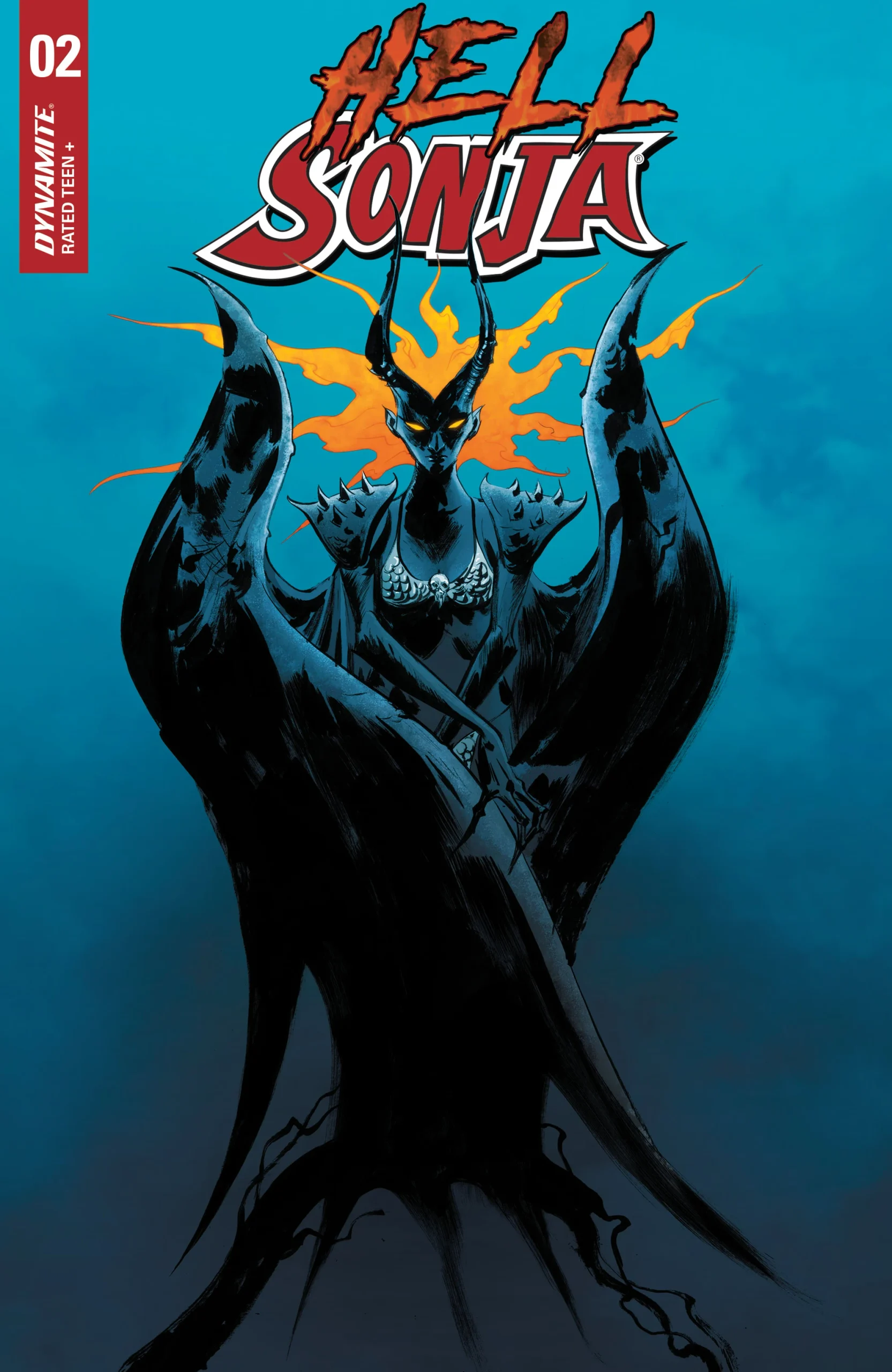
Colour is also used to organise the different worlds more clearly. The idea is hardly original, but it serves its purpose. The post-apocalyptic Earth is characterised by turquoise, navy blue and green, while Hell is defined by oranges, reds and pinks.
Author of “Panorama of Hong Kong and Taiwan Cinema”, a lover of Asian cinema, action films, and space voyages aboard the starship Enterprise. He once studied Polish philology, and later became a citizen of the NSK State in Time. He has published in Kinomisja, Ekrany, Kultura Liberalna, Torii, Dwutygodnik Kulturalny, and others.