Issue One. Issue Two. Issue Three. Issue Four. Issue Five.
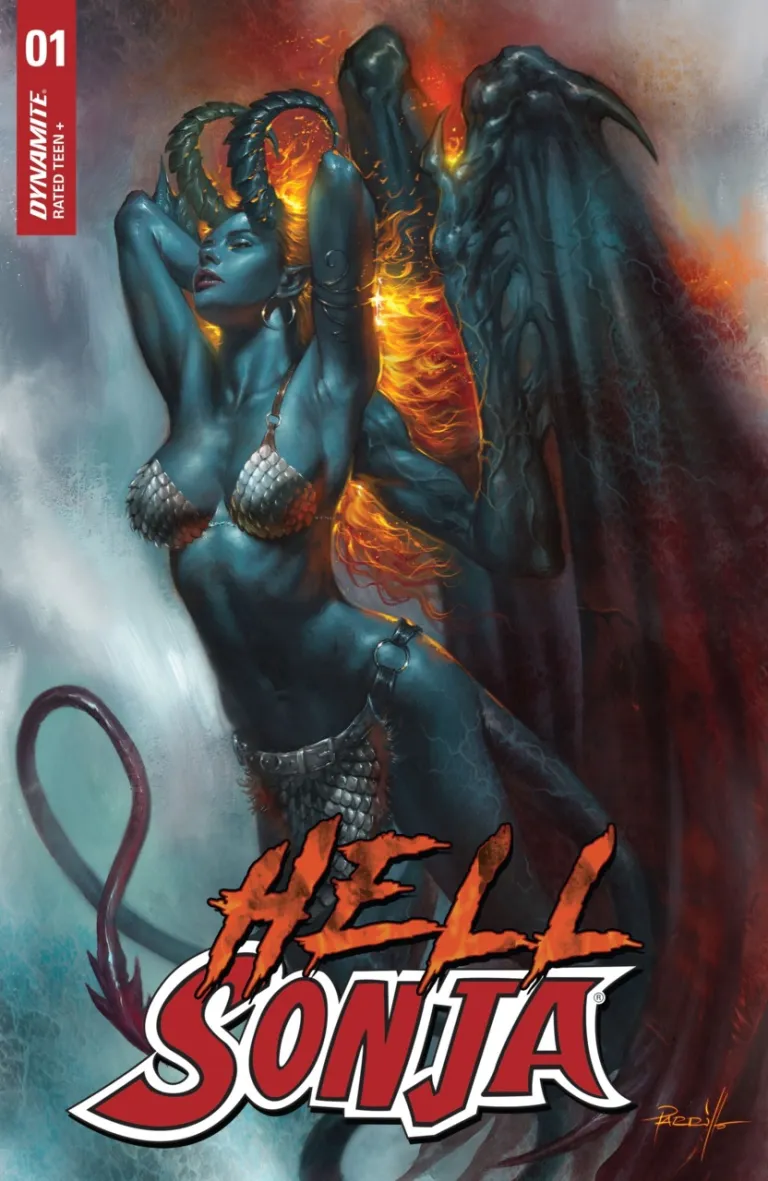
Hell Sonja, #1–5
Writer: Christopher Hastings
Art: Pasquale Qualano (#1–4), Andres Labrada (#5)
Colours: Kike J. Díaz (#1–2, #4), Ellie Wright (#3, #5)
Lettering: Jeff Eckleberry
Publisher: Dynamite Entertainment
Publication: 12 January – 18 May 2022
Covers: Lucio Parrillo (Cover A), Jae Lee (B), Junggeun Yoon (C), Joseph Michael Linsner (D), as well as photographic cosplay covers featuring Gracie the Cosplay Lass (E).
The comic begins like a classic sword-and-sorcery story. We find ourselves in a dark-fantasy world currently being conquered by a man named Hrodulf, who intends to sacrifice its inhabitants to the demon Asmodeus. Hastings quickly blows this convention apart: after one of the prisoners prays for help, the classic Red Sonja arrives on the scene—but she is not alone. She is accompanied by Blue Sonja with an assault rifle, Moon Sonja, who is an android, Gold Sonja—a smuggler with a stolen dragon—and others.
This genre mash-up, fully aware of its own absurdity, is the principal driving force behind the miniseries’ first issue. Drawing upon the idea of the Sonjaverse, Hell Sonja throws different varieties of pulp into a single title. Blue Sonja represents militaristic action cinema, Moon Sonja science fiction, Gold Sonja space opera, while Hell and Purple Sonja represent dark fantasy and horror. Hastings manages to combine them quite effectively, which is the comic’s greatest strength.
Across all five issues, the miniseries develops its vision of Hell and Heaven, building a surprisingly interesting mythology for the Sonjaverse. When we first encounter Hell Sonja, Hell is not so much a place of moral judgement in the Christian tradition as a cosmic mechanism. An ancient god made a bargain with the Sonjas: he gave them the strength to fight, but the souls of the enemies they defeated were to be sent to Hell. The god no longer exists, but the ‘hunger of Hell’ remains. If it is not fed souls, it will begin devouring the multiverse. Hell Sonja does not attempt to abolish this system; instead, she decides to choose for herself who will be used to satisfy its infernal appetite.
The idea is morally ambiguous—the Sonjas effectively become suppliers of ‘fuel’ for a literally monstrous system—but Hastings avoids delving too deeply into the more disturbing questions surrounding it: who deserves such a hellish fate and why, whether a victim’s prayer is sufficient grounds for identifying the guilty party, and whether any form of divine judgement exists at all. Nevertheless, the concept is not without perversity. In the first issue, its most interesting twist is that the prayers of people begging for help are answered not by Heaven, but by Hell.
Structurally, the comic clearly alludes to the once enormously popular television series The A-Team. Promotional material even includes the line: ‘if someone really bad is after you, you’re desperate enough, and no one else can help, maybe your prayer will be heard by Hell Sonja’. It is an obvious reworking of the series’ familiar formula. And the construction of Hell Sonja is indeed similar, albeit enriched with elements taken from RPGs: a specialist team in which every character has a different function and personality, character-card-style introductions listing worlds of origin, abilities and motivations, followed by a mission, a plan that immediately falls apart, improvisation by the heroines, and then a rapid move on to the next adventure.
The greatest weaknesses of the comic—and of the miniseries as a whole—are its sense of humour and rapid narrative pace. While the jokey tone can sometimes be used effectively, the pacing practically never slows down. An enormous number of ideas are packed into five issues, meaning that the characters frequently bombard us with excessively expository dialogue while the action races ahead at breakneck speed.
The positive and negative sides of the humour are already visible in the first issue. Hrodulf believes—and the comic initially allows the reader to believe—that Asmodeus really is the king of Hell. Hastings presumably chose the name deliberately: in older traditions Asmodeus does, after all, appear as a powerful demon and sometimes even as a king of demons. Yet this becomes the basis for a joke about mortals having no idea how Hell actually operates. Speaking of references beyond comics, it is also worth noting that Hastings alludes to Dante’s Inferno by mentioning the seventh circle of Hell, reserved for those guilty of violence—including tyrants and murderers—and therefore entirely appropriate for Hrodulf.
Unfortunately, elsewhere the humour weakens the comic. Virtually every character is reduced to a comic archetype, and almost every event—no matter how gruesome or dramatic—is punctuated by a joke, inviting comparisons with comics and films from the Marvel stable. In other words, anyone expecting horror—and they might reasonably have done so, since promotional materials list it as one of the principal genres alongside action/adventure—will be sorely disappointed. Although Hell, skeletons and demons all appear, the comic’s tone is humorous and adventurous, making it a work aimed more at admirers of pulpy fantasy.
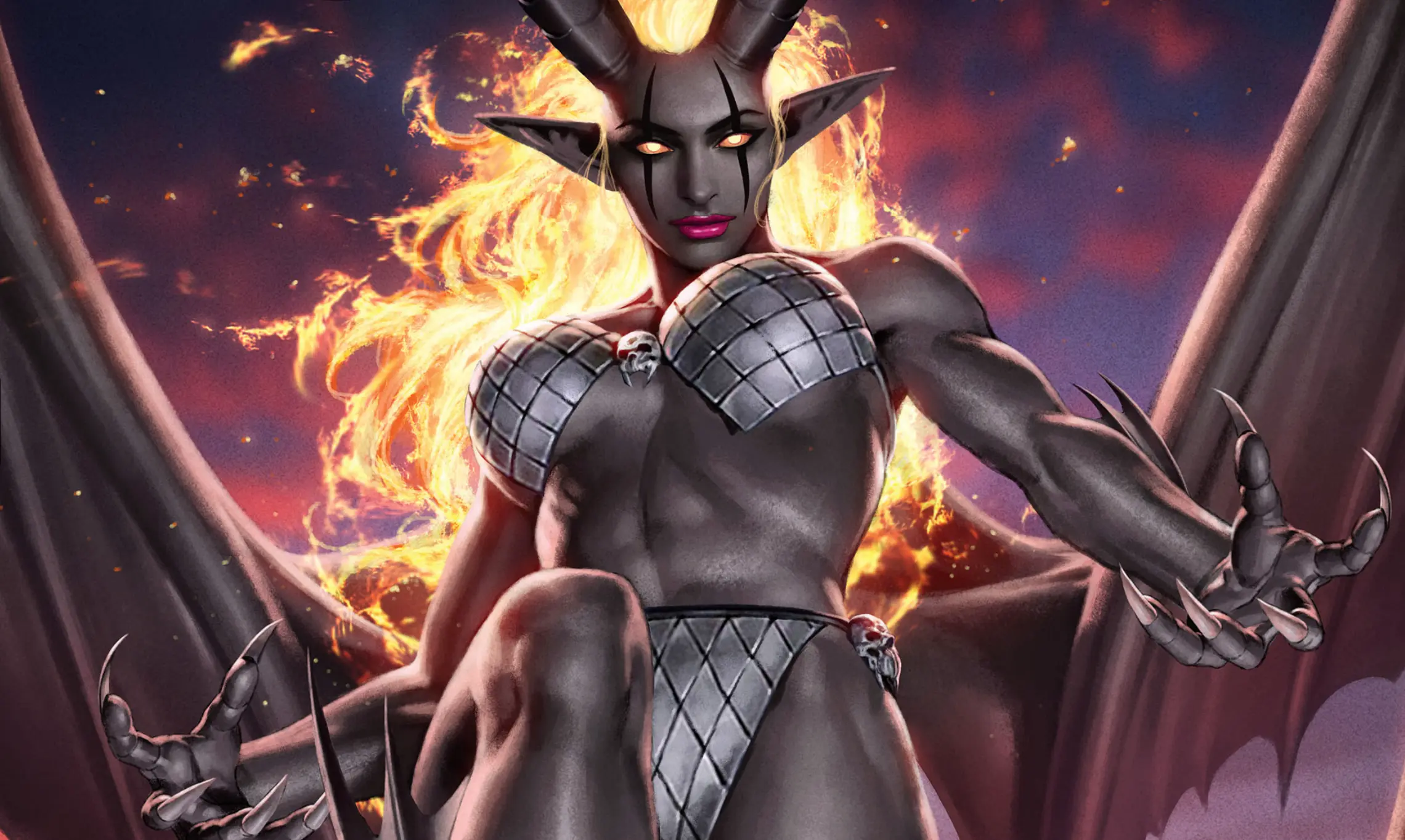
Interestingly, the marketing is distinctly more erotic than the contents of the issue itself. Dynamite tempted readers with an enormous number of variant covers and incentive editions, many of which present more or less eroticised images of Hell Sonja. It is a classic Dynamite strategy: bad-girl imagery and pulp sexuality are heavily emphasised on the covers, while the comics themselves usually turn out to contain little of this straightforward eroticism.
Art
Pasquale Qualano is solid, although the energy of the page layouts makes a stronger impression than the drawings of specific characters. There are numerous tilted panels, overlapping frames and splashes extending beyond their borders. As a result, the issue reads quickly and the action scenes feel dynamic.
The comic works best when genres collide visually: Sonja in chainmail standing beside an assault rifle, a dragon against firearms, or a medieval castle combined with interdimensional technology. Ideas of this kind are the ones that remain most firmly in the memory.
Kike J. Díaz’s colours significantly strengthen the comic’s visual presentation. Most of the first section is immersed in oranges and reds, while later passages introduce cold greens associated with Moon Sonja and infernal energy. This creates a strong visual unity, although admittedly the overall effect can occasionally become a little too uniform.
But Which Red Sonja, Exactly?
She-devil with a sword has undergone several reboots, but that does not mean that one reboot completely erased the previous versions of the character. The Sonjaverse exists, after all, and within it every variation of the red-haired warrior continues to thrive.
The Marvel version of Sonja, created in 1973—with the famous origin added in 1975 involving the murder of her family, rape, the appearance of the goddess Scáthach, who grants Sonja her fighting abilities, and the oath that she will not be with a man unless he first defeats her in combat—was rebooted by Gail Simone in 2013. Dynamite had initially continued a model closer to the classic version of the character.
Simone’s Sonja is not raped, does not receive her combat abilities from Scáthach and makes no sexual oath. She survives the destruction of her community, fends for herself, is later enslaved and develops her abilities through years of gladiatorial combat.
The Red Sonja appearing in Hell Sonja is a variant conceived as the classic Sonja, derived from the model established by Marvel during the 1970s. The miniseries itself is a spin-off of Hastings and Qualano’s Sonjaversal.
In Hastings’s interpretation—which reworks the original origin without requiring another reboot—the red-haired warrior has rejected her oath and no longer wishes to kill for her god or send souls to Hell. Hastings interprets the divine gift as a transaction in which Sonja was exploited. The deity gives her strength, but every person she kills becomes fuel for the system. Sonja eventually realises what her ‘oath’ truly amounted to and refuses to continue participating in it.
I do not want to suggest that Hastings is carrying out a feminist deconstruction of the 1975 origin, but it is difficult not to notice that what was originally presented as Sonja reclaiming strength and agency after trauma is transformed here into an oppressive divine contract.


Author of “Panorama of Hong Kong and Taiwan Cinema”, a lover of Asian cinema, action films, and space voyages aboard the starship Enterprise. He once studied Polish philology, and later became a citizen of the NSK State in Time. He has published in Kinomisja, Ekrany, Kultura Liberalna, Torii, Dwutygodnik Kulturalny, and others.