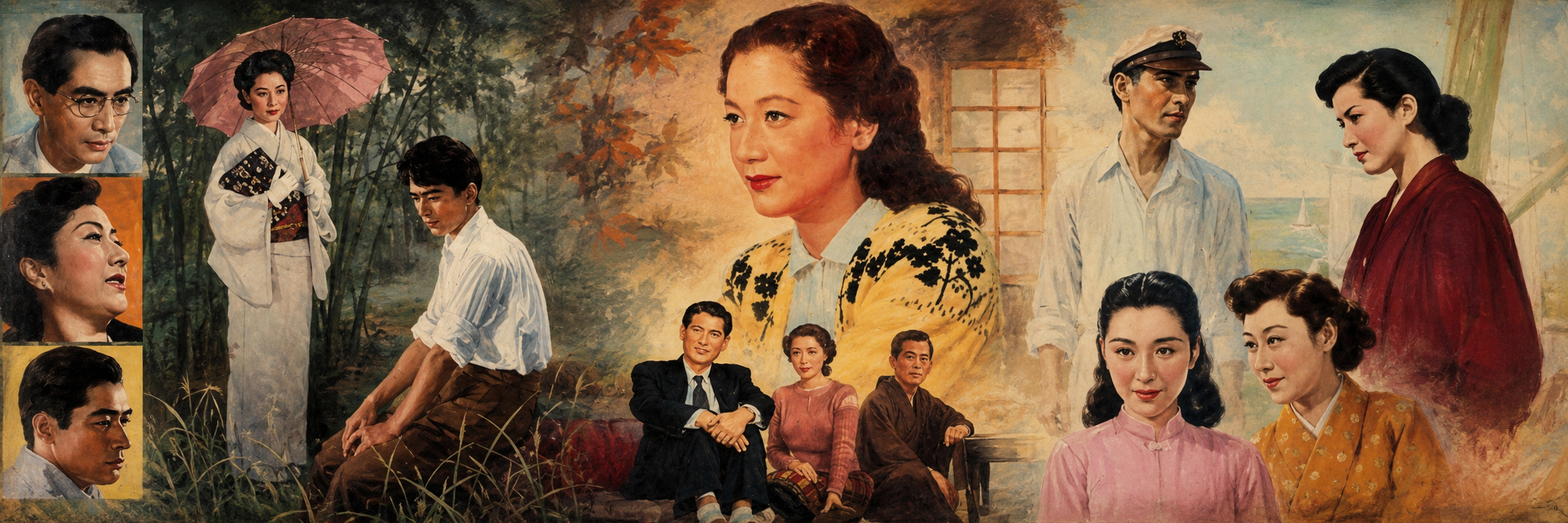
- The Lady of Musashino, Kenji Mizoguchi (drama)
- Early Summer, Yasujirō Ozu (drama)
- Fireworks over the Sea, Keisuke Kinoshita (drama, romance, action)
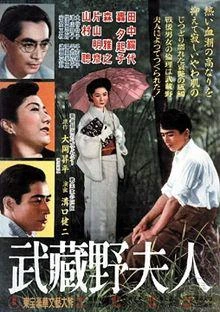
The Lady of Musashino
(Musashino fujin)
Director: Kenji Mizoguchi
Screenplay: Yoshikata Yoda
Cinematography: Masao Tamai
Music: Fumio Hayasaka
Asst. director: no info
Studio: Toho
Genre: Drama
Cast: Kinuyo Tanaka, Yukiko Todoroki, Masayuki Mori, Akihiko Katayama, Sō Yamamura, Eitarō Shindō, Kiyoko Hirai
Set in post-war Japan, the story follows Michiko, an unhappily married woman with whom her young cousin falls in love.
Commentary: The Lady of Musashino was based on a novel by Shōhei Ōoka, published in 1950. The book was an enormous success with critics and readers alike, so an adaptation for the big screen was an expected development. Kenji Mizoguchi took on the task. It is hardly surprising that the novel attracted his interest. After all, it centres on a complex female character, while Ōoka engages in social criticism, explores class conflict, paints a broad portrait of post-war Japan and draws inspiration from French literature.
In Mizoguchi’s hands, the story told in the novel became a kind of morality play concerning – unsurprisingly – the impossibility of women achieving self-determination and happiness within a patriarchal socio-political order. This subject is closely connected here with the ideological chaos that followed 1945. Old ideas had become associated with military propaganda and were readily rejected; the poverty caused by defeat deepened class divisions and moral decline; and the influx of new ideas from the West was perceived both as an opportunity for progress and as a weakening of Japanese culture. Under such ideologically fractured conditions, it was difficult to find a stable moral foundation. Japanese artists, politicians and philosophers all embarked upon a search for one. Cinema took part in this search as well, as demonstrated not only by Mizoguchi’s films, but also by those of Mikio Naruse or Yasujirō Ozu.
The protagonist of The Lady of Musashino is Michiko Akiyama, played by the ever-reliable Kinuyo Tanaka. We first meet her towards the end of the war, when she flees Tokyo with her husband, Tadao Akiyama (Masayuki Mori), and moves to her parents’ large estate near Musashino. At the time, the region was an Arcadian idyll; today, it is one of Tokyo’s districts and bears no resemblance whatsoever to its appearance seventy years ago. Living nearby are Michiko’s cousin, Eiji Ono (Sō Yamamura), and his wife, Tomiko (Yukiko Todoroki). Before long, Michiko’s parents die and the estate passes into her hands. Another of her cousins, Tsutomu (Akihiko Katayama), a former prisoner of war, then arrives.
Through its gallery of characters, the film presents a rich cross-section of society and delves into matters of the heart, which much more often manifest themselves as physical desire than as pure, profound affection. Tadao comes from a farming family but is now a university lecturer who readily embraces Western ideas. He is also openly interested in the married Tomiko, whose husband, Eiji, is an immoral egotist concerned solely with financial gain. Tomiko, however, is no traditional, modest and dutiful woman. Quite the opposite: her sexuality is all too conspicuous, while her marriage – as she makes no attempt to conceal from anyone – is entirely devoid of love. Nor does she feel any attraction towards Akiyama, as it is the young student Tsutomu who interests her.
This rather stereotypical young man, meanwhile, is naive and unable to perceive the hypocrisy surrounding him. Fascinated by a mature, quietly suffering and classically Japanese woman, he falls in love with Michiko. Although she returns his feelings, her respect for tradition leads her to reject his advances. Her emotional resolve begins to crumble when she learns that Tadao intends to leave her for Tomiko.
Narratively, The Lady of Musashino has a fairly episodic structure and moves at a brisk pace, as though reflecting the accelerating rhythm of life in the country’s post-war reality. The dominant impression is one of being unable to plan one’s own future, whether because of unforeseen events, the behaviour of those around us or social expectations. To some extent, the film’s atmosphere might even be described as apocalyptic. This impression is created by references to the Second World War, which destroyed the world as it had previously existed. A new world arose in its place, but one incapable of cohering into a morally consistent whole and therefore producing psychological distress and ideological chaos.
Mizoguchi’s stylistic approach is somewhat disappointing, however. He was a director renowned for long takes and a mobile camera that followed his characters with great precision. For some reason, in The Lady of Musashino he contents himself with relatively simple means of expression, causing the production to lose its visual identity and preventing it from conveying the full weight of its emotions. One possible explanation is the short shooting schedule. Kinuyo Tanaka was an enormously sought-after actress at the time: four films starring her were released in 1951 alone, which meant that she could not spend very long on the set of any one of them.
Thematically, the film is more political than the other two entries in Mizoguchi’s loose trilogy about upper-middle-class women, which also includes Portrait of Madame Yuki and Miss Oyu. The Lady of Musashino not only presents the dichotomies of modernity and tradition, and the younger and older generations, but also places greater emphasis on broader social change and sexuality within the new socio-political paradigm. Michiko, for instance, belongs to the older generation but is in love with a young man who is also her cousin. This and other elements of her private life place her at the very centre of the issues that are crucial to the film’s political thought.
Mizoguchi appears to emphasise the importance of tradition as a fragile foundation for moral values that are frequently lost amid modernity. His position may seem somewhat surprising when one remembers that the director had often appeared critical of patriarchal social structures in the past. The primary target of criticism in The Lady of Musashino, however, seems to be the widespread greed concealed beneath the modern individual’s surface of sophistication and refinement. To some extent, this can be interpreted as a critique of capitalism, although it should also be remembered that greed, as the dominant force driving the actions of numerous social groups and governments themselves, is a permanent feature of humanity.
Naturally, post-war Japan, as a traumatised country, often felt a greater need to analyse and expose moral corruption, and to oppose it with enduring ethical values. These were frequently sought among traditional virtues, above all loyalty and obedience. Michiko therefore embodies the film’s dominant conviction that morality and fidelity to one’s beliefs are the highest values. She argues that one must adhere to a particular system of values even in the face of social change, thereby voicing the admittedly naive hope that society will itself change and return to values regarded as moral from the perspective of tradition. Michiko’s recognition of the futility of this hope leads her to a final act of self-destruction, which appears to her preferable to continuing to exist in a ‘corrupt’ world.
Psychologically, the ending results from the collapse of Michiko’s final source of moral support, but it is too emotional, too sudden and too disproportionate in relation to the events that precede it. The film’s certain theatricality does not help, particularly in the performances of the male cast, which seem to have been transferred from a stylised jidaigeki into a realist drama. This creates an unnatural contrast with the rest of the film and diminishes the gravity of its events.
Ultimately, The Lady of Musashino addresses important issues in an interesting manner, but does so with a somewhat questionable and one-sided morality. Despite Tanaka’s excellent performance and numerous beautiful shots, it remains stylistically rather undistinguished, producing an ambivalent response to the work as a whole. I could by no means describe it as a bad or unsuccessful film, but neither can I place it on the same level as Mizoguchi’s greatest achievements. Within the context of the director’s filmography from this period, The Lady of Musashino may therefore be regarded as disappointing, although it undoubtedly remains a film worth discovering.
7+/10
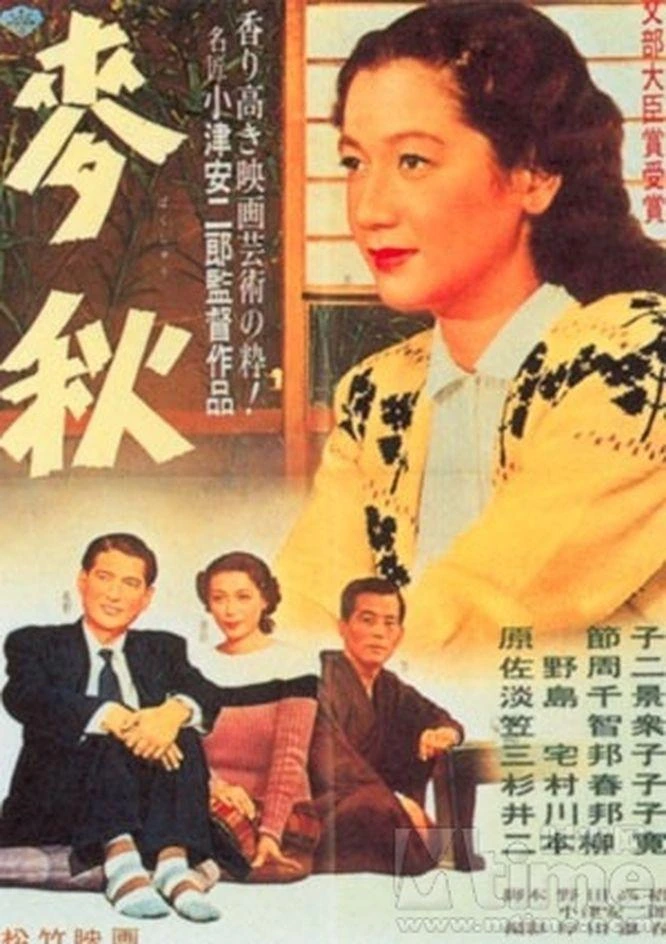
Early Summer
(Bakushū; literally ‘grain autumn’, referring to the wheat and barley harvest season in early summer)
Director: Yasujirō Ozu
Screenplay: Yasujirō Ozu, Kōgo Noda
Cinematography: Yūharu Atsuta
Music: Senji Itō
Asst. director: Kōzō Yamamoto, Shōhei Imamura
Studio: Shochiku
Genre: Drama
Cast: Setsuko Hara, Chishū Ryū, Chikage Awashima, Kuniko Miyake, Ichirō Sugai, Chieko Higashiyama, Haruko Sugimura, Kuniko Igawa, Hiroshi Nihon’yanagi, Shūji Sano
No. 6 at the Japanese box office.
No. 1 in Kinema Junpo’s Best Ten.
The moderately well-off Mamiya family attempt to find a husband for twenty-eight-year-old Noriko, whose independence does not always meet with the approval of her relatives.
Commentary: Another classic from one of Japan’s master directors, Yasujirō Ozu, Early Summer commands attention for at least several reasons. The first is its natural depiction of the characters’ everyday lives – particularly evident in the film’s opening act – which is perfectly integrated into the central narrative. The meals being prepared and the journeys to work shown on screen are all more or less connected with the Mamiya family’s preparations for their uncle’s arrival, which constitutes the first of the central plot’s three pillars.
Ozu uses his arrival and everything associated with it to introduce the principal characters in a remarkably relaxed manner that never feels purely expository. This is worth emphasising because Early Summer contains a genuinely large number of characters. The Mamiya family alone consists of eight people when the uncle is included, while the addition of their friends, colleagues and neighbours brings the total to nineteen – or even twenty, should we count the unseen but frequently mentioned Mr Manabe. Ozu spends approximately forty minutes introducing them while simultaneously outlining the plot, resulting in a comprehensive portrait of both the principal and supporting characters.
The other two pillars of the central narrative concern the family’s desire to find a husband for Noriko – which soon becomes the film’s primary subject – and the repercussions of her own marriage plans. Her family’s reactions and Noriko’s attempts to negotiate them form the subject of the second act, while the third focuses on the consequences of all the decisions made earlier and concludes with an epilogue that gives Early Summer a circular structure.
On the one hand, then, the film has a remarkably compact construction; on the other, it leaves considerable room for the development of its characters and the presentation of their lives – and, in the background, life in contemporary Japan more generally. As David Bordwell observes in his book Ozu and the Poetics of Cinema (1988), the director employs alternating motifs involving everyday activities and arranged meetings in order to develop his narrative and character portraits in a manner not entirely dissimilar to contemporary Hollywood productions.
Ozu links successive sections of the story through dialogue – for example, a character mentions someone during a conversation, followed by a cut to the person being discussed – or through sound, as when a musical theme performed live in one scene continues on the radio in the next. In themselves, these are highly conventional methods of narration: simple but effective and, within the carefully considered structure of Early Summer, exceptionally efficient. They also complement the film’s uncomplicated storyline, filled with the ordinary, unembellished everyday life of Japan’s middle class.
The apparent simplicity of the plot is, however – at least to some extent – deceptive. Ozu allows viewers to accept the story without seriously questioning the development of events or the characters’ motivations, yet at a certain point gaps begin to emerge, suggesting that not everything has been stated explicitly and that at least some events have taken place beyond the audience’s field of vision.
This is particularly evident in Noriko’s unexpected decision to marry her neighbour Yabe. What makes it especially interesting is that Ozu continues until the very end of the film to avoid explaining the reasons behind her choice. His determination to conceal them inevitably leads to particular stylistic decisions. He entirely omits Noriko’s meeting with Mr Manabe, the wealthy bachelor who wishes to marry her. Once we learn of her decision to choose Yabe, meanwhile, Yabe himself is almost completely removed from the film, leaving us with virtually no opportunity to observe any interaction between him and Noriko.
Even earlier, when his mother proposes the marriage to Noriko, the camera never once shows the young woman from the front. She is visible only from behind, meaning that we are never able to observe her reaction to the words of Yabe’s mother. Furthermore, even the wedding – theoretically the most important event and the culmination of all the narrative strands – is reduced to a distant image of a bridal procession appearing in the epilogue.
Naturally, as befits a drama of its period, the film is also largely concerned with the tradition–modernity dichotomy. Within this context, Noriko and her metropolitan surroundings become symbols of modernity. Symbols of the old order – sometimes displayed almost ostentatiously within the frame – include a calligraphy scroll, the Great Buddha of Kamakura and the scenes set in a kabuki theatre. Among the characters, the clearest embodiment of tradition is undoubtedly Grandfather Mamiya.
In many respects, Noriko represents an intriguing example of a modern woman presented in a broadly positive light and never allowed to descend into immorality. Her modernity is emphasised by her surroundings: the urban spaces of Tokyo, the cafés of Ginza and so forth. Yet she never completely abandons tradition, nor does she run a business on her own or enter into an open relationship. Instead, she decides to marry a respectable man.
It is the manner in which she reaches this decision that constitutes a transgression against Japanese convention. She makes it without consulting her family in any way. She entirely deprives her relatives of the opportunity to participate in choosing her husband, which represents an enormous violation of accepted social norms. This is all the more significant because her family has already been negotiating with Manabe, who represents the classic highly desirable match for an unmarried woman: a wealthy, handsome bachelor eager to marry. Noriko’s decision to marry Yabe therefore places her family in an embarrassing and perhaps even dishonourable position.
She also confronts Yabe himself with a fait accompli, leaving him virtually no opportunity to express an opinion. In this respect, Noriko’s independence and strength are revealed with particular force, while her status as a symbol of modernity also points towards the changes taking place throughout the country. Her transgression lies not in rejecting marriage, therefore, but in asserting her right to define it for herself.
At the same time, however, her choice – the desire to marry an impoverished childhood friend who, moreover, reminds her of her missing brother – is rooted in conservative thought. Noriko’s conduct is therefore a paradoxical synthesis of modernity and traditionalism. David Bordwell writes that the film posits a fragile modernity, one which recognises that a ‘love match’ is still chancy and may arise from a desire to recapture the innocence of the pre-war years.
In one respect, the modern act of defying traditional behaviour leads both Noriko and her family towards an even greater traditionalism. The decision made in modern Tokyo removes her from metropolitan life and sends her – together with her parents – towards more traditional rural areas.
The excellent performances, carefully constructed plot that refuses to provide easy answers, profound character portraits and remarkable consideration of modernity and its relationship with tradition make Early Summer an outstanding example of Japanese domestic drama. It demonstrates that, within this form of cinema, Ozu was an almost unsurpassable filmmaker.
9/10
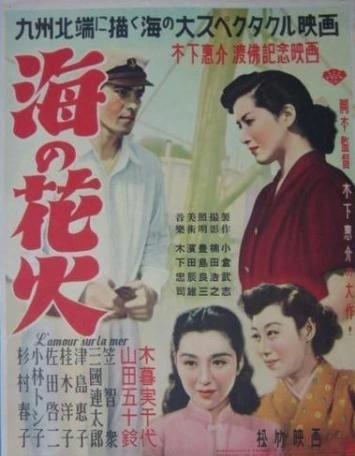
Fireworks over the Sea
(Umi no hanabi)
Director and Screenplay: Keisuke Kinoshita
Cinematography: Hiroyuki Kusuda
Music: Chūji Kinoshita
Asst. director: no info
Studio: Shochiku
Genre: Drama, Romance, Action
Cast: Michiyo Kogure, Yōko Katsuragi, Rentarō Mikuni, Isuzu Yamada, Teruko Kishi, Chishū Ryū, Toshiko Kobayashi, Chieko Higashiyama, Keiji Sada, Akira Ishihama, Keiko Tsushima, Takashi Miki
The Kamiya family struggle to keep their fishing business afloat while contending with financial difficulties, an unscrupulous captain and conflicting emotions.
Commentary: Between Carmen Comes Home and Carmen’s Innocent Love, Keisuke Kinoshita directed two films: Boyhood and Fireworks over the Sea. The latter is, on the one hand, a typical Kinoshita work, filled with melodrama and sentimentality; on the other, it surprises with the introduction of criminal elements and even some tentatively sketched action scenes.
Fireworks over the Sea follows the fortunes of a family who made the not entirely well-considered decision to enter the fishing industry. This attracted the attention of business swindlers and duplicitous relatives, while – as was characteristic of dramas from the period – it also opened the door to sometimes damaging romantic entanglements and arranged marriages that were not always welcome. As we may remember from Kinoshita’s previous films, whenever a tragic protagonist – whether individual or collective – appears in one of his works, fate will continue placing obstacles in their path and grant them virtually no respite until the final scenes. Such is also the case here.
The story begins in 1949. This date clearly indicates that Fireworks over the Sea will address social issues, particularly those associated with post-war inequality and poverty in Japan. The setting is the port town of Yobuko, where two brothers, Tarobei (Chishū Ryū) and Jinkichi Kamiya (Takeshi Sakamoto), run a small fishing company. Their business is on the verge of collapse because one of the captains they employ steals fish and sells them on the black market, which was both a scourge of post-war Japan and a site of exploitation – though sometimes also of survival – for the poorest members of society.
Fortune smiles upon them when Shōgo (Takashi Miki), who had been stationed in Yobuko during the war, returns to the town. Although his arrival is motivated by his love for Tarobei’s daughter Mie (Michiyo Kogure), he proves helpful in finding a new captain: his friend Yabuki (Rentarō Mikuni).
One of the principal difficulties facing the Kamiya family stems directly from the country’s severe economic conditions. As is characteristic of Kinoshita, the protagonists are almost entirely without fault: honest and good-natured people whose kindness is perceived as a weakness in a world filled with financial hardship that breeds greed and selfishness. Consequently, they are exploited, attacked and deceived from almost every direction.
Unfortunately, Kinoshita goes too far in burdening his characters with misfortunes. Their predicament becomes exaggerated to an almost grotesque degree, creating the impression that realism has been abandoned in favour of overly insistent moralising – a recurring weakness of the director’s work (see The Good Fairy).
After a while, the protagonists decide to fight against the corrupt system. This time, however, in a manner quite unlike Kinoshita, Tarobei’s belief that victory is possible remains uncertain, making him vulnerable to the temptation of achieving success by taking a shortcut. This provides an opportunity to introduce Miwa (Yōko Katsuragi), a young woman whose wealthy father promises Tarobei financial assistance on the condition that Tarobei’s son marries her.
The introduction of arranged marriage allows the film to address several further themes. Among them is the emotional conflict experienced by women – here Miwa and Mie – between pursuing their own dreams and sacrificing themselves for their families, the latter being regarded as the traditional and socially desirable course of action. Fireworks over the Sea also examines the tendency of parents to treat their children as instruments through which they can achieve their own aims, which naturally connects with its criticism of the traditional practice of arranged marriage.
Kinoshita, of course, is also unable to resist making several bitter observations about the trap of social convention. A storyline similar to Miwa’s concerns Shōgo, whose sister-in-law (Isuzu Yamada) attempts to marry him to her niece (Keiko Tsushima) for reasons that serve her own interests rather than his.
Nor do the film’s romantic and social struggles end there. It also features a geisha (Toshiko Kobayashi) who is the object of the corrupt captain’s desire. She herself falls in love with the aforementioned Yabuki, who in turn falls in love with Mie.
It is in the sheer number of characters and narrative threads that the greatest weaknesses of Fireworks over the Sea become apparent. There are so many of them that Kinoshita never manages to unite them within a coherent structure or create fully realised characters. The film’s generic diversity has a similarly negative effect: it shifts between aggressively mawkish melodrama, socially engaged drama and even gangster and action cinema.
The result is a considerable degree of chaos. The film never finds its own voice, while its narrative remains permanently fragmented and disorganised. This was most likely caused, at least in part, by the production period being shortened because of the director’s journey to France.
Ultimately, despite competent editing, several attractive shots and an excellent cast, Fireworks over the Sea proves to be one of the more disappointing entries in Keisuke Kinoshita’s extensive body of work.
6/10

Author of “Panorama of Hong Kong and Taiwan Cinema”, a lover of Asian cinema, action films, and space voyages aboard the starship Enterprise. He once studied Polish philology, and later became a citizen of the NSK State in Time. He has published in Kinomisja, Ekrany, Kultura Liberalna, Torii, Dwutygodnik Kulturalny, and others.