- Fencing Master, Masahiro Makino (drama)
- Portrait of Madame Yuki, Kenji Mizoguchi (drama)
- Battle of Roses, Mikio Naruse (melodrama)
- Sasaki Kojiro, Hiroshi Inagaki (drama, chanbara, jidaigeki)
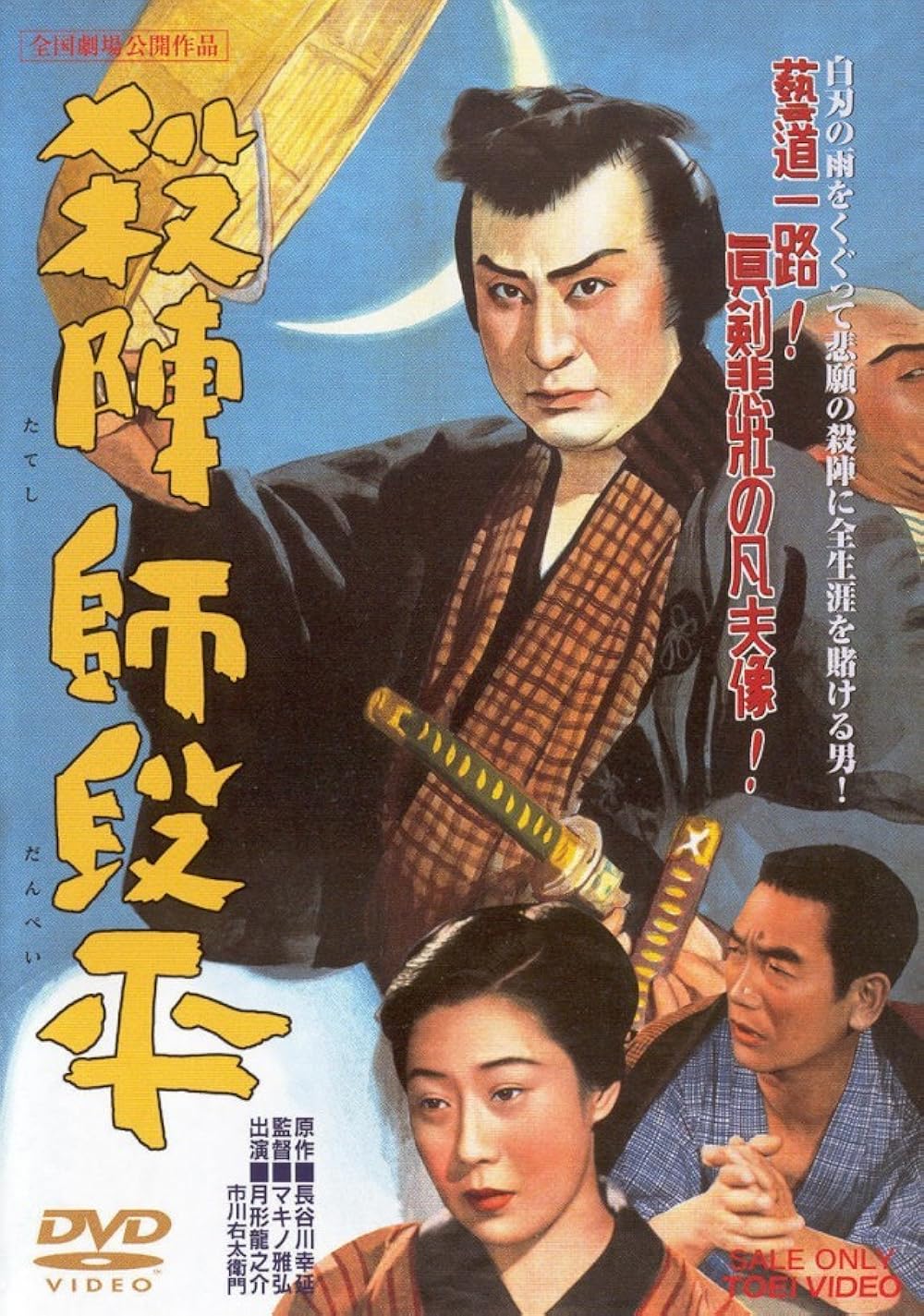
Fencing Master
(Tateshi Danpei; lit.: Danpei, Master of Stage Combat)
Direction: Masahiro Makino
Screenplay: Akira Kurosawa
Cinematography: Shigeto Miki
Music: Tokujiro Ōkubo
Asst. director: no info
Studio: Toyoko Eiga
Genre: drama
Cast: Utaemon Ichikawa, Isuzu Yamada, Entatsu Yokoyama, Chiaki Tsukioka, Eitarō Shindō, Kyoji Sugi, Yoshi Katō, Kinnosuke Takamatsu, Reiko Hatsune, Shizuo Maeda, Kensaku Hara, Ryūnosuke Tsukigata
Danpei, a choreographer of stage combat sequences, must contend with modern theatrical styles that threaten his traditional approach to his craft.
Commentary: The film can be read on two levels. The first is its surface layer — a (melo)drama following Danpei as he strives to create the finest possible sword fight choreography. Although the viewer is introduced to his work in a light, almost comedic tone, the accumulation of various misfortunes means that Fencing Master quickly takes on a bitter flavour. Danpei’s theatrical troupe plans to abandon sword-fighting plays, his wife dies, and he himself suffers paralysis. His troubles are compounded by his struggles with the new theatrical forms gaining ever greater popularity across the country — which in turn directs our attention to the second layer of the production, as a metaphor for the transformations taking place in Japan at the time.
Japan was embracing Western trends, philosophies, and art forms in the early twentieth century with extraordinary intensity. The Taishō era was strongly marked by the absorption of Western ideas and fashions, but also by a simultaneous movement towards aggressive resistance to them, which came to dominate Japanese culture in the late 1930s and 1940s. Since the film’s action is set in the Taishō era, Danpei is compelled to abandon the old school of stage combat choreography rooted in kabuki theatre in favour of a realism previously unknown to him. Parallels can be drawn between the period in which the film is set and the period of its making — the aftermath of the Second World War — for both share a common context of defeat in confrontation with the West, followed by the assimilation of Western thought, principles, values, and technology.
Makino’s film is an attempt to reflect the social mood of the time, but one that strives to maintain as neutral a tone as possible. It is therefore impossible to infer from the production which side — the classical or the realistic — its authors consider more valuable, nor is there any broader exploration of the impact of cultural change. The shift towards Western thinking is presented neither positively nor negatively. If anything, the two sides seem to balance each other out: embracing the new brings Danpei recognition and fame, but costs him his wife and his health; when he devoted himself to traditional theatre he was poor, disrespected, and felt inadequate as a man, yet he had a stable way of life. His fate can more readily be understood as a symbolic representation of the suffering and pain inherent in the process of modernization. This lack of any clear stance on the nature of these transformations — and the absence of genuine insight into the theatrical world during this pivotal period — may of course simply reflect the filmmakers’ reluctance to delve deeper into the subject, preferring instead to keep to the tried-and-tested model of the popular sentimental melodrama.
And while the diegesis offers no clear answers as to the filmmakers’ own views, some light may perhaps be shed by the production side of the film and the direction taken by its principal screenwriter, Akira Kurosawa. Seen through that lens, the picture presents itself as an attempt to introduce elements of realistic cinema into jidaigeki — something Kurosawa would go on to do from the director’s chair in the years immediately following, with Seven Samurai (Shichinin no samurai, 1954) and Yojimbo (Yojinbō, 1961), but also with Rashomon, which premiered just one day before Fencing Master. It must be added, however, that Kurosawa was not so much importing realism into historical cinema as seeking new ways to strengthen the relationship between style, action, and the psychological dimension of his films.
7/10
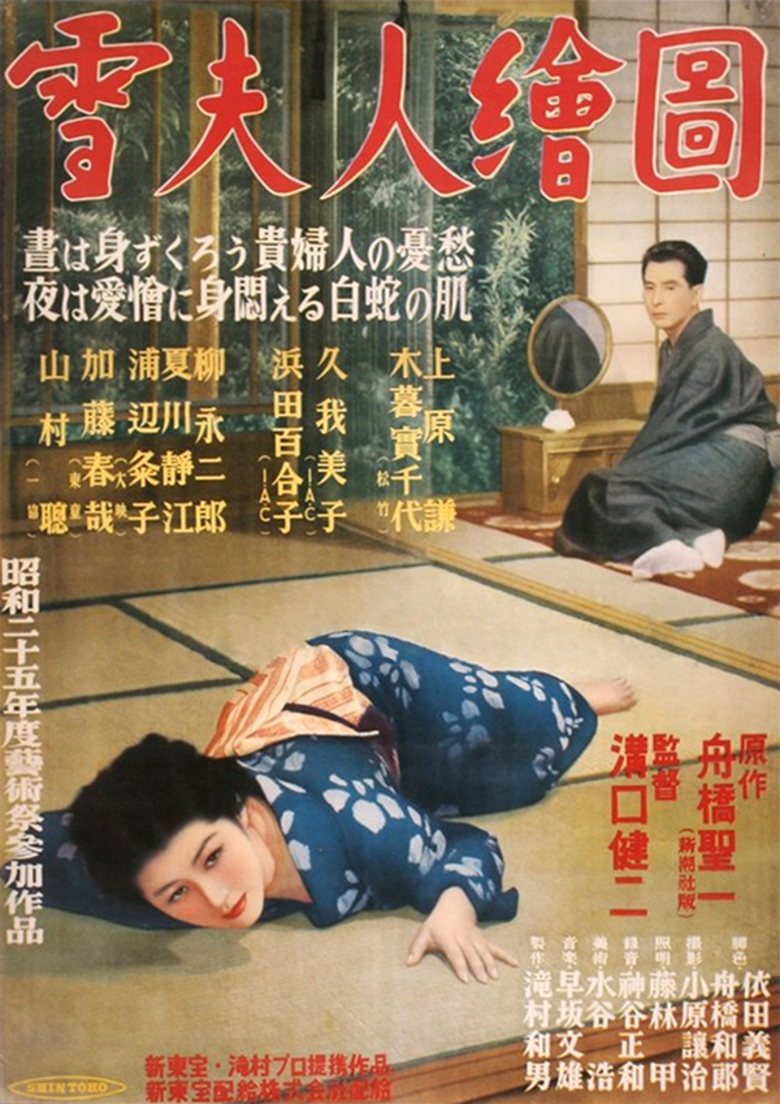
Portrait of Madame Yuki
(Yuki fujin ezu)
Direction: Kenji Mizoguchi
Screenplay: Yoshikata Yoda, Kazuo Funahashi
Cinematography: Jōji Ohara
Music: Fumio Hayasaka
Asst. director: Kiyoshi Komori
Studio: Takimura Productions, Shintoho
Genre: drama
Cast: Michiyo Kogure, Ken Uehara, Eijirō Yanagi, Yoshiko Kuga, Haruya Katō, Yuriko Hamada, Kumeko Urabe, Shizue Natsukawa, Sō Yamamura
A young woman takes a job as a servant to a noblewoman and soon discovers that beneath the surface of luxury lies great suffering.
Commentary: Watching Portrait of Madame Yuki, one cannot help but be reminded of the director’s earlier films, and in particular Osaka Elegy (1936). That film tells the story of Ayako Murai, a young woman who finds herself trapped in a modernizing Japan — a country that, during the Meiji Restoration and the Taishō era, was undergoing a period of rapid socio-political change. The transformations were, however, more frequent in theory than in practice; human mentality, as we know, does not change at the same pace as legislation and political ideas. In order to help her debt-ridden father and her brother who is studying, Ayako decides to become her employer’s mistress — a decision that results not only in social exclusion but also in rejection by the very family she was trying to help.
Mizoguchi does not engage in a critique of the woman’s conduct. Instead, he sketches a critique of the patriarchal system and illuminates its pathologies. Men in his films frequently occupy a dominant position, but solely by virtue of socio-political circumstances; for at every turn it is the men who suffer one failure after another and continue to behave in an infantile manner. Ayako’s employer is an immoral womanizer, her father a failure, her brother unable to earn money, and her fiancé is devoid of courage and hides behind the woman at the first sign of trouble. And yet for Ayako herself — a modern woman in a traditionalist society — there is no possibility of success. It is worth adding, also in the context of Portrait of Madame Yuki, that Osaka Elegy is considered to contain autobiographical elements in its depiction of the protagonist’s family, and especially her father, who resembles the director’s own.
In 1950 Mizoguchi left Shochiku after failing to reach an agreement regarding an adaptation of Saikaku’s prose that he had been planning. Without a contract with any studio, he made his next three films at three different institutions: Shintoho (Portrait of Madame Yuki), Daiei (Miss Oyu), and Toho (The Lady of Musashino). These form a loose trilogy, after which Mizoguchi finally managed to realize his intention of adapting Saikaku’s work — a production he completed in 1952 for Shintoho, and which brought him worldwide recognition.
Portrait of Madame Yuki is a classic example of the director’s work, focused on the impasse that arises at the intersection of a modern, modernizing system and traditional principles of social conduct. Mizoguchi here contrasts the figure of the traditional Japanese woman — the titular Madame Yuki, whose attachment to old values is confirmed at the visual level by her traditional kimono — with the modern woman, the husband’s mistress, dressed in Western clothing: loud, dominant, using her sexuality to climb the social ladder.
Although the viewer spends considerably more time with the titular Madame Yuki, the director does not assert the primacy of one woman over the other, but rather points to the existence of a paradoxical social system that prevents a woman from finding happiness regardless of whether she is traditional or modern. A traditional, conformist woman can never get her own way; in confrontation with others she is incapable of asserting herself, and all that remains for her is the passive acceptance of others’ decisions, which frequently entail her own suffering and humiliation. She is the archetypal Japanese woman who, in the modernizing post-war society, is slowly fading into the past — as the film’s finale, enclosed in extraordinarily refined and visually beautiful scenes, attests.
The modern woman, meanwhile, is compelled to use cunning and deception in order to ascend the social ladder, for in a world dominated by men there is no honest path to success. The sincere, “classically Japanese” woman must therefore sit at home in a man’s shadow, while the self-assured and rebellious one is inevitably driven onto the path of immorality — for only that path allows women to overcome men in an (extremely) patriarchal society. Her immorality, in turn, entails the social exclusion that Mizoguchi so effectively portrayed in the aforementioned Osaka Elegy. As there, here too he places the blame for this unjust state of affairs on society — and on men in particular, who are once again presented as infantile, egocentric, and idle.
The film can furthermore be read as a depiction of the conflict between honne and tatemae, not so unlike the conflict between ninjō and giri that characterizes many chanbara films. Honne is the sphere of private feelings and opinions; tatemae is the feelings and opinions adjusted to the needs of the collective and accepted by society. As such they are frequently in conflict, producing an almost schizophrenic dissonance. This is why Madame Yuki — like the heroines of so many Japanese dramas — so often falls silent or gives no indication of her desires, even when asked about them directly. The drama presented in the production is therefore also the protagonist’s inner drama: the drama of the impossibility of overcoming the barrier of social expectations and conventions. Fear of exclusion compels her to censor her own desires (honne), but fear of her own suffering will not allow her to surrender entirely to the role dictated by society (tatemae). Unable to find happiness, or even basic peace, in either sphere, Yuki contemplates suicide, which in her eyes becomes the ultimate escape from an irresolvable crisis. It is worth noting, however, that the ability to distinguish between these two spheres belongs only to those of a higher social standing who are conscious of social conventions. Madame Yuki’s servant — through whose perspective the viewer observes many of the events — is without this capacity, and consequently is not required to respect or follow the path of tatemae. This naturally means she is unable to understand her mistress’s decisions and behaviour. Perhaps, then, it is she who represents the future of Japanese women.
7/10
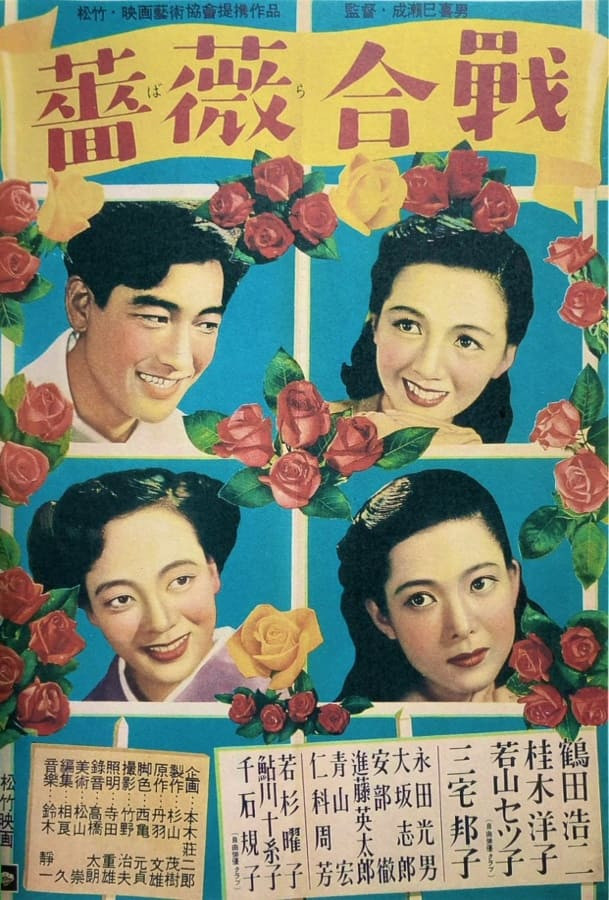
Battle of Roses
(Bara kassen)
Direction: Mikio Naruse
Screenplay: Motosada Nishikame
Cinematography: Haruo Takeno
Music: Seiichi Suzuki
Asst. director: Ryōsuke Kurahashi
Studio: Film Art Association, Shochiku
Genre: melodrama
Cast: Kuniko Miyake, Setsuko Wakayama, Yōko Katsuragi, Koji Tsuruta, Tōru Abe, Mitsuo Nagata, Yōko Wakasugi, Shirō Ōsaka, Noriko Sengoku
The story of three sisters, rival fashion companies, and an attempted murder.
Commentary: Much like Mikio Naruse’s other productions from 1950, this one too proves more intriguing when examined in the context of its portrayal of women’s position in Japanese society at the time, and less so when assessed in terms of its overall execution. It lacks, unfortunately, any particularly high artistic ambitions, and instead displays an unpleasant tendency towards sensationalism in its treatment of the subject matter. Using its three protagonists as a lens, Battle of Roses presents three possible life paths available to Japanese women of the era: dedication to a career, submission to tradition and marriage to a man with whom one will find no happiness, and a “modern” attempt to experience different sides of life within a quasi-marital relationship.
As befits Naruse’s productions, which are traditionalist at their core, any attempt to step outside the patriarchal order once again yields no positive results. The youngest sister — and, naturally, the one least inclined to show respect for tradition — is therefore constantly deceived by her partner, who is in reality only after her money. He also turns out to be married, and his wife exploits the situation to blackmail the girl. The businesswoman who runs the company becomes too emotionally entangled with her lover and makes several other ill-judged decisions in her private life, which inevitably cast a shadow over her professional life as well. The crushing blow to her proves to be a defamatory biography written by the youngest sister’s former partner. The last of the three, meanwhile, married an employee of a cosmetics company despite being in love with someone else. And although, unlike her sisters who resist a traditionalist upbringing, she is initially visited by numerous misfortunes — such as her husband’s alcoholism and even his attempt to kill her — her submissiveness and modest acceptance of her assigned social role ultimately yield lasting rewards: the marriage is salvaged, and the couple’s life comes to be founded on a newly born love that becomes the source of happiness and fulfilment.
A plot with such an explicit thematic message — clearly similar to those of The Angry Street and White Beast — unsurprisingly makes pretextual use of its characters, reducing their psychological depth in favour of the film’s commentary. The cause is not helped by abrupt jumps between storylines, nor by the excessive dispersal of the viewer’s attention across secondary and tertiary characters who are often of little narrative consequence; their scenes merely dilute the story’s structure and cause it to stumble.
6/10
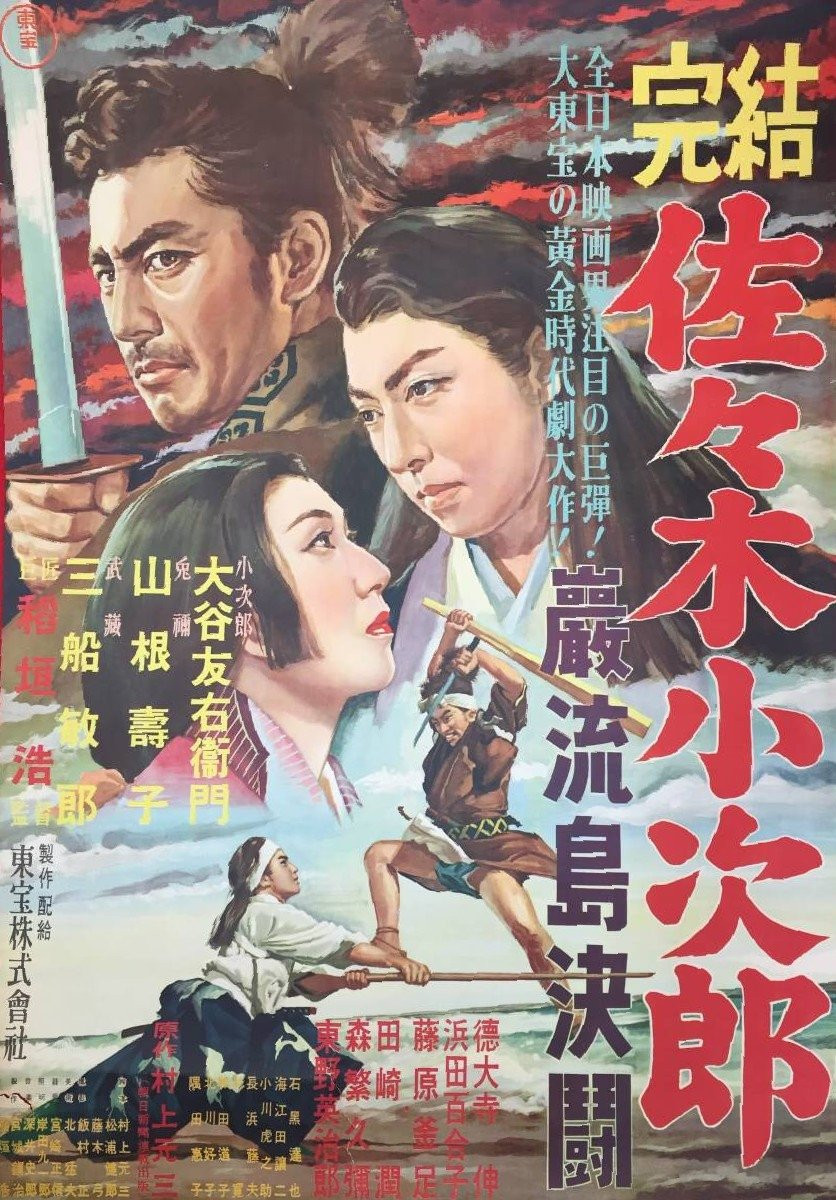
Sasaki Kojiro
(Sasaki Kojirō)
Direction: Hiroshi Inagaki
Screenplay: Hiroshi Inagaki, Kenrō Matsuura, Genzo Murakami
Cinematography: Jun Yasumoto
Music: Shirō Fukai
Asst. director: no info
Studio: Toho, Morita Productions
Genre: drama, chanbara, jidaigeki
Cast: Tomoemon Otani, Ryōtarō Mizushima, Kamatari Fujiwara, Hideko Takamine, Toshirō Mifune, Yoshio Kosugi, Hisako Yamane, Shôji Kiyokawa, Shin Tokudaiji, Yuriko Hamada, Ryūnosuke Tsukigata, Reisaburo Yamamoto, Ko Mihashi, Eijirō Yanagi
Originally released in three parts: Part one placed third and part two placed fourth at the Japanese box office in 1950. Part three placed ninth at the Japanese box office in 1951.
Only an abridged version of the trilogy, condensed into a single film, is currently available.
The story of the life of Sasaki Kojiro, the legendary swordsman and nemesis of Musashi Miyamoto.
Commentary: The screenplay was based on a serialized newspaper novel by Genzo Murakami.
In productions centring on Miyamoto, the figure of Sasaki typically remains — for obvious reasons — in the shadow of the main protagonist, reduced either to the role of a significant antagonist or to that of a character whose arrogance and pride prove his undoing. Yet inherent in Sasaki’s characterization is also a tragic dimension, and it is precisely this tragic quality that Inagaki chose to foreground in his trilogy. In this context, the (anti)hero emerges as a positive figure, constrained by unjust social circumstances and torn by conflicting emotions; Miyamoto, meanwhile, takes on the qualities of a brooding brute who appears in the film three times wielding a rough-hewn wooden “sword,” caving in the skulls of his rivals.
One of Sasaki’s distinguishing physical traits — and one that stands in clear opposition to the stereotypically masculine Miyamoto — is his almost girlish beauty. He has delicate facial features, immaculate hair, and manners of a subtler nature; his outbursts of rage carry a hysterical quality, and he is invariably dressed in white, setting him further apart from his greatest rival. Inagaki preserves the classical image of the character, though not in order to suggest vanity, madness, or cast doubt on the hero’s sexual orientation, but rather to emphasize all the more strongly his delicacy — a quality he is compelled to suppress within himself in order to develop his swordsmanship.
Sasaki’s pursuit of fame, and even his personal troubles, are presented with truly epic sweep. Although we unfortunately have no opportunity to watch the full version of the film, it is still difficult not to be captivated by the numerous adventures the protagonist undergoes: from challenging masters of swordsmanship to duels, earning the status of a samurai, a friendship with a ninja that lends the film comedic touches, a romance with a dancer and an adventure with a princess from the Ryukyu Kingdom, the founding of his own fencing school, and finally the fateful duel with Miyamoto Musashi — we come to know Sasaki from almost every angle.
Inagaki’s film also deserves praise for its outstanding performances: Otani, a kabuki actor specializing in female roles; Mifune, appearing in two scenes as Miyamoto himself, several years before he played the role in the Oscar-winning Samurai trilogy; and the ever-excellent Takamine as a kung-fu-trained princess (whose martial arts abilities are, unfortunately, not shown on screen).
Sasaki Kojiro — it is worth emphasizing — marked the triumphant return of chanbara to Japanese cinemas after a hiatus of roughly five years, caused in part by the American occupying power’s hostility towards the genre. The ambition of the production therefore comes as no surprise, manifested not least in the decision to realize it as a trilogy. It also constitutes the first post-war film in which Musashi Miyamoto appears, thereby shaping his popular cultural image for years to come — an image first established in 1935 by the writer Eiji Yoshikawa.
Since the film was conceived as a mainstream production, it is difficult to identify any particularly challenging content in either a social or political context. Conceived as a portrait and popular cultural rehabilitation of the figure of Sasaki, it reads more as a commentary on the tragedy of life, the conflicted nature of humanity, and social determinism. In a certain sense it can also be interpreted as a cautionary portrait of excessive surrender to one’s own ambitions. Sasaki is an honourable and ambitious figure, but it is precisely these qualities that seal his fate and prevent him from realizing his plans. In this context, the story of the swordsman also presents itself as a vision of life’s unpredictability.
As befits a chanbara production, the film features a generous number of sword-fighting sequences; these are carefully composed, drawing less from a realistic and more from a theatrical tradition. There are many exaggerated gestures, moments where the camera turns to nature, shots in which the fighting figures are obscured, and a focus on their shadows. Inagaki is more concerned with the aesthetic dimension of martial arts than with the combat scenes as such; what matters to him is their outcome, which drives the narrative forward and furnishes the characters with additional motivation. This is not to say that the film lacks interesting choreography or suspense — on the contrary, Inagaki very frequently generates considerable tension, which is all the more praiseworthy given that the viewer knows the film’s ending from the very outset.
7/10

Author of “Panorama of Hong Kong and Taiwan Cinema”, a lover of Asian cinema, action films, and space voyages aboard the starship Enterprise. He once studied Polish philology, and later became a citizen of the NSK State in Time. He has published in Kinomisja, Ekrany, Kultura Liberalna, Torii, Dwutygodnik Kulturalny, and others.