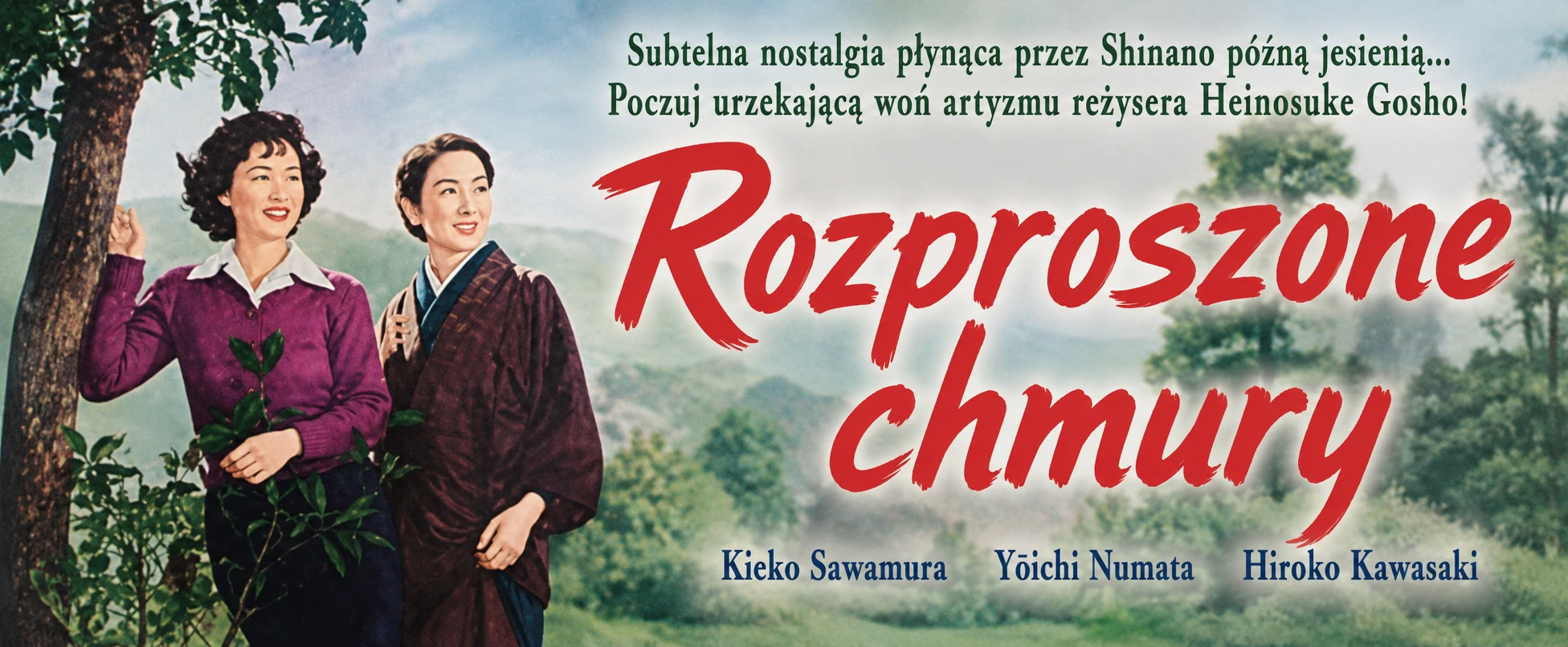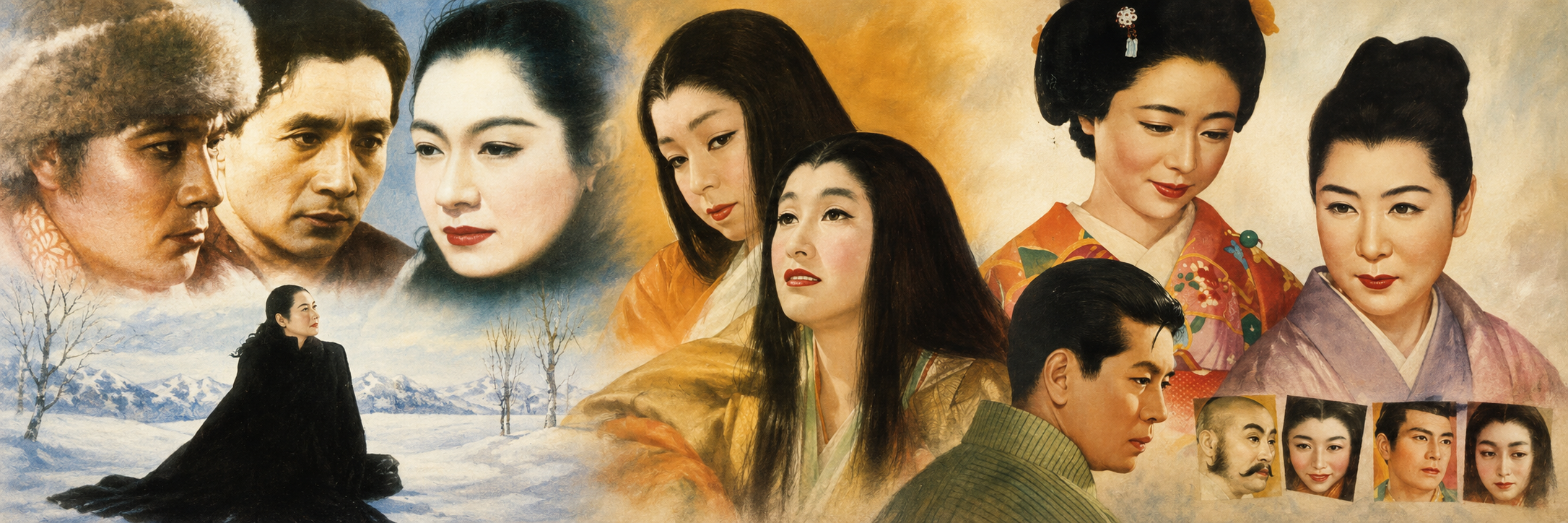
- The Idiot, Akira Kurosawa (drama)
- The Tale of Genji, Kōzaburō Yoshimura (drama, romance, jidaigeki, biographical)
- Miss Oyu, Kenji Mizoguchi (drama, jidaigeki)
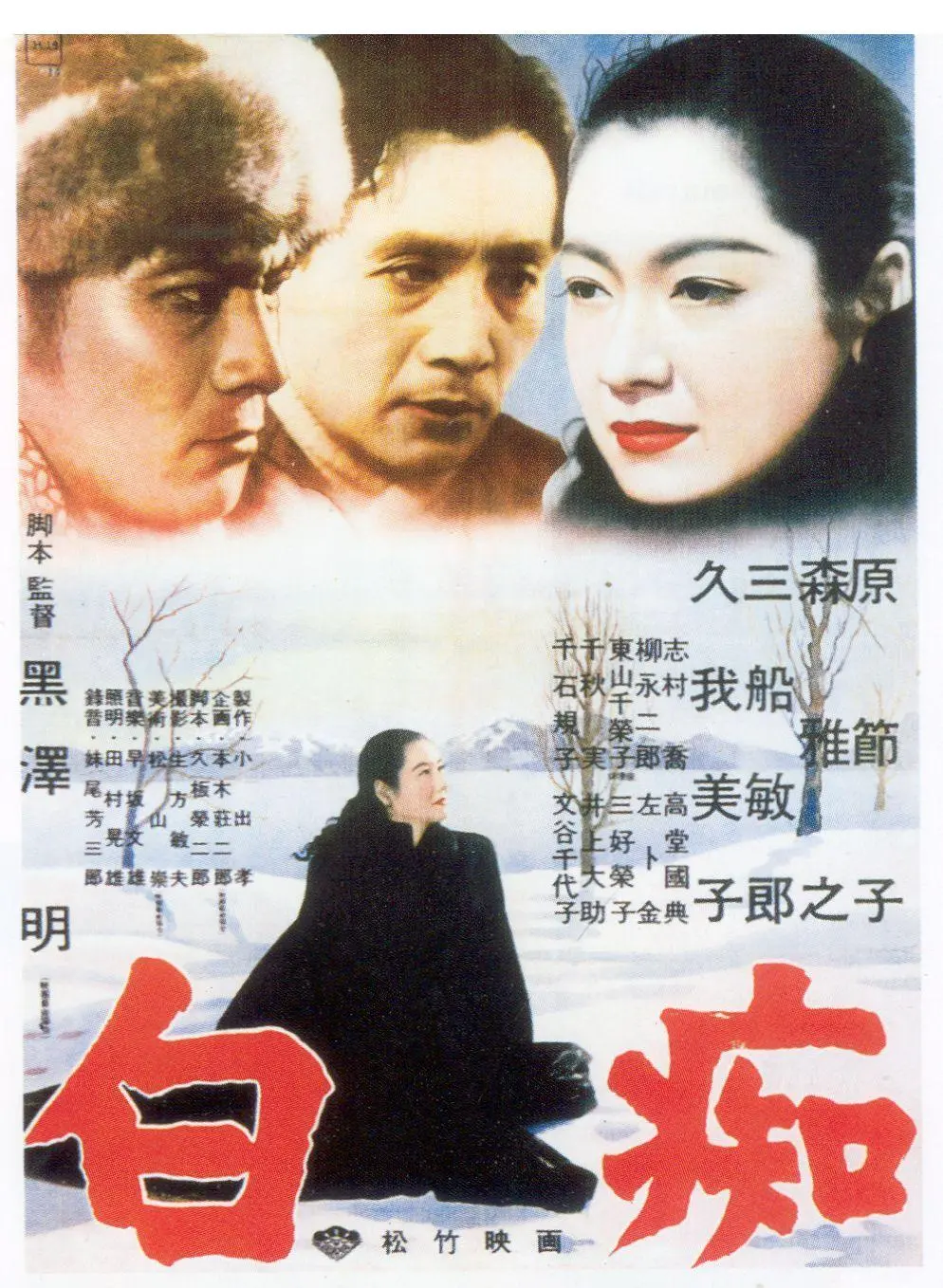
The Idiot
(Hakuchi)
Direction: Akira Kurosawa
Screenplay: Akira Kurosawa, Eijirō Hisaita
Cinematography: Toshio Ubukata
Music: Fumio Hayasaka
Asst. director: Yoshitarō Nomura, Kō Nakahira
Studio: Shochiku
Genre: drama
Cast: Setsuko Hara, Masayuki Mori, Toshirō Mifune, Yoshiko Kuga, Takashi Shimura, Chieko Higashiyama, Eijirō Yanagi, Minoru Chiaki, Noriko Sengoku, Kokuten Kōdō, Bokuzen Hidari
A Second World War veteran arrives in Hokkaido, where he unwittingly becomes part of a romantic triangle.
Commentary: Shortly after completing work on Rashomon, Akira Kurosawa began preparations for his next project, to be made for Shochiku. It was an adaptation of one of the director’s favourite novels: Fyodor Dostoyevsky’s The Idiot. Kurosawa chose to follow the novel’s events and philosophical reflections fairly faithfully, but to transplant them onto Japanese soil. To this end he changed the setting and time period from nineteenth-century Russia to Japan in the immediate aftermath of the Second World War, thereby inserting the film into the trend of the country’s post-war cinema. Prince Myshkin, returning from a Swiss clinic to Saint Petersburg, was thus replaced by Kameda (Masayuki Mori), a former prisoner of war returning to the frozen landscape of Hokkaido. Like his literary counterpart, Kameda is a character of extreme sincerity, innocence, and considerable naivety, which significantly hampers his social reintegration and leads to him being perceived as a person with mental problems. The principal characters he meets and forms close relationships with are his unhappy friend Denkichi (Toshirō Mifune), the seductive Taeko (Setsuko Hara), and the young Ayako (Yoshiko Kuga), with whom he embarks on a romance.
The original version of The Idiot ran to approximately four and a half hours, but Shochiku’s management did not consider the production significant enough, nor sufficiently commercially viable, to release it in such a long form or divided into two or more parts. Instead, the studio cut it substantially — to 166 minutes — removing many storylines and scenes in the process, leaving the narrative structure of The Idiot jagged, frequently incoherent, chaotic, and cursory. Released in this form, the film achieved neither commercial nor critical success, and both the studio’s decision and the reception of the work left Kurosawa emotionally devastated. Fortunately, the international success of Rashomon — which came, unfortunately, only after the Japanese premiere of The Idiot — saved the director’s career. It can be surmised that had that success come earlier, or had The Idiot been made later, Shochiku’s management would most likely not have chosen to intervene so drastically in Kurosawa’s vision.
The production is divided into two chapters, the first of which is titled “Love and Agony” and was subject to more extensive modifications by the studio — extensive enough that intertitle cards were occasionally inserted to explain absent events without which viewers would have been unable to follow the film. In addition to replacing numerous scenes with summaries of them, the first chapter also displays various editing problems, such as abruptly truncated scenes and unsmooth transitions between them, to say nothing of the breakneck pace of the narration. The second chapter, “Love and Hatred,” appears less affected by the producer’s scissors, as it contains not a single intertitle card.
In addition to its basis in a Russian novel, the production also contains references to other works of Russian and Norwegian culture, attesting to the director’s desire to create both a story about the post-war state of Japanese society and a work of universal resonance. This ambition was largely realized, though it would undoubtedly have been more fully achieved had the film remained in the version planned by the director. In the context of the intertitle cards it is worth adding that some of them also explain the ideas underlying Dostoyevsky’s novel itself. One even explains what role the protagonist plays in it and that the writer, wishing to portray “a pure soul,” made him “an idiot.” Such unequivocal descriptions, leaving no room for interpretation, suggest that the studio feared that cutting such a large number of scenes would not only render the film incomprehensible but would also cause it to lose its message.
Even so, Kameda is not a person incapable of functioning in modern society. He is rather a kind of “man out of time” who, through his experience of the war, his brush with death, and his absence during Japan’s metamorphosis, has considerable difficulty recognizing contemporary codes of conduct and is marked by significant naivety and an inability to do evil. Ultimately, however, it seems that even if he cannot fully learn the new social rules, he will certainly be able to exist within them once they have become the norm for him.
Nor is he a person who is constantly criticized and subjected to violence by those around him. On the contrary — though he does encounter unpleasantness, his conduct is frequently perceived as sincere and pure, and therefore worthy of admiration not only by the viewer but also by the other characters in the film. A particularly striking example is Taeko, who refuses to marry Kameda because, knowing her own sins, she does not want them to taint the protagonist’s pure heart. Ultimately the dominant impression — expressed directly by Ayako — is that it is everyone around Kameda, and not Kameda himself, who are “idiots.”
On today’s terms the plot does not seem particularly groundbreaking, since many other films and series have drawn on similar narrative patterns. Nevertheless, its placement within a specific cultural and historical context speaks to a degree of originality as well as to the universality of a message that has aged little in sixty-five years.
Although The Idiot cannot be faulted on the acting front, visually it is one of Kurosawa’s simpler pictures. Very few shots or scenes linger in the memory, which in a sense reflects the simplicity of the protagonist’s character, but — particularly in combination with the chaotic narration and editing — does not help in creating a particularly compelling cinematic experience. The Idiot has unfortunately suffered too greatly at the hands of its producers to fully dazzle, though it cannot be called a failed film. It can, however, be called a dark one — and in writing this I have in mind above all its visual dimension: there is little light in The Idiot, which underscores the sombre quality of the reality surrounding Kameda, as well as the troubled, suffering souls of the other characters, symbolically submerged in moral and emotional darkness. As befits Kurosawa, he genuinely sympathizes with each of them, which is why the film is a complete success on the level of characterization. And the fact that the narration here is more strongly anchored in character development than in a sequence of events means that the editorial fragmentation has caused less damage in this respect to the work as a whole.
Ultimately The Idiot is not a masterpiece on the level of Rashomon, nor would I place it on a par with Drunken Angel (Yoidore tenshi, 1948) or Stray Dog (Nora inu, 1949), but it is undeniably valuable, considered, and timely cinema.
8/10
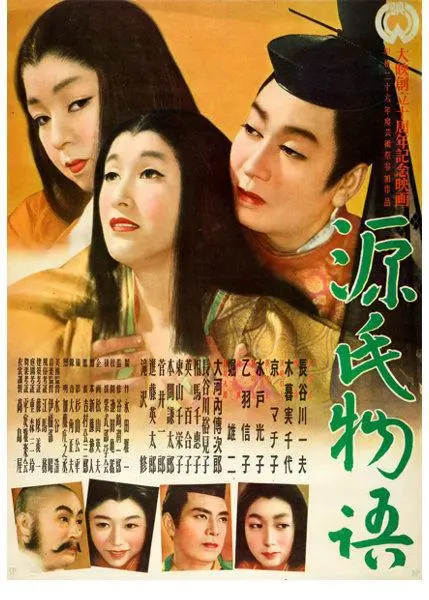
The Tale of Genji
(Genji monogatari)
Director: Kōzaburō Yoshimura
Screenplay: Kaneto Shindō
Cinematography: Kōhei Sugiyama
Music: Akira Ifukube
Asst. director: Kenji Misumi
Studio: Daiei
Genre: drama, romance, jidaigeki, biographical
Cast: Kazuo Hasegawa, Denjirō Ōkōchi, Michiyo Kogure, Mitsuko Mito, Machiko Kyō, Nobuko Otowa, Yūji Hori, Yumiko Hasegawa, Chieko Sōma, Yuriko Hanabusa
#1 at the Japanese box office.
#7 on the Kinema Junpo list.
The titular Genji is the son of the Emperor of Japan and his favourite concubine, who comes from the lower social classes. As a handsome young man at the imperial court, Genji is extremely popular among women, yet the true object of his longing remains unmoved by the affection shown to her. The young man’s feelings, however, are exceedingly fickle, which is why the number of lovers in his life steadily grows — something his enemies at the imperial court decide to exploit.
Commentary: The film is based on the novel of the same title by Murasaki Shikibu, written more than 1,000 years ago in the Heian era (8th–12th c.), a period characterised by tranquillity and cultural flourishing. The imperial court was presented by the author as almost entirely stripped of any political interests beyond private desires for advancement, which means that those ruling the country care nothing at all for the fate of the Japanese people. Plotting, betrayals, secret assassinations, and above all amorous conquests — interspersed with attendance at theatrical performances — are the only occupations of the magnates, for whom the reason for being is climbing the rungs of a career and/or devoting themselves to one romance after another. Thus, although Prince Genji is portrayed as a positive hero and certainly appeared as such at the time the novel was written, today his participation in courtly amusements — characterised above all by an excessive fondness for women, as well as his lack of respect for conventions, leading even to rape — does not allow his character to be regarded as anything other than, if not outright negative, then at least naïve and lacking a moral compass, or marked by moral ambivalence.
Unlike many other courtiers, however — a considerable number of whom try to kill the prince — his evil deeds are not the result of courtly aspirations, greed, or sadism, but the result of infantilism, caused by the lack of a proper upbringing and the view of the time that (social) respect is due only to persons in high positions. Genji’s failure to receive the upbringing due to him is a consequence of his mother’s death; while the prince was still a small child, the woman was destroyed by her enemies, who were fighting for the emperor’s favour. Despite being the ruler’s favourite concubine and despite having borne him a child, as someone deprived of highborn male members of her closest family, she inevitably fell out of favour, which caused Genji to be removed from the line of succession to the throne. His father, then, apart from providing him with financial support and social respect, is an entirely absent presence in the prince’s life. It is worth noting, however, that in reality this was not an exceptional situation in the Heian era: “In court society, the institution of the nurse or wet nurse (menoto) was […] extraordinarily important. The nurse took care of feeding and raising the child, and very often her relations with her charge, especially the emotional ones, were closer than with the biological mother”[1].
As a ward of the court, deprived of proper supervision, Genji carelessly and childishly toys with the feelings of others, unaware of the suffering he causes. For while violating the rules of courtly etiquette seems to carry almost no consequences for him personally, for the women affected by Genji’s behaviour, the manner in which he treats them and abuses his position covers them in disgrace — which in the Japanese society of the time was often regarded as a fate worse than death. In this way, the extremely patriarchal social character of the era is revealed, as is the prince’s egoism. But, as the viewer anticipates, he will be forced to change at least some of his views and to revise his conduct.
Indeed, in the final portions of the film he is confronted with behaviour similar to his own, which provokes in him an explosion of fury and an outburst of murderous rage. Quickly, however, his own behaviour is pointed out to him, which brings about a most drastic change in him. This change, though — as already mentioned — desirable and expected, comes across as rather unnatural because of its suddenness. Given the literary roots of the film, excessive interference with the source material was perhaps not the creators’ intention, as they did not try too hard to enrich the psychologisation of the characters with anything beyond the most essential matters. Knowing, however, the screenwriting abilities of Kaneto Shindō and the talent of the famous writer Jun’ichirō Tanizaki, the result is nonetheless rather disappointing.
The shortcomings in content are counterbalanced by the fact that The Tale of Genji presents itself as exceptionally aesthetic, full of formal, cold shots emphasising the labyrinth of conventions and the chill of extremely formalised interpersonal relations, full of half-truths, concealment of feelings, and rivalry. Memorable, for instance, are the scenes of the attempt to murder Genji by a group of assassins, taking place at night in the marshes. It is therefore no surprise that the picture was awarded for cinematography at the Cannes Film Festival as the first Japanese production in history. The music, composed by one of Japan’s most famous film-music composers, Akira Ifukube, also presents itself attractively. Characteristically for him, he enriches the soundtrack with low, monumental trumpets and frequently heightens the atmosphere, striking an unobtrusively solemn tone.
Owing to its exceptionally apt casting, as well as to the still — though waning — sufficiently high popularity of the source material at the time, this Heian-era romance achieved an excellent result at the Japanese box office, becoming the highest-grossing film of 1951 and exceeding 100 million yen in earnings from screenings. The production’s problems — namely the simplifications in the creation of the characters, the narrative jumps, and ultimately a rather shallow subject — did not cause problems for viewers, thanks to the production’s scope and aesthetic layer. Nor did it hinder it that the film was widely criticised as an example of a broader trend in Japanese cinema — to which productions such as Rashomon, Ugetsu, The Life of Oharu, and Gate of Hell were also assigned — portraying an imagined image of Japan cut out from the past, but often with little bearing on the real problems of Japan and the country’s society in the 1940s and 1950s. Although it remains a fact that allegorical meanings can be sought in many productions set in historical realities, and that the very popularity of selected titles is testimony to the tastes and moods of the audience of the time, one cannot fail to notice that the number of films more openly engaged with the problems of Japan and the world would soon increase.
Other critical voices also appeared, accusing The Tale of Genji of being absurd in its portrayal of “love” and “life”, and arguing that its popularity among Japanese audiences was a reaction to the American-centrism that had hitherto dominated the film industry [2] and in no way attests to the merits of the production itself. This is a view that ignores the virtues the film undoubtedly possesses. While one cannot fail to agree with the criticism of the narrative escapism that seems to be the creators’ main ambition, it must be remembered that during the period of the country’s occupation by the United States, a production deeply rooted in the era of the flourishing of Japanese culture could be a desirable escape for many viewers, as well as an expression of the society’s wish to rebuild the country’s cultural prestige. As was also mentioned earlier, it is impossible not to notice the attention to the film’s aesthetic side and the acting abilities of the cast. The Tale of Genji ultimately constitutes, then, a valuable piece, pointing to the tastes of the Japanese audience of the time, and at the same time executed with artistic verve and arousing curiosity also among contemporary lovers of cinema.
1 Iwona Kordzińska-Nawrocka, Wieczorna rozmowa bohaterów Genji monogatari a kulturowy wzorzec kobiecości w społeczeństwie dworskim, [in:] W kręgu tradycji dworu Heian, ed. Iwona Kordzińska-Nawrocka, 2008, p. 28.
2 Haruo Shirane, Envisioning the Tale of Genji: Media, Gender, and Cultural Production, 2008, p. 307.
7/10
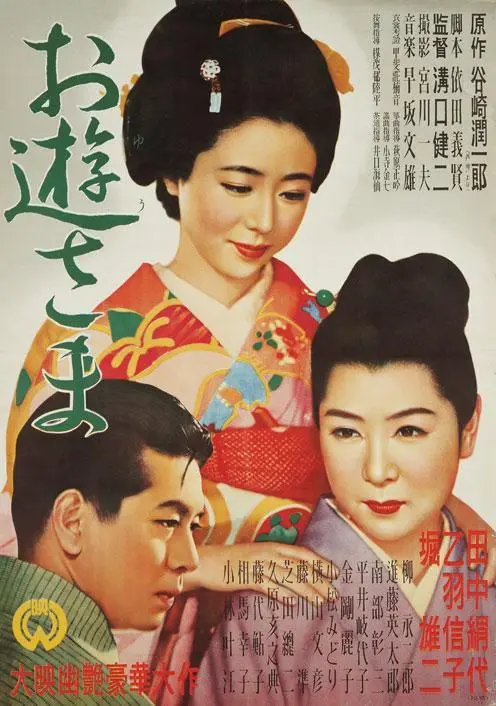
Miss Oyu
(Oyū-sama)
Director: Kenji Mizoguchi
Screenplay: Yoshikata Yoda
Cinematography: Kazuo Miyagawa
Music: Fumio Hayasaka
Asst. director: no info
Studio: Daiei
Genre: drama, jidaigeki
Cast: Kinuyo Tanaka, Nobuko Otowa, Yūji Hori, Kiyoko Hirai, Reiko Kongō, Eijirō Yanagi, Eitarō Shindō, Kanae Kobayashi
The young bachelor Shinnosuke — arranged to be the husband of the young Oshizu — falls in love, with reciprocation, with the woman’s older sister: Oyū. Because of social constraints, however, he cannot unite with her, and so Oyū persuades him into a relationship with Oshizu.
Commentary: The titular Miss Oyū from Jun’ichirō Tanizaki’s novella is perceived as the embodiment of the ideal lover and the ideal mother, as the writer imagined them. Tanizaki created this character — as his letters attest — basing her on the person of Nezu Matsuko, a woman who later became his third and last wife. Oyū was not the only heroine to arise from inspiration by Matsuko, who can without exaggeration be described as the writer’s great muse. At the same time, it must be clearly stated that the character of Oyū is not so much a reflection of the real Matsuko as an imagined or idealised image of her as the ideal woman according to Tanizaki. As such, Oyū is a simple-hearted, childlike woman, taking the luxuries and admiration surrounding her as a given, unable to imagine that life could look otherwise. She is in no way arrogant or aggressive; simply, in her contentment with life and through being shielded from brutal reality by her loved ones, it never occurs to Oyū that any life other than the one she possesses could exist. More about her, as well as about Tanizaki himself, can be read in: Anthony Hood Chambers, The Secret Window: Ideal Worlds in Tanizaki’s Fiction, 1994; we, meanwhile, shall move on to the film adaptation of the novella.
The opposite of the titular heroine is her sister, named Oshizu. The contrast between them is revealed already at the level of the writing of their names: Oyū — お遊, where yū 遊 (also asobi) means “pleasure”, “play”, and Oshizu — お静, where shizu 静 means “silence”, “calm”. Oshizu is therefore a quiet, selfless, calculating person, far removed from the infantile charm and spontaneity of her sister. In the film created on the basis of a screenplay by Yoshikata Yoda (co-screenwriter of the earlier Portrait of Madame Yuki [Yuki fujin ezu, Kenji Mizoguchi, 1950]), Mizoguchi and Yoda significantly modified Tanizaki’s ideas, giving the story much greater directness, and by casting the 41-year-old Kinuyo Tanaka in the title role of a character who in the literary original is 22 years old, they more strongly emphasised the worries about motherhood and widowhood that torment her. In this way they increased the universality of the character and departed considerably from the childishness that characterises her in the prose.
The central plot point of Miss Oyu is a peculiarly presented sisterly rivalry: Oyū and Oshizu (Nobuko Otowa) wish to marry the same man, named Shinnosuke (Yūji Hori). It is not a rivalry in the classic style; Oyū wishes for her quiet sister to marry the kind, well-mannered Shinnosuke, but he falls in love with Oyū, which Oshizu notices, and she asks the man to make her sister happy. Shinnosuke therefore promises that he will do everything to make Oyū happy, to which she replies: if you want me to be happy, then marry Oshizu.
Miss Oyu is counted among an informal trilogy about women from the upper social classes, also consisting of Portrait of Madame Yuki and The Lady of Musashino (Musashino fujin, 1951). In this context, it is no surprise that Mizoguchi and Yoda readily make use of classic templates of Japanese dramas, with particular emphasis on the role of tradition standing in the way of achieving happiness. For while behind Oshizu’s sacrifice lies selflessness, Oyū’s decision not to marry Shinnosuke is motivated not only by sisterly love but also — perhaps to a greater degree — by the necessity of respecting traditional conventions. Oyū is a widow, so her socially assigned task is to raise her son as the head of her late husband’s family; remarrying would in this context be a slap in the face of traditional principles. Shinnosuke therefore marries the younger sister, yet all three live together, which ultimately leads to scandal. Oyū remains throughout a permanently mysterious figure, full of ambiguous behaviours. As viewers, we never truly know to what extent she devotes herself to tradition and to what extent she conceals her romantic advances beneath its cloak, if she makes any at all. For the creation of Oyū is based on the ambiguities of her intentions, maintained through stylistic and narrative choices that ensure we never have full insight into her character, yet a fairly clear suggestion appears that she brought about Shinnosuke’s marriage to Oshizu so that she herself could remain close to her beloved. Ultimately it does not matter whether her covert behaviour acts against tradition or not, because in a patriarchal social structure her every attempt — conscious or not — to achieve happiness is doomed to failure from the start. This fate therefore links her with the tragic heroines from productions about middle-class women, as for example in most of Mikio Naruse’s films.
Through stylistic choices straight out of theatre, Mizoguchi allows his actors to create elaborate performances, though rather by means of facial expression and gesture than of words. Combined with the arrangement of the characters within the frames (the most characteristic being the one with the married couple at the sides of the frame and Oyū between them), the director shows more than he says outright about the characters’ troubles, thus creating a rather subtle, yet still moving picture full of stifled hopes, unfulfilled loves, and suffocating conventions. And so, despite a certain narrative predictability, Miss Oyu retains a strong emotional charge, and the perfectly outlined characters, the wonderfully arranged scenes, and the elaboration of classic motifs through what is left unsaid intrigue the viewer and compel them to immerse themselves more deeply in the tragic fate of the characters. Kinuyo Tanaka once again proves here why she is regarded as one of the best actresses in the history of cinema; Nobuko Otowa, who had debuted a year earlier in Wedding Ring (Konyaku yubiwa, Keisuke Kinoshita, 1950), demonstrates her talent, taking another important step in her rich career, and Yūji Hori — known from the productions of Mikio Naruse and Yasujirō Ozu — once again shows himself to be a natural actor. He portrays Shinnosuke’s shyness and bewilderment in a relaxed manner that easily earns him the viewers’ favour. Ultimately, then, Miss Oyu constitutes yet another classic and in every respect highly recommendable piece from the hand of Kenji Mizoguchi.
7/10

Author of “Panorama of Hong Kong and Taiwan Cinema”, a lover of Asian cinema, action films, and space voyages aboard the starship Enterprise. He once studied Polish philology, and later became a citizen of the NSK State in Time. He has published in Kinomisja, Ekrany, Kultura Liberalna, Torii, Dwutygodnik Kulturalny, and others.