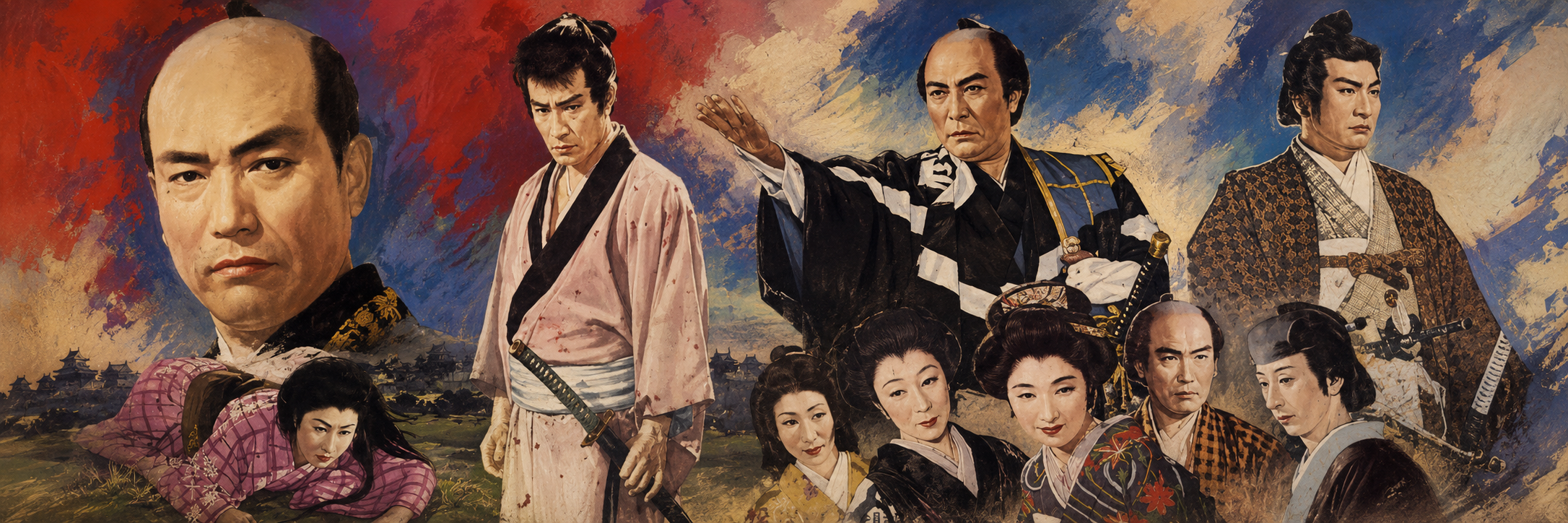
- Miki, The Swordman, Kyōtarō Namiki (jidaigeki, chanbara)
- Five Men of Edo, Daisuke Itō (jidaigeki, chanbara)
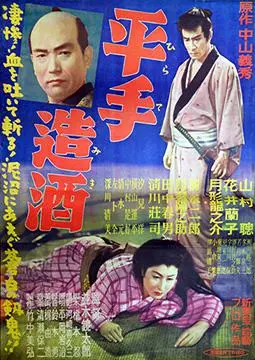
Miki, The Swordman
(Hirate Miki)
Director: Kyōtarō Namiki
Screenplay: Shinobu Hashimoto
Cinematography: Kikusaburō Kawasaki
Music: no info
Asst. director: no info
Action choreography: no info
Studios: Shintoho, Sogei
Genre: Jidaigeki, chanbara
Cast: Sō Yamamura, Ryūnosuke Tsukigata, Ranko Hanai, Eijirō Yanagi, Haruo Tanaka, Yōnosuke Toba, Unpei Yokoyama, Bokuzen Hidari
The life story of the rōnin Miki Hirate, who, unable to attain a high-ranking position within his clan, joins the yakuza.
Commentary: Miki Hirate is a historical and legendary figure from the first half of the nineteenth century whose image was preserved primarily through the popular tales known as Tenpō Suikoden.* His tragic fate earned him a place in Japan’s cultural consciousness, although not to the same extent as, for example, the famous forty-seven loyal rōnin.
Hirate was a master swordsman trained at the dōjō of Shūsaku Chiba—Chiba Shūsaku Taira no Narimasa—the founder of the Hokushin Ittō-ryū Hyōhō school, who was born in either 1792 or 1794 and died in either 1855 or 1856. Chiba is frequently ranked among the greatest swordsmen of the late Edo period and is sometimes described as a kensei, or ‘sword saint’.** One of Chiba’s students whose legend became particularly firmly established in popular culture was Miki Hirate.
The exact date of Hirate’s birth is unknown, although he is believed to have been born between 1810 and 1815. He was an exceptionally talented swordsman, but poor health—most likely caused by a serious illness—prevented him from attaining a high position within a clan. As a result, he became a rōnin and subsequently found employment as a bodyguard and fencing instructor to Sasagawa Shigezō, the boss of a large yakuza group.
In the course of performing his duties, Hirate took part in the Battle of the Tone River at Ōtonegawara in 1844, when the gangs of Sasagawa Shigezō and Iioka Sukegorō clashed. He was seriously wounded during the fighting and died at approximately six o’clock the following morning.
The film deepens his tragedy in comparison with the legend and biography outlined above. Most importantly, the revelation of Hirate’s illness—tuberculosis in this version—is delayed considerably, while his inability to attain a position within a clan is connected with the social injustice of the period. This allows the film to paint a negative portrait of Edo Japan and, in a broader context, of the injustices inherent in an archaic and rigidly hierarchical system.
This critical tone is confirmed by Hirate’s own blunt observation: ‘People without ability rise through society.’ His inability to escape an unjust system leads to frustration, which finds release in occasional drinking bouts during which his barely concealed aggression erupts. His illness is likewise connected with alcohol consumption: he begins coughing up blood after drinking too heavily, and later as a result of physical exertion. His poor health is therefore indirectly linked with the country’s social and political conditions.
As an honourable warrior living in a dishonourable environment, Hirate is unable to withstand these social pressures. He consequently decides to leave Edo in search of a place where he can develop his sword-fighting abilities in peace. He is joined by a beautiful geisha who functions, to some extent, as a female counterpart to the protagonist.
She, too, has devoted her life to mastering her art—playing the shamisen, dancing and so forth—but when confronted with brutal reality, her artistic abilities prove meaningless. Her clients pay greater attention to physical appearance and prefer to spend their time with promiscuous women rather than those accomplished in the traditional arts. In accordance with the conventions of Japanese chanbara, however, the relationship between Hirate and the geisha remains forever platonic.
During his travels, Hirate encounters the aforementioned Shigezō, who asks him for swordsmanship lessons. The protagonist initially refuses, but after witnessing Shigezō’s confrontation with a master belonging to the Iioka clan, he decides to join Shigezō’s gang.
Life as a yakuza proves neither particularly pleasant nor especially honourable, an uncomfortable truth that Hirate is forced to confront. As a rōnin, he is merely a tool in the hands of the gangsters, and he has no doubt that the moment someone stronger appears, he will be expelled from the group or even killed. Having belonged to a criminal organisation also means that he will never again have any chance of attaining a socially respected position.
The story therefore moves pessimistically towards its anticipated conclusion. Barely alive following an attack of his illness, Hirate—driven by loyalty and the desire to bring his life to an honourable end—decides to enter the battle and go to meet his death.
The film is a low-budget production made at Shintoho, a studio established in 1947 by producers and employees who had left Toho. It offered greater creative freedom than its competitors, which enabled such classics as Akira Kurosawa’s Stray Dog (Nora inu, 1949) to be made there. Nevertheless, the studio rather quickly encountered financial difficulties, motivating its executives to search for genres capable of attracting broader audiences.
A turn towards chanbara, among other forms, was a logical decision. The genre had enjoyed enormous popularity before the war, while the success of Hiroshi Inagaki’s Sasaki Kojirō trilogy (1950–51) and the return of classic pre-war heroes such as the Bored Hatamoto, Kurama Tengu and Zenigata Heiji confirmed its financial potential in the post-war period.
The screenplay for Miki, the Swordman was written by the talented and historically conscientious Shinobu Hashimoto. It was his first work as a sole screenwriter; he had previously collaborated with Akira Kurosawa on the screenplay for the brilliant Rashomon (Akira Kurosawa, 1950).
With a running time of only sixty-four minutes, Miki, the Swordman forced Hashimoto to introduce far-reaching simplifications and narrative leaps. It is consequently a film with a very simple, single-strand story that summarises a substantial portion of the protagonist’s life within a short period, frequently supplementing it with competently executed sword-fighting sequences.
Characterised by effective, even if archaic, choreography, these sequences are simultaneously one of the film’s strengths and one of its weaknesses. Despite their attractiveness, they take time away from the narrative, including the development of the characters, meaning that Miki, the Swordman never arouses particularly strong emotions in the viewer. Nevertheless, the important scene of Hirate’s duel in the dōjō undoubtedly deserves praise: it is visually interesting, excellently arranged and surprisingly realistic.
In terms of stylistic attractions, Miki, the Swordman admittedly does not offer very much. Nevertheless, the shots of corridors bathed in sunlight, the aforementioned duel and the scenes of a yakuza member floundering in the mud while blindly swinging his sword remain memorable. Even though it is difficult to regard the production as exceptional when compared with other Japanese films of the period, admirers of chanbara and jidaigeki should certainly seek it out.
7/10
* Tenpō Suikoden — a cycle of popular kōdan and rōkyoku tales concerning conflicts between bakuto groups in Shimōsa Province, particularly the confrontation between the families of Iioka Sukegorō and Sasagawa Shigezō beside the Ōtone River in 1844. These narratives shaped the legendary image of Miki Hirate as an ailing and tragic swordsman connected with the world of the yakuza.
** Kensei — literally ‘sword saint’; an honorific description of a master swordsman believed to have attained the highest level of technical and spiritual mastery of the art of the sword. The term is partly legendary in character and does not refer to a formal title awarded according to a single, fixed list. It has been applied to legendary masters such as Miyamoto Musashi, Tsukahara Bokuden, and sometimes Kamiizumi Nobutsuna, Itō Ittōsai or Shūsaku Chiba.
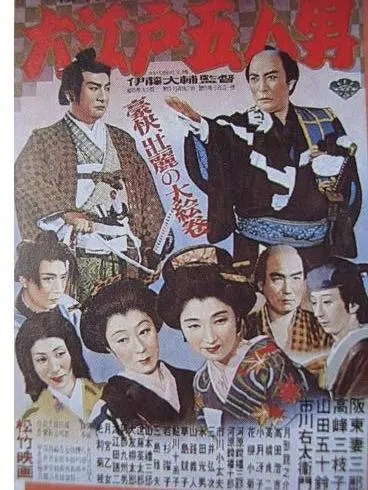
Five Men of Edo
(Ōedo gonin otoko)
Director: Daisuke Itō
Screenplay: Fuji Yahiro, Shin’ichi Yanagawa, Yoshikata Yoda
Story construction: Kakōkai*
Cinematography: Hideo Ishimoto
Music: Shirō Fukai
Asst. director: Kunio Matoi, possibly also: Minoru Watanabe
Action choreography: no info
Studio: Shochiku
Genre: Jidaigeki, chanbara
Cast: Tsumasaburō Bandō, Utaemon Ichikawa, Isuzu Yamada, Kōkichi Takada, Masao Mishima, Kusuo Abe, Toshiko Ayukawa, Bandō Minosaburō, Teiji Takahashi, Kawarasaki Gonzaburō, Kogiku Hanayagi, Kodayū Ichikawa, Jōji Kaida, Gonjūrō Kawarasaki, Kōji Mitsui, Mitsuo Nagata, Ryūtarō Ōtomo, Kazunari Motomatsu, Eitarō Shindō, Yoshito Yamaji, Reizaburō Yamamoto, Mieko Takamine, Yōko Wakasugi
No. 2 at the Japanese box office.
The film is set in the seventeenth century, when bands of hatamoto—rowdy samurai drawn from the direct retainers of the Tokugawa shogun—spread chaos and destruction throughout the country’s new capital, Edo, now Tokyo. Standing against them is a group of machi-yakko, men from the lower social classes led by the charismatic Banzui-in Chōbei.**
Commentary: Although the film’s title clearly suggests that its story centres upon five protagonists, three characters actually move to the foreground. The first is Jūrozaemon Mizuno, the leader of the hatamoto, trapped in an impasse between the obligations of his class and his own conscience. The second is Chōbei, the leader of a group fighting against the upper classes’ brutal exploitation. The third is a young man who joins Chōbei, but whose ambitions extend beyond the limitations of both factions.
Although the rivalry between the two groups forms the central narrative axis, Itō and the screenwriters devote considerable time to developing complex characters and establishing the historical and political background. The film’s narrative is therefore unhurried, while both principal and supporting characters are frequently shown going about their everyday lives, which nevertheless remain burdened by numerous concerns.
The leader of the hatamoto commands a group of aggressive and arrogant samurai, which is no easy task. The socio-political conditions of Japan’s rigidly hierarchical society established the samurai as an upper class, gradually causing them to lose all respect for those beneath them. The country followed the four-tier social model known as shi-nō-kō-shō—warriors, peasants, artisans and merchants—with the samurai at its summit.
This division affected every aspect of life, including the type of dwelling a person could occupy and the colours of clothing they were permitted to wear. Travel by members of the lower classes was subject to numerous restrictions and controls, while the use of family surnames by peasants and townspeople was generally reserved for exceptional cases. As a result of these and many other privileges, the social gulf within the country steadily widened. Peasants and other members of the lower classes developed an increasingly powerful hatred of the samurai, while the samurai felt progressively more immune from punishment and treated those beneath them with brutal superiority.
Five Men of Edo sinks its teeth into the heart of this problem and opposes both the traditional image of the samurai found in films made according to the propagandistic model of the 1940s and the archetype of the samurai as an inherently honourable figure.
During the post-war period, the dominant tendency moved in the opposite direction. The samurai was no longer a monumental figure, a noble warrior or an ideal to which one should aspire. He became a vulgar hypocrite who, beneath a mask of honour, elevated himself above others, abused the weak and exploited his position for wicked purposes.
In the film, the samurai drink themselves senseless, behave crudely during a theatrical performance, display greed and show no concern for the safety of ordinary people. When confronted with their immoral conduct, they respond curtly that ‘commoners will never understand a samurai’s honour’, sheltering behind the empty façade of a mythologised samurai code.
In a broader context, Itō moves towards a critical examination of the values that nationalist and militarist propaganda had presented as supreme. The film exposes the falsehood behind pride in attachment to tradition, stripping that tradition of its heroic veneer.
Social hierarchy is subjected to particularly severe criticism. Five Men of Edo places all human beings on an equal level and argues that everyone has the same right to live, irrespective of their position upon the social ladder. It also suggests that almost all people desire above all else to remain alive, thereby opposing policies that endorse suicide—whether through suicidal attacks upon an enemy or through taking one’s own life to ‘preserve’ honour.
The ritual of seppuku is consequently presented not as an exalted act that rescues a person’s honour, but as an assumption of responsibility and a punishment for violence committed against innocent people.
This does not mean that Five Men of Edo offers a black-and-white portrait of seventeenth-century Japan. Quite the opposite: both sides of the conflict are assigned positive as well as negative characteristics.
The leader of the hatamoto is a sensitive man capable of looking beyond his own beliefs and admitting that others are correct. Unfortunately, he remains isolated within the samurai world. Because of the unwillingness and inability of those around him to recognise their own transgressions, he is imprisoned within the immoral constraints of samurai custom.
Chōbei, meanwhile, is blinded by his role as a ‘defender of ordinary people’, something revealed to the viewer in the very scene that introduces him. When the hatamoto disrupt a kabuki performance, Chōbei confronts them, winning the audience’s applause, and introduces himself as a defender of the oppressed with a barely concealed smile of self-satisfaction.
Before long, however, he is forced to confront the fact that a violent rivalry with the samurai is inseparably connected with inflicting suffering upon innocent bystanders. This is emphasised through scenes such as the death of an innocent man crushed beneath a cart that is accidentally pushed during a street disturbance.
There is, in fact, only one fundamental difference between Chōbei and his men and the samurai led by Mizuno Jūrozaemon. Although both leaders are capable of recognising the errors of their conduct, accepting them and working to correct them, their retainers differ considerably.
Chōbei’s men, who come from the lower social classes, sometimes accept his decisions with considerable pain. Even when they disagree with him, however, they follow his instructions out of respect and because they do not regard themselves as infallible.
The hatamoto, by contrast, are guided by a primitive conception of honour that orders them to destroy anyone who points out their errors, accuses them of immorality or simply draws attention to their conduct. They are incapable of changing their behaviour in any way and are therefore, as the film suggests, relics of the past.
A Japan in which the upper class remains untouchable and military power can destroy its enemies without restraint should disappear forever. In its place should arise a country that respects life and treats every human being as an equal.
Five Men of Edo also deserves praise for its numerous scenes of everyday life, which unfold within detailed sets. The filmmakers clearly attempted to recreate the realities of seventeenth-century Japan. Particular attention was consequently devoted to contemporary theatrical performances, architecture and ceremonies, all supervised by specially employed advisers who specialised in such fields as the tea ceremony and the architecture of feudal Japan.
The world presented in the film teems with life and creates an impression of realism. Its expansive sets are far removed from claustrophobic or inexpensive-looking interiors, revealing the film to have been a high-budget production. Like Carmen Comes Home, Five Men of Edo was a prestigious film made to commemorate the thirtieth anniversary of Shochiku’s establishment.
The film may also be considered in terms of how unusual it was in comparison with contemporary chanbara productions, which more frequently continued pre-war genre conventions directly and less often commented so openly upon politics or social hierarchy.
Daisuke Itō, by contrast, shows no hesitation in addressing these subjects. This is hardly surprising, since the director—known for his use of an extremely mobile camera—had already become famous during the 1920s for making chanbara films with a socio-political edge.
These were the so-called keikō eiga, or ‘tendency films’: left-leaning, socially committed productions made during the late 1920s and early 1930s. Following the rise to power of a nationalist and militarist government, they gradually became the objects of criticism and targets of aggressive censorship. Other directors associated with keikō eiga included Kenji Mizoguchi and Tomu Uchida.
Attention should also be paid to the cast, which further confirms the film’s prestigious character. One of its principal roles is played by the unforgettable Tsumasaburō Bandō, one of the most important Japanese actors of the first half of the twentieth century. He began his extensive career in 1923 at the age of twenty-two.
His performance in Five Men of Edo was one of his last. The legendary actor subsequently appeared in only two more productions. In 1953, he died suddenly from an intracerebral haemorrhage while working on another film.
Another icon of Japanese cinema appearing in a principal role is Utaemon Ichikawa. The star made his debut in 1925 at the age of eighteen, having previously worked as a child kabuki actor, and appeared in more than three hundred productions.
The Japanese government awarded him the Medal with Purple Ribbon for his artistic achievements in 1972 and the Order of the Rising Sun for his artistic accomplishments and contribution to the promotion of Japanese culture in 1979.
The principal female role went to Isuzu Yamada, who made her cinema debut in 1930 at the age of twelve, having previously studied nagauta and traditional dance. During the 1930s, she gained widespread recognition through her performances in films directed by Kenji Mizoguchi and Mikio Naruse.
As one of the female icons of pre-war Japanese cinema, she successfully continued her career after the war, appearing in productions by Yasujirō Ozu and Akira Kurosawa. During the 1950s, however, she gradually reduced the number of film roles she accepted in favour of work in theatre and television.
She received the Best Actress award at the Mainichi Film Awards in 1952 and 1956, as well as Best Supporting Actress in 1955. In 1995, the Japanese Academy presented her with a special lifetime achievement award.
Her theatrical career also earned her considerable acclaim, as demonstrated by three major awards for her stage performances in 1974, 1977 and 1983. Furthermore, the Japanese government designated her a Person of Cultural Merit in 1993. In 2000, Yamada became the first woman in Japanese history to receive the Order of Culture, the country’s highest cultural distinction.
Five Men of Edo is therefore not only an intriguing production, but also a valuable opportunity to encounter several great icons of Japanese cinema in a film that points towards the direction in which post-war chanbara would develop. As such, it deserves a strong recommendation.
8/10
* Kakōkai — a playful reference to kakō kai, meaning approximately ‘shall we write something?’ The name was used by a group of screenwriters living in Kyoto.
** The film is concerned specifically with the Shirozuka-gumi or Shiratsuka-gumi, the ‘white-hilt group’ led by Mizuno. Banzui-in Chōbei is a semi-historical and heavily mythologised leader of the machi-yakko. According to tradition, he was the rival of the hatamoto-yakko leader Mizuno and was murdered at Mizuno’s residence. The machi-yakko were urban ‘toughs’ and defenders of townspeople, frequently idealised as representatives of the common people standing against samurai violence.

Author of “Panorama of Hong Kong and Taiwan Cinema”, a lover of Asian cinema, action films, and space voyages aboard the starship Enterprise. He once studied Polish philology, and later became a citizen of the NSK State in Time. He has published in Kinomisja, Ekrany, Kultura Liberalna, Torii, Dwutygodnik Kulturalny, and others.