- Kurama Tengu: Acrobat in a Lion Mask, Tatsuo Ōsone (chanbara, jidaigeki, comedy, musical)
- The Blue Pearl, Ishirō Honda (melodrama)
We begin the fourth part of our 1951 survey with a brief historical note.
As I mentioned in the 1950 year-end summary, chanbara had been making a steady return to Japanese cinemas from the late 1940s onwards as one of the most popular genres. Evidence of this includes, for example, the Shōchiku films about Heiji Zenigata, made with their entertainment and commercial potential in mind. Shōchiku, in fact, despite being usually associated with classical dramas, was initially at the forefront of this post-war trend. Before long, however, the dominant position in the market for mass-produced chanbara was taken by Tōei, which signed contracts with many actors and filmmakers previously associated with other studios. One example is Hibari Misora, who plays one of the leading roles in Kurama Tengu: Acrobat in a Lion Mask, made at Shōchiku.
Following the Great Kantō Earthquake that struck Japan on 1 September 1923, the Shōchiku studio relocated its production team to Shimokamo in Kyoto and opened a new film studio there. Initially both contemporary dramas and jidaigeki (historical films, including chanbara) were shot in Shimokamo. Capitalizing, however, on the wave of chanbara‘s growing popularity — during which swordsmanship films’ stars were one by one establishing independent studios — Shōchiku began mass-producing costume films in collaboration with them. First, in 1925–1926, it took into the Shimokamo facility Tsumasaburō Bandō’s studio (which later moved to its own studio in Uzumasa). In 1926 it entered into a distribution partnership with Kinugasa Eiga Renmei, and in 1928 with Ichikawa Utaemon Production. In addition, Chōjirō Hayashi made his debut in 1927 and Kōkichi Takada in 1930. In this way a clear division of labour took shape at Shōchiku: contemporary dramas were produced at the Kamata studio, and historical films at the Shimokamo studio. From Kyoto there soon began to flow further ambitious works, such as Man-Slashing Horse-Piercing Sword (Zanjin zanbaken, Daisuke Itō, 1929) and the major box-office hit that was the An Actor’s Revenge trilogy (Yukinojō henge, Teinosuke Kinugasa, 1935). In 1940 Shōchiku acquired the Uzumasa studio and converted it into the Shōchiku Uzumasa Studio, where monumental historical dramas were produced, including The 47 Ronin (Genroku chūshingura), Parts 1 and 2 (1941–1942), directed by Kenji Mizoguchi. Shōchiku in Kyoto henceforth operated a two-studio system.
During the occupation that followed the lost war, the production of historical films was subject to restrictions, and so contemporary dramas began to be shot once again at the Shōchiku branch in Kyoto. Unfortunately, in 1950 a fire broke out at the Shimokamo studio, destroying a third of the site. The following year, 1951, the quantitative limit on jidaigeki production was lifted. In response, the soundstages at the Uzumasa studio were expanded and the main operational base was relocated there (the Shimokamo studio was sold in 1952). From that point on, Uzumasa Studio produced a wide range of historical films: from major productions through artistic dramas and sung costume films to comedies. The central figure of the studio was director Tatsuo Ōsone, who had come from the pre-war staff. The Uzumasa Studio, in addition to continuing the production of historical films, also created the popular contemporary series Private Second Class (Nitōhei monogatari, 1955–1961). Its activity was halted, however, in 1965 following a decision by Shōchiku’s head office to close the studio as part of a restructuring process. Later, in 1974, Kyōto Eiga — a company affiliated with Shōchiku — moved into the former Uzumasa Studio, where films, television programmes, and commercials continue to be shot to this day.
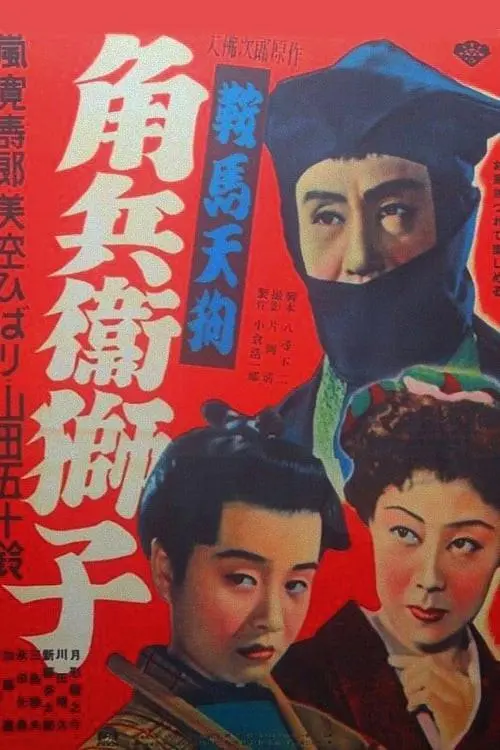
Kurama Tengu: Acrobat in a Lion Mask
(Kurama Tengu kakubei jishi)
Direction: Tatsuo Ōsone
Screenplay: Fuji Yahiro
Cinematography: Kiyoshi Kataoka
Music: Seiichi Suzuki
Asst. director: no info
Action choreography: no info
Studio: Shōchiku
Genre: chanbara, jidaigeki, comedy, musical
Cast: Kanjūrō Arashi, Hibari Misora, Isuzu Yamada, Ryūnosuke Tsukigata, Yoshi Katō, Kensaku Hara, and others.
A masked warrior, Kurama Tengu, fights against loyalists of the shogunate. In the meantime he helps young performers who have lost their money.
Commentary: In 1924 the popular writer Jirō Osaragi wrote a story titled Kimen no rōjo (The Old Woman with the Demon Mask), published in the magazine Pocket. This story marked the debut of the celebrated Kurama Tengu, who would go on to become the protagonist of dozens of novels, stories, and films. His pseudonym draws on the figure of the folkloric and theatrical Kurama Tengu — the great Tengu of Mount Kurama in Kyoto — who, according to legend, taught the young Minamoto no Yoshitsune the arts of swordsmanship and military tactics. Osaragi thus adopted a name deeply rooted in the martial-fantastical tradition and gave it to a mysterious, masked swordsman operating during the Bakumatsu period.
The literary Tengu is a secret agent supporting the position of the emperor. As such he is devoted to the Sonnō jōi movement (“Revere the Emperor, Expel the Barbarians”) and seeks to bring down the Tokugawa shogunate. Despite possessing formidable swordsmanship abilities, he prefers to operate in the shadows and to manipulate events. He is also a master of concealment, possessing an extensive collection of false identities. He most often presents himself as Tenzen Kurata, but uses many other names as well. His true identity has never been revealed.
In the stories and novels, Tengu is of medium build, approximately 165 centimetres tall, fair-complexioned, with a prominent nose and beautiful eyes. His most legendary feature, however, is his attire: on his head he wears a sōjūrō zukin (a head and face covering of a distinctive shape, somewhat resembling a black balaclava, exposing only the wearer’s eyes and nose; visible on the film’s poster), and his body is draped in a flowing black kimono. This costume was established primarily through the cinematic adaptations of the stories, but has become entirely fused with the character in the Japanese popular consciousness.
In terms of personality, Tengu is known for his cheerful, open disposition. He avoids bloodshed and often strikes with the blunt side of his sword during combat in order to spare the lives of his opponents. Interestingly, he sometimes harbours a kind of sympathy for his adversaries — for example, Kondō Isami of the Shinsengumi forces. Later, after the fall of Tokugawa power, Tengu also took a critical view of the new Meiji government.
The first film about the masked hero, A Woman’s Hell (Nyonin jigoku, Shiroku Nagao), premiered in 1924, just a few months after the publication of the first story. Kurama Tengu was played in it by Jitsukawa Enshō. A year later the celebrated silent film actor Matsunosuke Onoe was cast in the role, which he then reprised four more times. By 1934, nineteen productions about the warrior had been made. The actor most closely identified with the character, however, is undoubtedly Kanjūrō Arashi, known to his fans as Arakan. Arashi, who played the role of Kurama forty-six times, was a kabuki actor who made his screen debut in the leading role in The Street Performer: Part 1 (Kurama Tengu ibun: kakubei jishi, Junzō Sone) in 1927. The production was a major hit, and Arashi himself was responsible for creating the visual identity of the character, including the use of the aforementioned sōjūrō zukin.
On this basis it can be inferred that Kurama Tengu: Acrobat in a Lion Mask is a similar film — in terms of its production context — to the two-part Bored Hatamoto, made in 1950. In both cases we have a popular pre-war protagonist; both are representatives of chanbara; in both the titular characters are played by actors who had portrayed them before the war; both take an escapist approach to the genre; and both are oriented more towards commercial than artistic success.
The 1951 film is based on the same story as the 1927 film, which would also be adapted again later. In it, Tengu assists loyalists opposing the shogunate. For this reason he is pursued by samurai loyal to the Tokugawa and by the local police. His life is also threatened by the widow of a man murdered by those very samurai, who mistakenly believes Tengu to be responsible for her husband’s death. The local police chief, furthermore, exploits orphans by having them perform on the street and hand over their earnings to him. When Kurama helps them, he inevitably exposes his position to his enemies.
Kurama Tengu: Acrobat in a Lion Mask successfully transplants onto the post-war market a hero of mysterious identity — masked and fighting against evil — thereby serving as a bridge between the pre-war sword-wielding warriors and later Japanese superheroes such as Gekkō Kamen (Moonlight Mask), who debuted on television in the 1950s. The film also stands at a popular cultural bridge between eras in other respects. Arashi on screen is accompanied by Isuzu Yamada in the role of the widow who devotes herself to a mission of revenge — a popular pre-war actress who successfully continued her career after the war. The younger generation is represented by the celebrated singer and actress Hibari Misora, who would soon herself become the face of chanbara film series built around her star status. Misora plays here a boy orphan named Sugisaku whom Tengu helps. Misora was cast in male roles several times throughout her career and frequently portrayed characters who dressed as men. Her distinctive appearance and slightly husky voice made her an ideal choice for more androgynous performances.
As one might expect, the film combines action sequences — executed in a rather classical, theatrically inspired style rather than a fully realistic one — with musical scenes, comedic scenes, and dramatic ones. Regarding the music, I will admit that I was somewhat surprised by the rather modest use of Misora’s vocal talent; in similar productions she typically had considerably more singing scenes. In keeping with the genre template, Tengu will inspire romantic feeling in a woman but will never fall in love himself and will remain faithful to his mission — which underscores his sincerity, loyalty, and devotion to the patriotic cause. Even so, the three most important characters temporarily form a surrogate family here, consisting of Tengu, Sugisaku, and the widow. Their shared scenes express a critique of the social injustices existing in the starkly hierarchical society. The opponents of the shogunate fight in this context not so much for the restoration of power to the emperor — whose social and political perception had changed considerably after the Second World War, causing a thematic shift in the adapted story — but rather for democratization and a world where everyone can enjoy equal rights regardless of financial status or family connections. Kurama Tengu works for a better life for people such as the orphan Sugisaku and the widow, thereby evoking the post-war state of Japanese society, full of war orphans and women left alone.
Kurama Tengu: Acrobat in a Lion Mask is not a particularly successful film from a stylistic or artistic standpoint, but nor does it harbour such ambitions. It was made as fast, undemanding entertainment cinema — part of a larger series built around recognizable characters and actors, as well as familiar narrative templates, songs, jokes, and light action. It is, however, an interesting example of chanbara‘s reclamation of popularity in the post-war years, when the genre combined old heroes and actors with new stars, new musical forms, and new techniques for presenting action cinema. For those interested in the development of Japanese filmmaking — and in particular Japanese popular filmmaking — it is therefore a production decidedly worth seeking out.
5/10
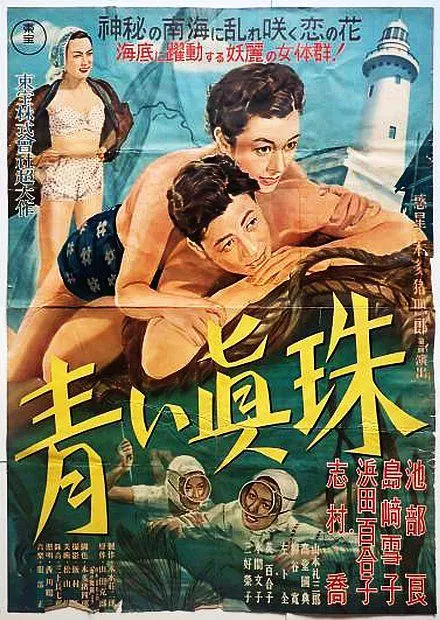
The Blue Pearl
(Aoi shinju)
Direction and screenplay: Ishirō Honda
Cinematography: Tadashi Iimura
Music: Tadashi Hattori
Asst. director: no info
Studio: Toho
Genre: melodrama
Cast: Ryō Ikebe, Yukiko Shimazaki, Yuriko Hamada, Takashi Shimura, Reizaburo Yamamoto, Kan Yanagiya, Bokuzen Hidari
Ishirō Honda’s directorial debut.
A young man from Tokyo arrives in a superstitious coastal village, where he falls in love with a modest girl, while he himself is pursued by an aggressive woman corrupted by a brief life in the metropolis.
Commentary: Ishirō Honda is today associated above all with fantasy productions — and in particular with Godzilla, which premiered in 1954. And while The Blue Pearl, based on Katsurō Yamada’s novel Umi no haien (Ruins of the Sea), is a melodramatic work, it also features extended underwater sequences that were innovative by the standards of the time in Japan and prefigure the director’s future achievements. These were filmed thanks to the technical ingenuity of cinematographer Tadashi Iimura, who independently constructed waterproof housings for the camera. Even within a standard romantic genre of the period, Honda thus reveals himself from the very beginning of his career as someone interested in images and techniques that conventional studio dramas of the time could not easily provide. Iimura, meanwhile, is evidence of Japanese filmmakers devising practical solutions to reach spaces that their country’s cinema had not yet mastered.
This makes the film considerably more interesting on the stylistic level than on the thematic one, which offers a rather unexciting love triangle presented in an overly stereotypical manner — equating metropolitan life with a negative cultural influence while promoting submissive attitudes in women, and subjecting the superstitious character of rural areas to criticism. The production takes place on a small island off the coast of the Shima Peninsula, in a community that thrives on ama labor. Honda was familiar with the region from his earlier documentary, Ise-Shima, and his experiences there served as one of the inspirations for The Blue Pearl, which was also filmed in the Ise-Shima region.
Beyond its technical dimension, the production is also of interest for its use of the figure of the ama — the traditional women divers who, in coastal communities, formed the backbone of villages and small towns as the primary providers of food for their inhabitants. For this reason the presence of women in the community depicted in the film is more significant than in many other productions of the period. They are physically active, important to the local economy, and connected to the maritime spaces more directly than the men. The Blue Pearl is unable — or unwilling — to present them fully as independent women, however, and instead reshapes them into a submissive ones or as a melodramatic threat: active, seductive femmes fatales. This portrayal is reinforced by the minimal clothing that the ama wear as a result of their frequent diving — clothing which is used in the film to heighten its erotic charge and appeal to the male portion of the contemporary audience. This means that The Blue Pearl can be regarded as an unwitting precursor of the later exploitation cinema that would, in subsequent years, lay claim to the ama figure within the currents of erotic film.
6/10

Author of “Panorama of Hong Kong and Taiwan Cinema”, a lover of Asian cinema, action films, and space voyages aboard the starship Enterprise. He once studied Polish philology, and later became a citizen of the NSK State in Time. He has published in Kinomisja, Ekrany, Kultura Liberalna, Torii, Dwutygodnik Kulturalny, and others.