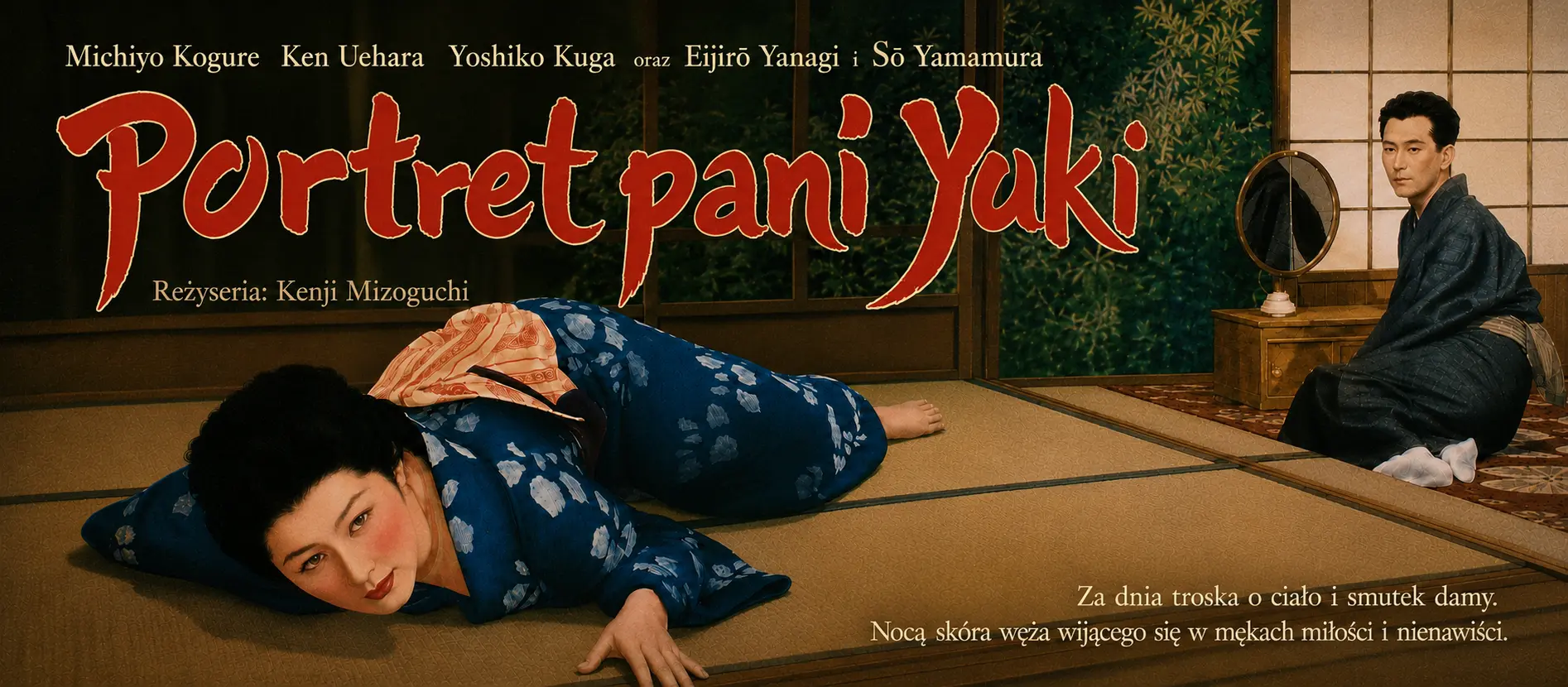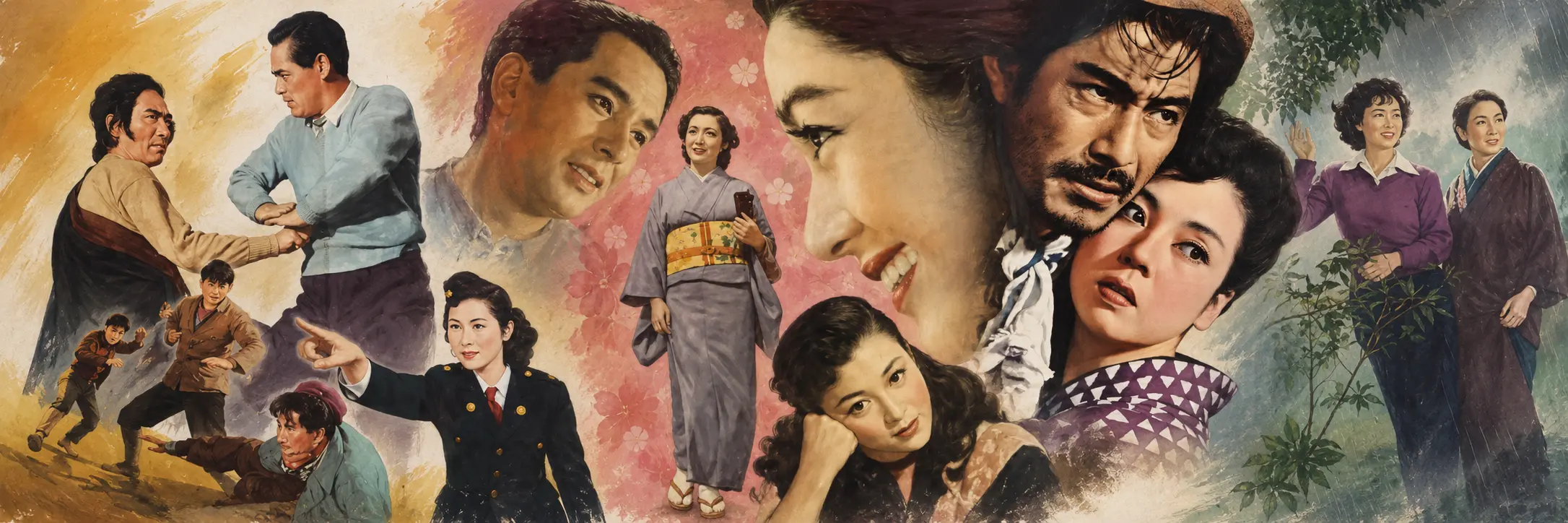
- Repast, Mikio Naruse (drama)
- Dispersed Clouds, Heinosuke Gosho (drama)
- The Life of a Horse Trader, Keigo Kimura (drama)
- Karate Sanshiro, Kyōtarō Namiki (action, martial arts, drama, crime)
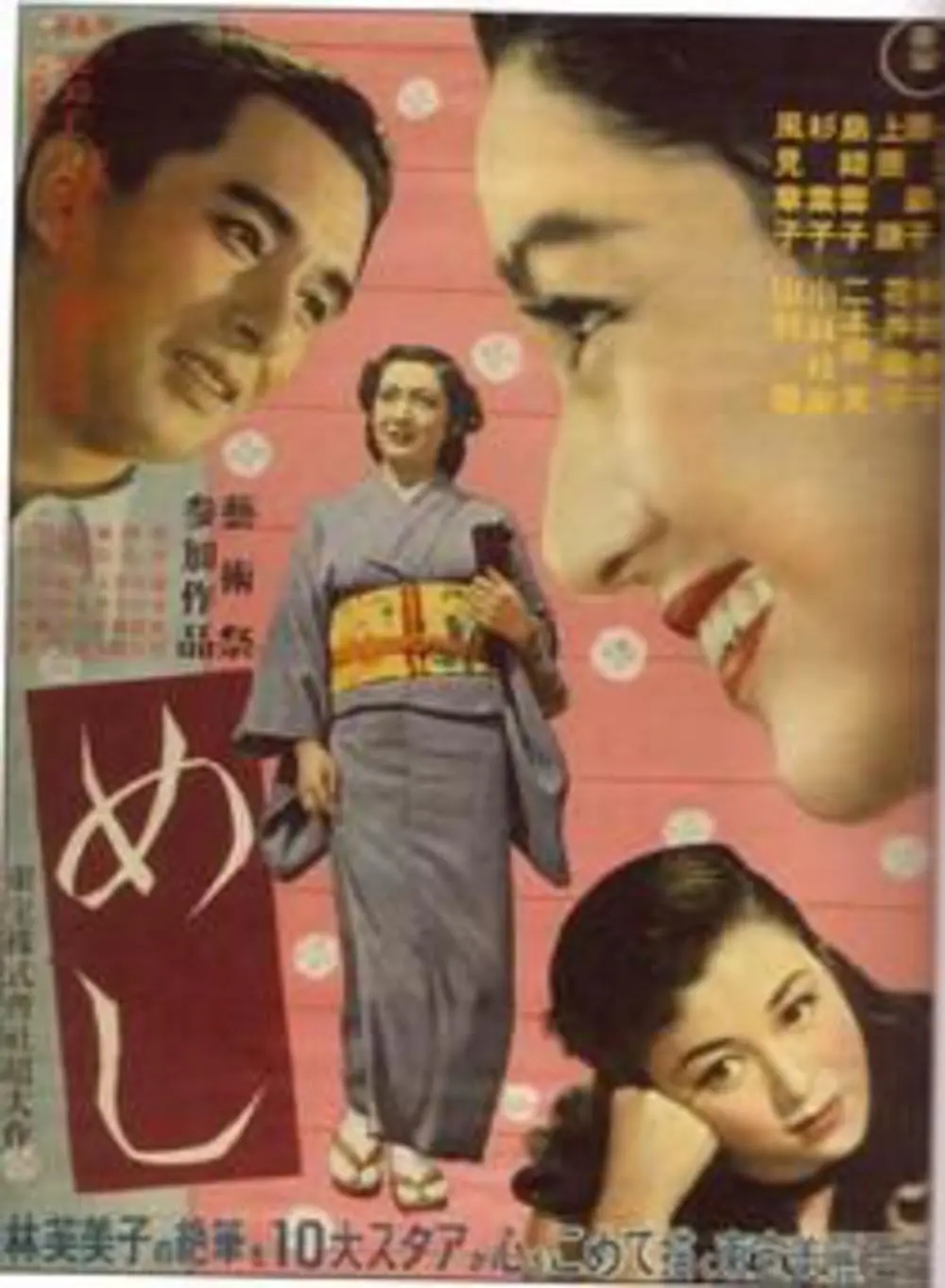
Repast
aka A Married Life
(Meshi)
Director: Mikio Naruse
Screenplay: Toshirō Ide, Sumie Tanaka
Cinematography: Masao Tamai
Music: Fumio Hayasaka
Asst. director: Masayoshi Kawanishi
Studio: Toho
Genre: Drama
Cast: Setsuko Hara, Ken Uehara, Yukiko Shimazaki, Yōko Sugi, Akiko Kazami, Haruko Sugimura, Ranko Hanai, Hiroshi Nihon’yanagi, Keiju Kobayashi, Sō Yamamura, Eitarō Shindō and others.
No. 2 in Kinema Junpo’s rankings.
Michiyo is an unhappy married woman living with her husband in a poor district of Osaka. She spends her time doing housework, but longs for something more from life.
Commentary: Repast is widely regarded as the film that inaugurated the finest period of Mikio Naruse’s career. At its centre is Michiyo Okamoto (an excellent Setsuko Hara), a woman trapped in an unhappy marriage to Hatsunosuke (Ken Uehara, familiar from numerous similar roles). The couple’s relationship is almost entirely devoid of emotion, while Michiyo herself has essentially been reduced to the role of a servant. Nor has she found meaning in married life through parenthood, since the couple have never had children.
Hatsunosuke appears emotionally extinguished, either unable or unwilling to show his wife affection. Michiyo’s troubles do not end there, as the man also lacks ambition, which translates into his modest earnings and forces the couple to live in a humble, lower-middle-class district of Osaka inhabited by, among others, unemployed people, prostitutes and petty criminals. The final straw is the arrival of Hatsunosuke’s twenty-year-old niece Satoko, an energetic young woman who has fled Tokyo to escape an arranged marriage.
At first, the two women appear to be complete opposites. Michiyo spends her time cleaning the house and preparing meals, while Satoko rests and relaxes; Michiyo occasionally chats with the unhappy people of the neighbourhood, while Satoko flirts with Hatsunosuke; Michiyo wanders aimlessly around the city, while the smiling Satoko spends her time seeking pleasure.
Michiyo’s life is one of emptiness and stagnation, defined by absence: the absence of pleasure and the absence of access to what she desires. She does not refrain from complaining about the fate that has befallen her and expresses her bitterness in conversations with various people. Yet, as it turns out, Satoko respects her and is even somewhat afraid of the older, more experienced woman, seeing in her a stability and strength that she herself does not yet possess.
Anyone reading analyses of Repast will almost certainly encounter at least two contrasting interpretations of Michiyo’s behaviour. Mikio Naruse is commonly regarded as a director who portrayed the dreams of contemporary Japanese women and their failures in attempting to fulfil them.
As in his other films discussed so far in the Panorama of Japanese Cinema, Repast also contains the motif of a woman rebelling against the restrictions imposed upon her: here, through Michiyo leaving her husband and returning to her family in Tokyo. Yet, again as in Naruse’s earlier films, the woman ultimately returns to her partner.
Her return can be—and usually is—interpreted as a victory for conservative values: an indication that she can find happiness only at a man’s side. According to this reading, the ending of Repast either expresses the director’s own conservative position or represents a position imposed upon him by a conservative studio, or by a studio wishing to appeal to an audience whose majority held conservative attitudes.
Another interpretation—present, for example, in Darragh O’Donoghue’s essay on the film in Senses of Cinema—casts Michiyo in a less flattering light and brings Hatsunosuke closer to the position of a victim of married life.
This reading stems partly from the fact that Michiyo left her family home when she was young in order to marry despite her parents’ objections, and partly from the later equation of Michiyo and Satoko within Repast. The two women, who initially appear so different from one another, prove at their core to be almost identical.
When Michiyo arrives in Tokyo, freed from her marital duties, she begins behaving in much the same way Satoko behaved earlier. This can be read as confirmation of her reluctance to improve either her own circumstances or those of her marriage, as well as an indication of a certain childishness or ignorance on her part.
Naruse also shows numerous working women, yet there is never a scene suggesting that Michiyo herself—despite complaining about poverty, her husband’s lack of ambition and inequality within the marriage—has ever seriously considered taking up employment.
Instead, the film suggests that she herself may be partly responsible for the situation in which the couple find themselves. It ironically juxtaposes Michiyo’s departure with a slight improvement in circumstances around Hatsunosuke: the husband receives a promotion, a neighbour finds work, and everyday life seems briefly to stabilise.
Her negative influence upon those around her is therefore further exaggerated by the fact that the overall situation in the neighbourhood improves during her absence, and by the suggestion at the end of Repast that, following Michiyo’s return, Hatsunosuke reverts to his behaviour from before she left.
Another element casting her character in a negative light is that, while staying in Tokyo and unconsciously behaving like Satoko, she substantially increases her mother’s workload—just as Satoko had previously increased hers. Once again, another man, Michiyo’s brother, has to point this out to her.
Regardless of which interpretation we find more convincing, it is difficult to separate the ending of Repast entirely from a conservative compromise. This does not mean, however, that the film as a whole is conservative. For most of its running time, Naruse instead presents the impasse of a woman unable to find happiness either within marriage or outside it.
The first interpretation points towards the protagonist’s inability to achieve fulfilment within a patriarchal order, and towards the idea that abandoning the desire for happiness and submitting to life beside a man becomes a woman’s true—or only—form of fulfilment.
In the second interpretation, we see Michiyo as the unstable element within the marital equation: through her inconsistency and stereotypically feminine emotionality, she disrupts married life and causes suffering both to herself and to an innocent man. As a woman, she is also incapable of recognising the errors of her behaviour until another man points her towards the proper path.
Within this reading, Repast is not a critique of the institution of marriage or of patriarchal structures. At most, it may be regarded as a call for mutual understanding between partners, with particular emphasis placed upon the wife.
It should be noted, however, that the film acquires a conservative complexion—particularly in relation to Hatsunosuke’s character—when viewed from a contemporary perspective. From the perspective of the early 1950s, the situation looks rather different.
The husband then appears almost excessively gentle: he never harms his wife or even raises his voice to her, never makes poor financial decisions, never shows even the slightest interest in other women, and so forth.
Naturally, these traits can be interpreted as contributing to an idealised portrait of the man, presented against the unstable social unit represented by the woman. Yet if Naruse or the studio had genuinely wished to appeal more directly to a conservative audience, they would most likely have presented him as a stereotypical husband: completely dominant over a woman who serves him and finds fulfilment in that service.
From this perspective, he is a modern husband—or rather the version of the husband promoted by Naruse—which would mean that Repast is fundamentally a modern rather than a conservative film.
Interestingly, in Fumiko Hayashi’s novel, the reader is never in doubt about what Michiyo wants, what her intentions are or what she is thinking. Naruse, by contrast, deliberately leaves numerous ambiguities surrounding her behaviour, allowing for a variety of interpretations of the character and, consequently, of the entire film.
The only exception is the ending. According to accounts cited by Catherine Russell, it—together with the unnatural voice-over narration—was the result of a compromise with Toho, which, contrary to the wishes of the screenwriters, did not want the film to end in divorce. Takao Toda explicitly states that the final narration does not sound like Hayashi and may have been added for ‘mass appeal’.
Repast is not only narratively accomplished, but technically realised to an exceptionally high standard, and it is not without reason that it is regarded as the first film of Naruse’s great period.
Through numerous stylistic choices—framing and lighting among them—Naruse continually preserves a sense of mystery surrounding the question of happiness within a long-term marriage, lending considerable poetry to an otherwise simple, domestic and remarkably realistic story.
He is also greatly assisted by his actors, who, through repeatedly returning to similar kinds of roles, had achieved mastery in portraying them with naturalness and emotional force. Setsuko Hara is particularly magnificent, once again confirming why she is regarded as one of the greatest actresses in Japanese cinema.
Finally, a few words should be said about the film’s title. The original Japanese word meshi, written in hiragana in the title, originates in masculine speech and carries several meanings: ‘cooked rice’, ‘meal’, but also ‘livelihood’ or ‘means of subsistence’.
In this context, it refers to several aspects of the film. Firstly, it relates to male dominance and the limited opportunities available to women for social and professional development. Through the stereotypical question asked by a husband returning from work—meshi ja nai ka?, ‘Isn’t the meal ready?’—it defines the relationship between woman and man within marriage.
It also relates to Michiyo’s longing for the period before her marriage, symbolised by her dislike of imported rice and her fondness for rice from her home region.
Furthermore, it connects with the material dimension of life: maintaining a household, everyday cooking, earnings and economic dependence, all of which belong among the film’s central concerns.
Repast is an excellent example of the Japanese domestic drama, a form in which Mikio Naruse was one of the masters. It is a thought-provoking film, beautifully made and performed, lingering in the memory and generating emotions that emerge gradually rather than immediately. For anyone interested in cinema, it remains essential viewing to this day.
8/10
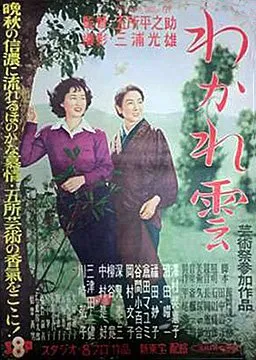
Dispersed Clouds
(Wakare-gumo)
Director: Heinosuke Gosho
Screenplay: Sumie Tanaka, Heinosuke Gosho, Kennosuke Tateoka
Cinematography: Mitsuo Miura
Music: Ikuma Dan
Asst. director: no info
Studio: Studio Eight Pro, Shintōhō
Genre: Drama
Cast: Kieko Sawamura, Yōichi Numata, Hiroko Kawasaki, Ken Mitsuda, Taeko Fukuda, Mayumi Kurata and others.
A young university student, Masako, develops a mild case of pneumonia while travelling and is forced to remain in a small town. There, she meets a kind-hearted maid and a handsome doctor.
Commentary: Readers of the Panorama of Japanese Cinema have probably already noticed that many films of the period placed female protagonists at their centre. This phenomenon resulted to a considerable extent from the socio-political changes associated with the American occupation of Japan after the Second World War. The new constitution, promulgated in 1946 and in force from May 1947, introduced, among other things, the principle of equality between the sexes. In order to promote that equality, film studios were encouraged to make productions focusing on young women learning to become independent.
The protagonist of Dispersed Clouds, the young university student Masako (Kieko Sawamura), is one example of such a character. The occupation authorities also promoted humanist, ‘everyday’ films as far removed as possible from military or nationalist subjects. Set in a small village where the protagonist is forced to remain because of illness, Dispersed Clouds is an ideal representative of occupation-era ideals in this respect as well: idyllic, full of human kindness and compassion. As such, it can be read as a film exceptionally consistent with the occupation ideal of humanist, anti-militarist cinema concerned with everyday life, although its gentleness and empathy also stem from the director’s own sensibility.
Gosho—like other filmmakers who had already made films centred on women before the war—was not deliberately attempting to conform to any directives imposed from above. Quite the opposite: Dispersed Clouds was in fact his first independently produced film and, consequently, one made on a low budget. Following the strikes at Toho, sparked by opposition to the studio’s policies and restrictions upon artistic freedom, Gosho sided with the protesters, which resulted in the cancellation of his contract.
Together with friends, he then founded the small Studio Eight Pro, whose inaugural production was Dispersed Clouds. The film was distributed by Shintōhō, itself founded by people who had previously left Toho.
Gosho therefore enjoyed complete artistic freedom during production, constrained only by the modest budget. He consequently decided to shoot the entire film on location, avoiding studio sets. The picture was filmed around the Yatsugatake Mountains and the town of Kobuchizawa.
The story, meanwhile, was based on a real incident involving Gosho’s daughter, although it was expanded to acquire a metaphorical dimension. The young Masako can be understood as a symbol of Japanese society: stubborn and traumatised, yet gradually healing its physical and psychological wounds through kindness, sincerity, love, respect and so forth, thereby progressing towards a hopeful future. The film can also be understood on a purely realistic level, as a story about gradually reconciling with one’s family.
The production therefore fits into numerous contemporary trends. It does so through its realistic presentation of events, its focus on simple dramas, its lyrical tone combining gentle humour with understated drama, its romantic subplot, and its references to the scars left by the war.
At the same time, it anticipates several later tendencies, such as setting an entire film in the countryside, where films by other directors—including Mikio Naruse and Tadashi Imai—would soon also take place. Nevertheless, it is difficult to escape the impression that everything Gosho does in Dispersed Clouds had already been done before, and done better, by filmmakers such as Yasujirō Ozu or Mikio Naruse.
The film nevertheless remains an interesting work and perhaps the last of Gosho’s films to be quite so optimistic, as his subsequent work would become increasingly pessimistic.
6/10
The Life of a Horse Trader
(Bakurō ichidai)
Director: Keigo Kimura
Screenplay: Masashige Narusawa, Keigo Kimura
Cinematography: Shigeyoshi Mine
Music: Fumio Hayasaka
Asst. director: Kazuhiko Saimura, Asaji Tanabe
Studio: Daiei
Genre: Drama
Cast: Toshirō Mifune, Machiko Kyō, Takashi Shimura, Ichirō Sugai, Mantarō Ushio, Hikaru Hoshi, Haruyo Ichikawa, Kyōji Sugi, Yōichi Mizuhara, Ryūzaburō Mitsuoka, Bokuzen Hidari, Kumeko Urabe and others.
No. 3 at the Japanese box office.
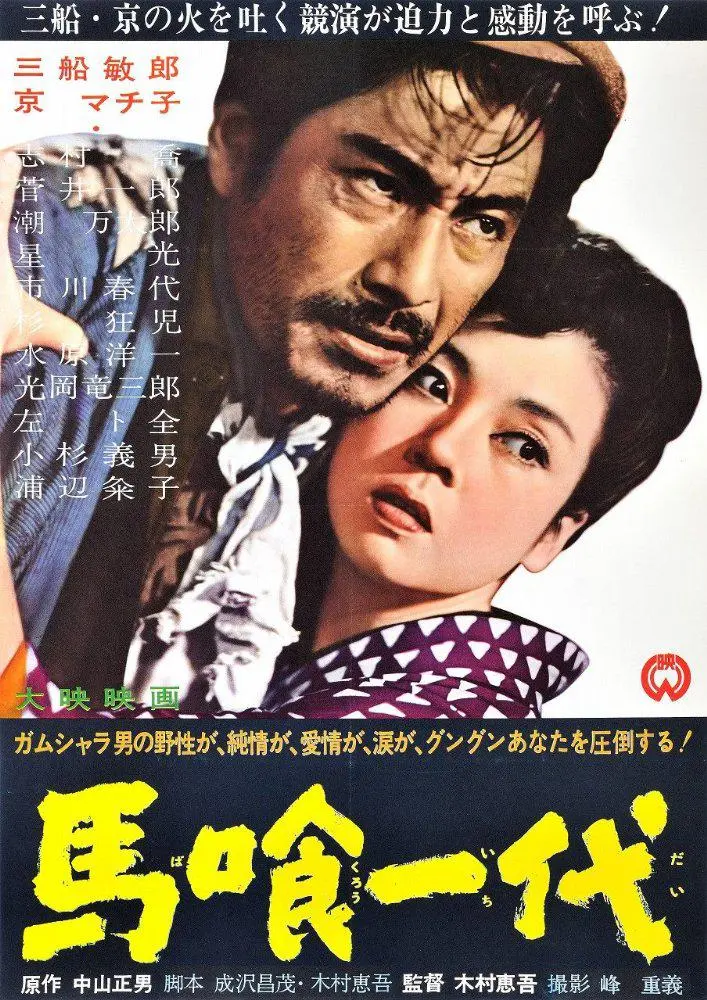
Yonetaro Katayama is a horse trader fond of gambling and drinking. When his wife dies, he is forced to raise his young son alone, which proves to be no easy task.
Commentary: Based on Masao Nakayama’s autobiographical novel, Kimura’s film stylistically recalls contemporary Hollywood cinema, albeit heavily filtered through Japanese realities. At its core, it presents a rather sentimental and moralising story, but it also offers an interesting glimpse into life in Hokkaido at the turn of the 1920s and 1930s, during the late Taishō and early Shōwa periods.
We see quite a few snapshots of everyday life in the Japanese provinces of the time: local amateur sumo competitions, scenes of horse trading and horse racing, performances of folk songs and even a local political campaign. This makes The Life of a Horse Trader at the very least an interesting film for anyone interested in Japanese cinema and the culture of the country.
The protagonist is played by Toshirō Mifune in one of the first roles so clearly tailored to his screen persona. He had, of course, already appeared in leading roles, including for Akira Kurosawa and Keisuke Kinoshita, but Kimura’s film is the first that seems to have been created specifically with Mifune in mind.
Indeed, to such an extent that I think it can easily be described not only as a production capitalising on the actor’s popularity, but also as one designed to promote him further. This is evident, among other things, in the way the film is shot, with Mifune kept at the centre of practically every scene.
Thematically, The Life of a Horse Trader expresses fairly simple values, promoting hard work and familial—or quasi-familial—relationships without attempting to engage in any polemic with the existing socio-political reality.
As a commercially oriented film, also intended to promote its star, however, it works extremely well, and thanks to its focus on a father raising a child alone, it can be described as remarkably energetic family entertainment.
Despite its somewhat excessive sentimentality, lack of greater artistic ambition and perhaps slightly overlong running time, its story is unquestionably engaging, while the narrative never becomes tedious or feels excessively rushed.
Moreover, the principal cast consists entirely of experienced and popular actors who bring charisma and credibility to their roles. Mifune is joined in the foreground by performers already familiar to him from Akira Kurosawa’s sets: Machiko Kyō as a woman in love with the protagonist, and Takashi Shimura as a local politician and Katayama’s rival.
8/10
Karate Sanshiro
(Karate Sanshirō)
Director: Kyōtarō Namiki
Screenplay: Ken’ichirō Iijima, Torao Setoguchi; based on a story by Keiichirō Ishino
Cinematography: Yoshimi Hirano
Music: Eiichi Yamada
Asst. director: no info
Action choreography: no information available
Studio: Shintoho
Genre: Action, martial arts, drama, crime
Cast: Eiji Okada, Koroku Kawakita, Yuriko Hamada, Kyōko Kagawa, Ryūnosuke Tsukigata, Susumu Fujita, Yoshiko Tsubouchi, Reiko Ōtani, Masao Shimizu
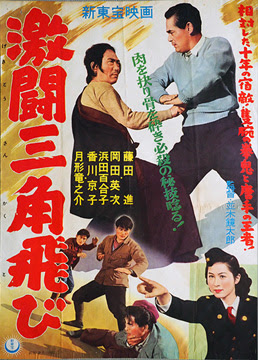
Because of a romantic rivalry, a young karate practitioner accidentally injures his friend. In order to earn money for his treatment, he takes a job at the docks, where his abilities attract the attention of gangsters. Working with them is a one-armed martial-arts master, a former enemy of the young man’s teacher.
Commentary: The film is emblematic of a lesser-known strand of low-budget martial-arts cinema that developed in Japan around the turn of the 1940s and 1950s. Its title directly links it, as well as the broader phenomenon of contemporary Japanese martial-arts cinema, with Akira Kurosawa’s Sugata Sanshiro (1943). Whereas Kurosawa’s title character was a judo practitioner, however, Karate Sanshiro features a master of karate. The two characters express a similar code of conduct and comparable moral attitudes, and were even played by the same actor: Susumu Fujita.
In Namiki’s film, however, Fujita’s character—who, despite the title, is named Ōsato—is not the protagonist, but a master teaching martial arts to the gifted young Yamauchi Tatsuhiko, played by Eiji Okada.
A desire to move beyond a single martial art had already appeared in Japanese action cinema in Kurosawa’s Sugata Sanshiro Part II (1945). That film includes characters practising karate and boxing, although the whole work was embedded within the nationalist framework of the wartime propaganda period.
Karate Sanshiro displays a similar desire to pit fighters with distinctive styles against one another, but relocates the action into the gangster cinema that was becoming increasingly popular after the war, close to films such as G-Men of Japan (1948) and A Bullet Hole Underground (1949). The gunfights found in those productions are, of course, replaced here by martial arts.
Unlike Kurosawa’s films, and particularly the first of them, Karate Sanshiro is a much simpler work: low-budget B-movie cinema capitalising upon the popularity of larger productions. Consequently, its morality is not presented through martial-arts training and discipline, but stated explicitly at the beginning of the film.
Namiki’s picture instead concentrates on action scenes, romantic entanglements and a secondary mistaken-identity plot. The story is largely an excuse for spectacle and is filled with genre clichés that were hardly original even in 1951. Moreover, many of its plotlines are only very loosely connected, creating the impression that they originated in two different films: one about past and present romances, and another about gangsters and martial-arts masters. Its narrative simplicity thus reveals that originality mattered less to the filmmakers than the attempt to exploit karate as a source of sensational entertainment.
Perceptions of the martial art were very different at the time from those of today. When the film was made, karate was still strongly associated with Okinawa, something emphasised on screen through characters originating from the islands, who use the local dialect and wear regional clothing.
The use of Okinawan cultural elements in productions of this kind functioned as a symbolic ‘guarantee’ that the filmmakers were presenting authentic martial arts on screen. At the same time, however, it also provided an element of exoticism entirely consistent with the films’ exploitation character, adding a sense of mystery and otherness.
This ‘authentic’ aspect of the presentation of martial arts is also visible in the promotional slogans and in the title Karate Sanshiro itself, where the word karate is written not with the characters standard in modern Japanese, 空手 (‘empty hand’), but with the older 唐手 (‘Chinese hand’).
A similar approach to karate and Okinawa characterised other productions of the 1950s, including Lightning Karate Blow and its sequel Meteor Karate Strike (both directed by Fujio Tsuda, 1956) for Toei.
It can therefore be observed that alongside the revival of popular chanbara and jidaigeki cinema—as demonstrated by productions such as Kurama Tengu: Acrobat in a Lion Mask (1951) and Sasaki Kojiro (1950–51)—a form of contemporary martial-arts cinema, less familiar outside Japan, was also developing in the country.
In its approach to the genre, it shared certain similarities—for example promotional slogans, the use of local martial arts and the presence of masters representing different styles—with the popular kung fu films of Cantonese cinema, which exploded in popularity in 1949 following the success of the Wong Fei-hung series.
By focusing on karate as a martial art that must not be used for aggression or violence, Karate Sanshiro extends the ethics of sword-fighting cinema into a contemporary form of unarmed combat cinema.
Combined with its gangster subject matter, young protagonists, romantic subplots and depictions of working-class spaces, the film stands at the intersection of several popular trends and can be regarded as a precursor not only to Toei’s martial-arts productions of the 1950s, but also to later films, including those starring Sonny Chiba.
The importance of Karate Sanshiro therefore lies not in its artistic quality, but in the fact that it represents one of the foundations of Japanese martial-arts cinema.
Namiki presents the karate scenes with a strongly exploitation-oriented sensibility. He attempts to attract the viewer primarily through ‘secret’ techniques supposedly capable of crushing bones and allowing fighters to leap to extraordinary heights.
Unfortunately, none of the actors appearing in the film had any substantial martial-arts training. Combined with archaic choreography and merely adequate editing, this deprives the action scenes of energy, spectacle and realism. They feel distinctly antiquated and are considerably inferior to the action found in contemporary Cantonese cinema.
Among the cast, Ryūnosuke Tsukigata fares best in this respect. An actor who repeatedly played villains in chanbara cinema, here he brings his characteristic energy to the role of a one-armed, alcohol-dependent master working for the gangsters.
The loss of his arm adds a tragic element to the character and may perhaps have been inspired by Tange Sazen. Tsukigata is hardly impressive in terms of physical ability either, but he is by far the most uninhibited performer in the film, making his villain perfectly suited to the exploitation world of Karate Sanshiro and overshadowing the much more restrained Okada and Fujita.
5/10

Author of “Panorama of Hong Kong and Taiwan Cinema”, a lover of Asian cinema, action films, and space voyages aboard the starship Enterprise. He once studied Polish philology, and later became a citizen of the NSK State in Time. He has published in Kinomisja, Ekrany, Kultura Liberalna, Torii, Dwutygodnik Kulturalny, and others.