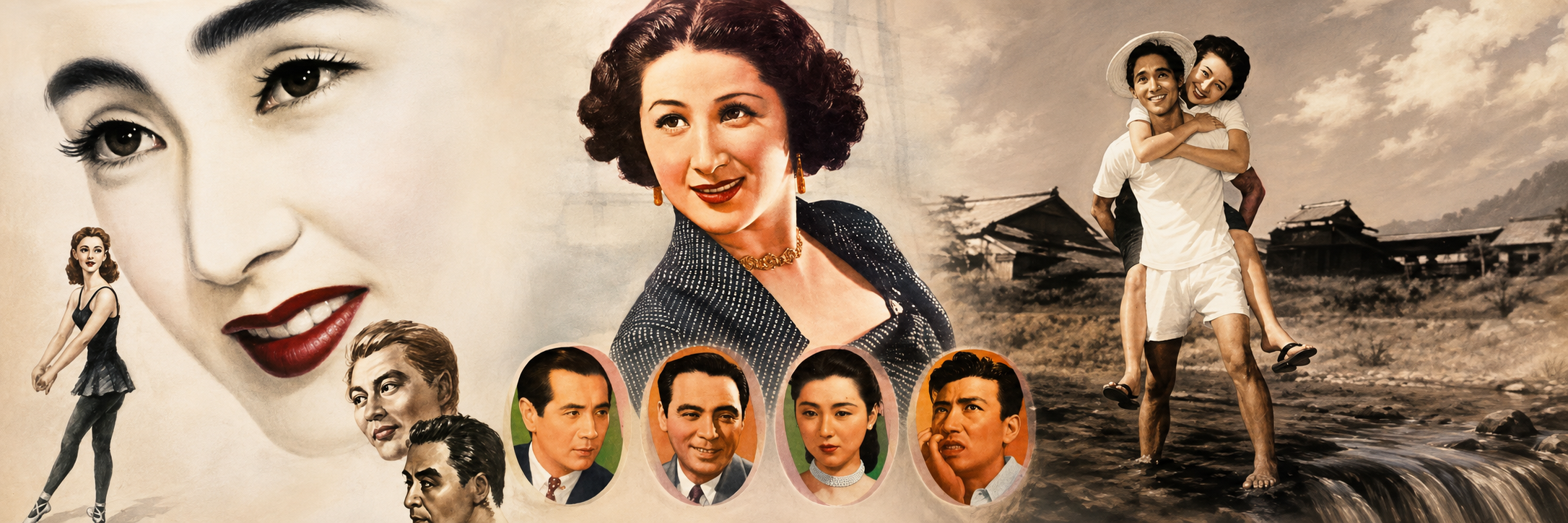
- Dancing Girl, Mikio Naruse (drama)
- Pure White Nights, Hideo Ōba (melodrama)
- Story of a Beloved Wife, Kaneto Shindō (drama, biographical)
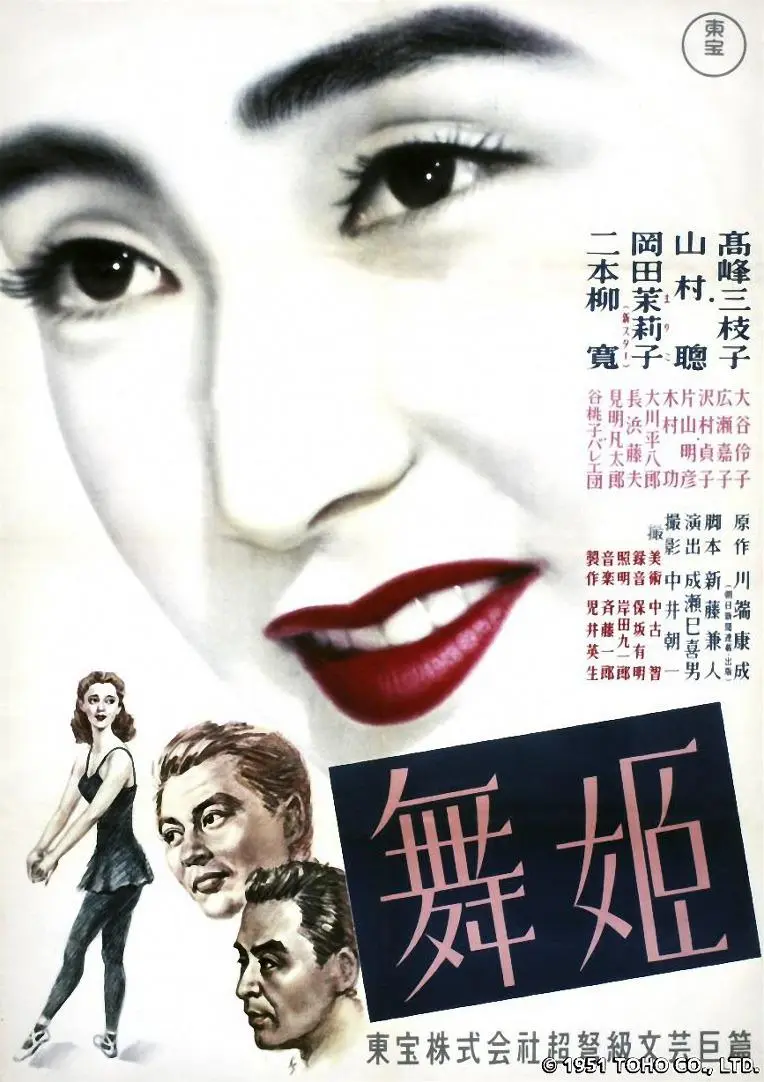
Dancing Girl
(Maihime)
Direction: Mikio Naruse
Screenplay: Kaneto Shindō
Cinematography: Asakazu Nakai
Music: Ichirō Saitō
Asst. director: no info
Studio: Toho
Genre: drama
Cast: Mieko Takamine, Sō Yamamura, Mariko Okada*, Isao Kimura, Heihachirō Ōkawa, Hiroshi Nihon’yanagi, Akihiko Katayama
*Mariko Okada, who would go on to become one of the most widely recognized actresses in the country, made her debut in Dancing Girl under the name Mariko Tanaka. She took the surname Okada from her deceased father, Tokihiko Okada.
The film tells the story of an unhappy marriage between a professor and a ballet teacher who has fallen in love with another man.
Commentary: Dancing Girl achieved no great commercial success and is not as widely known as many of Naruse’s earlier and later films. It is, however, a rather interesting entry in his filmography: a transitional point between the director’s style up to that time and the one that would secure his permanent place among the most important figures in Japanese cinema. Naruse draws fairly liberally here on techniques characteristic of his pre-war productions — including elaborate camera movements used to heighten dramatic tension — which successfully reflects the psychological problems of the characters at the stylistic level. Unfortunately this effect is limited to the two main protagonists, which means that the remaining figures serve as mere backdrop to their concerns, creating the impression of their separateness from the broader picture of post-war society — of which they are, after all, an inherent part. In her book The Cinema of Naruse Mikio: Women and Japanese Modernity, Catherine Russell writes in this context of “a glimpse of a shift in the aesthetics of realism hidden in the representation of Japan’s democratic self.” In other words, the film shows Naruse at a moment of searching for a language that would allow him to speak about the individual in the newly democratizing Japan — a country emerging from the deceptions of the wartime period and attempting to redefine its own identity. The post-war period had brought a collapse of faith in values, and in particular in traditional ones.
Dancing Girl — which is in some respects a precursor to Naruse’s later film Sound of the Mountain (Yama no oto, 1954) — is based on a novel by Yasunari Kawabata, to which the screenwriter Kaneto Shindō remained very faithful. He retained in his screenplay an excessive number of subplots and characters, the sheer abundance of which simply diminishes the importance of the main narrative thread. Somewhat unusually for Naruse, this is also a film focused on the upper social stratum. This means that for most of its duration we find ourselves in spaces rarely seen in the director’s other productions. We encounter, for instance, unnaturally looking, almost caricatural interiors of small Japanese apartments crammed with oversized Western furniture. I do not claim that Japanese people of the time did not furnish their homes this way, but these interiors look peculiar on screen and are distracting — which translates into the viewer’s reduced concern for the problems of the characters who live in them. Perhaps, however, this is intended to serve as visual evidence of the incompatibility of Western modernity with Japanese tradition; the appearance of the apartments may therefore constitute one of the symptoms of social crisis.
In terms of production context, the film was largely conceived as a vehicle exploiting the popularity of Mieko Takamine and further promoting her star image. The actress appears in a tailor-made white costume that lends her an almost literal radiance. Naruse approaches her extravagant attire with a degree of ambivalence — as he does her indulgence in luxury. On one hand he suggests that such behaviour would until recently have been considered simply vulgar; on the other she is met with numerous compliments. It is difficult to say with any certainty what attitude the character of Namiko herself — played by Takamine — holds towards this and many other questions. The actress adopts a surprisingly emotionless performance style here; her face barely changes expression throughout. This is not, however, a criticism of Takamine. Namiko’s face is the mask of a woman trapped in an unhappy, hollow marriage whose life is a succession of squandered opportunities. This fact causes not only her own suffering but also affects her husband and daughter — who, despite being of marriageable age, refuses to wed for fear that her relationship will be a repetition of her mother’s. Ultimately, then, every character here is unhappy.
Interestingly, the film suggests that the cause of the protagonists’ unhappiness is not an excess of social constraints but — on the contrary — an excess of the freedom offered to people after the war. In the film — as in Kawabata’s novel itself — one of the symptoms of the corruption caused by an absence of appropriate national discipline is infidelity and the indulgence of sexuality, characterized exclusively in negative terms. In this context the film constitutes a critique of democracy and — in a broader sense — of the ideology being introduced by the American occupier. The problem is, however, twofold: not only does the new ideology carry many dangers (and is transplanted onto Japanese soil with difficulty), but the old ideology has also been tainted by the wartime period. Indeed, the war is described here as the “destroyer of Japanese society,” which inflicted not only physical wounds upon that society (the deaths of citizens, destroyed cities) but also psychological ones (the nation’s difficulty in finding its footing in the new socio-political order). This necessitates the reformulation of a hierarchy of values. Different artists, philosophers, and politicians saw different paths out of this difficult situation. In Dancing Girl, Naruse locates the answer in a return to traditional social attitudes as a kind of anchor for the national spirit. This naturally means that the film’s main characters will ultimately come down on the side of those traditional values — values that compel women to relinquish their dreams in favour of fidelity (and obedience) to their husbands, regardless of what kind of person a husband may be, in a finale that feels rather abrupt and unnatural. Russell in this context invokes the words of David Pollack, who argues that Kawabata writes men are gods — “inactive centres of narrative galaxies around which women like stars perpetually revolve, fulfilling their destinies. Threatened male authority is undoubtedly the dominant theme of Kawabata’s novels, but that authority remains intact thanks to the active intervention of women whose very existence depends on the maintenance of that authority.” Ultimately, then, the old system must be preserved — according to both Kawabata and Naruse — and since the only unstable element of that system is the woman, the woman must sacrifice her desires and submit to the implicit authority of her husband. The film is therefore less a story of romantic renunciation than a drama of the restoration of social order, in which women must abandon their own desires so that the weakened authority of men may continue to function.
It is worth noting that the production’s traditionalist underpinning, combined with its eager use of Western furniture, the considerable presence of ballet, and many other stylistic choices, is strongly reminiscent of American cinema. This may not be particularly surprising, given that the predecessor of Eirin — the post-war institution of film self-regulation — was established under the influence of suggestions from the American occupation authorities and exerted a strong influence on many productions made at the time. Even so, Dancing Girl stands out as one of the most Hollywood-like films made not only by Naruse but in Japan generally in the early 1950s. It is something of a paradox that a production striving to criticize the modernity introduced by the Americans turns out to closely resemble popular American (melo)dramas. On the other hand, Dancing Girl might perhaps be viewed as a work attempting to use the modern, Western language of cinema to promote Japanese values. Despite its numerous merits — in terms of acting, direction, and cinematography — the thematic excess, predictable message, and limited stylistic originality lead one to regard Dancing Girl as one of Naruse’s weaker entries. At the same time it is an important film as one standing on the threshold of his finest period, traces of which can already be found here.
6/10
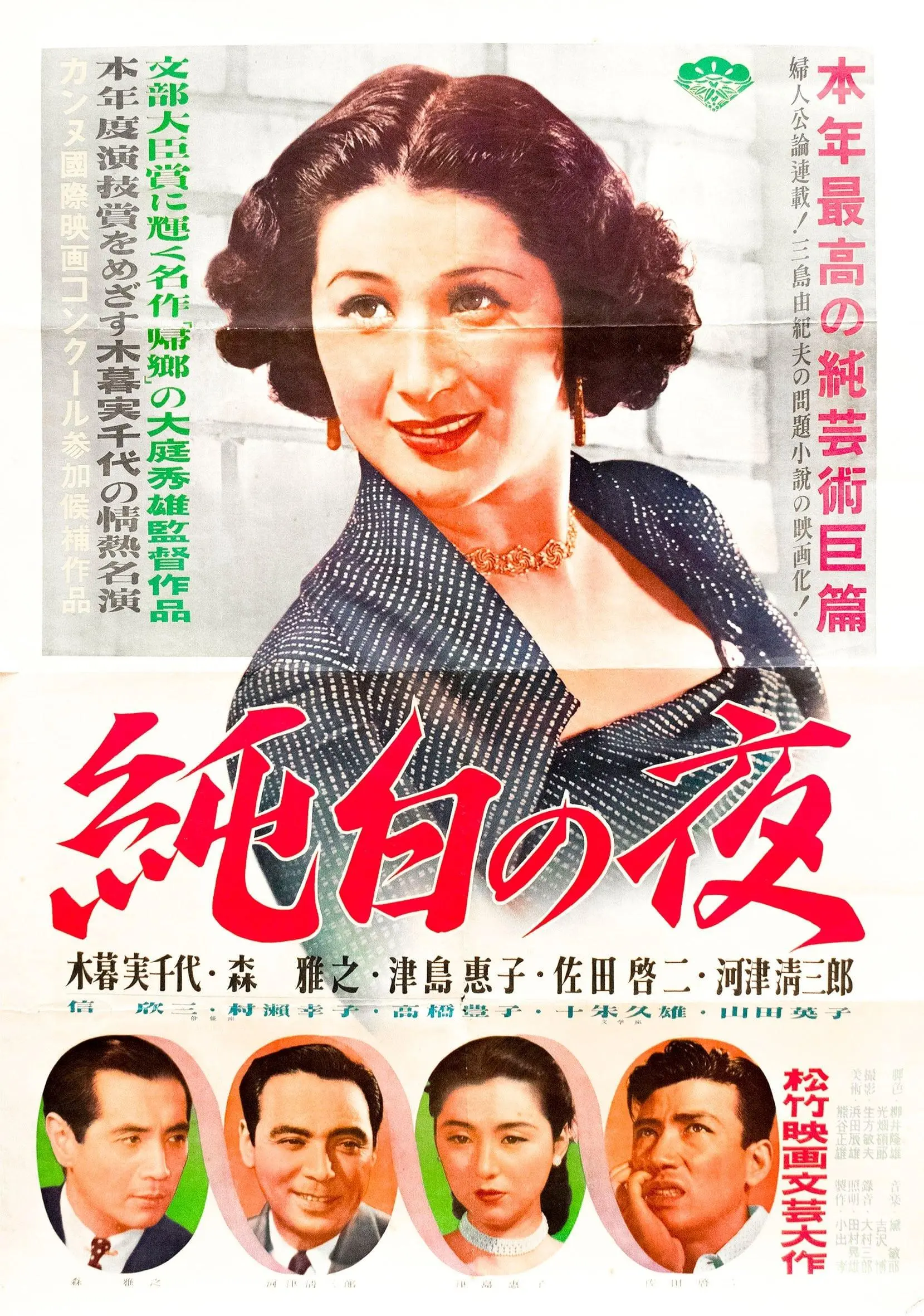
Pure White Nights
(Junpaku no yoru)
Direction: Hideo Ōba
Screenplay: Sekiro Mitsubata, Takao Yanai
Cinematography: Toshio Ubukata
Music: Toshirō Mayuzumi, Hiroshi Yoshizawa
Asst. director: Tadashi Arimoto
Studio: Shochiku
Genre: melodrama
Cast: Michiyo Kogure, Masayuki Mori, Seizaburō Kawazu, Kinzō Shin, Sachiko Murase, Keiko Tsushima, Toyo Takahashi, Hisao Toake, Shūichi Doki, Masami Morikawa, Yukio Mishima
A wealthy married woman becomes the object of a younger man’s love. Though initially toying with him, she gradually becomes less certain of her own feelings. Meanwhile her family tries to prevent her younger sister from being with her impoverished beloved.
Commentary: The film is based on a short story by Yukio Mishima of the same title, originally published in the women’s magazine Fujin kōron. Pure White Nights is also the first production based on the work of this celebrated and controversial writer. Its central thread is the romance between Ikuko (Michiyo Kogure) and a less affluent and younger former acquaintance of her husband, the financially struggling Kasunoki (Masayuki Mori). On one hand the woman knows she should not become involved with him for moral reasons and on account of prevailing behavioural norms; on the other, her frustrations and sense of physical and psychological suffocation within her stagnant marriage push her towards ever bolder conduct towards Kasunoki, and even towards a situation in which she is sexually exploited by another man.
As the viewer — and particularly a viewer familiar with contemporary Japanese cinema and Mishima’s prose — suspects (or knows from reading the story), her pursuit of passion and her attempts to escape from passive existence cannot end positively. Ikuko’s emotional turmoil and her inability to reconcile conflicting loyalties mean that after a point every decision she makes becomes a betrayal: of one of the men, of society, or of herself. Her final act is in this context both a punishment she imposes upon herself and a confirmation of the impossibility of finding happiness within the social system characterizing Japan at the time.
The film is made to a high technical standard, but the intense emotionality of the characters frequently renders them almost caricatural, which impedes one’s engagement with it. In many moments the behaviour of the protagonists seems exaggerated — and consequently simply foolish — calculated to produce certain narrative effects rather than allowing the story to develop naturally.
6/10
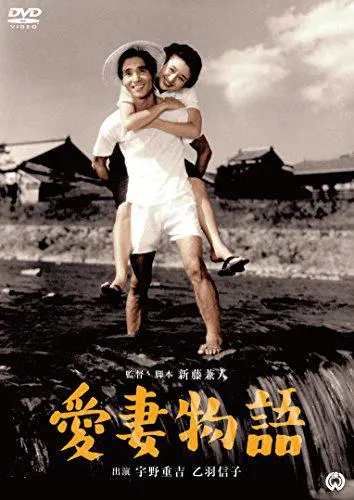
Story of a Beloved Wife
(Aisai monogatari)
Direction and screenplay: Kaneto Shindō
Cinematography: Yasukazu Takemura
Music: Chūji Kinoshita
Asst. director: Shin Amano
Studio: Daiei
Genre: drama, biographical
Cast: Nobuko Otowa, Jūkichi Uno, Denjirō Ōkōchi, Ichirō Sugai, Osamu Takizawa, Ryōsuke Kagawa, Yuriko Hanabusa, Masao Shimizu, Taiji Tonoyama, Seishirō Hara
Kaneto Shindō’s directorial debut.
#10 on the Kinema Junpo list.
An aspiring screenwriter and his wife — who married him against her parents’ wishes — try to survive the poverty of the wartime period. The film is inspired by Kaneto Shindō’s own memories.
Commentary: The production is a tribute to his wife and an autobiographical look at the early period of Kaneto Shindō’s career. The film’s protagonist, Keita Numazaki, is based on Shindō himself, while his wife Takako Kuji served as the model for the film’s Takako Ishikawa (played by Nobuko Otowa, who would later become the director’s third wife). Director Sakaguchi — who motivates the protagonist to keep learning and rejects his first screenplay — was in turn modelled on Kenji Mizoguchi. Shindō began his career in the film industry in 1934, when he was hired to develop film stock for Shinkō Kinema in Kyoto. While doing this work he became interested in writing screenplays and in the relationship between a script and the finished film. In 1935 Shinkō relocated to Tokyo, where Shindō began working in the art department managed by Hiroshi Mizutani. Before long he decided he wanted to become a screenwriter; the action of Story of a Beloved Wife begins shortly after this decision was made and depicts, among other things, his first steps in his new career — though it significantly modifies at least some of the events connected to it.
In the 1930s and early 1940s Shindō also served as assistant director to Kenji Mizoguchi, and additionally worked on the art direction for The 47 Ronin (Genroku chūshingura, Kenji Mizoguchi, 1941–42). During this period he showed Mizoguchi his screenplays, which the experienced director judged to have been written by someone without talent. The fictional Sakaguchi reacts similarly upon reading Numazaki’s first screenplay, but in Story of a Beloved Wife Shindō removed the element of a prior acquaintance between the characters; instead, the moment of presenting the screenplay to Sakaguchi constitutes the novice screenwriter’s first encounter with the director. In real life, in 1942 Shindō joined the Koa Film studio — belonging to Shochiku — under Mizoguchi’s tutelage, and in 1943 began working at Shochiku itself. That same year his wife died of tuberculosis, which is the event that closes the film.
After his wife’s death, Shindō achieved success as the author of numerous screenplays written for, among others, Kōzaburō Yoshimura, with whom he decided to leave Shochiku. Together with the actor and producer Taiji Tonoyama, both men founded the independent Kindai Eiga Kyōkai in 1950. It was then that Shindō decided to become a director and to base his debut film — Story of a Beloved Wife — on his own memories. The leading roles were played by Jūkichi Uno, who would soon grow into a distinguished dramatic actor, and the young and gifted Nobuko Otowa, a future star of Japanese cinema. Otowa was Shindō’s lover (their romance most likely began during or shortly after working on the film), and although the director soon married Miyo Shindō, he most likely never ended his relationship with Otowa. Miyo eventually divorced him; she died in 1977, and shortly after her death Otowa and Kaneto Shindō married. Their marriage lasted until 1994, when the actress died of liver cancer at the age of seventy. Shindō himself died eighteen years later, in 2012, at the age of one hundred; he directed his last film at the age of ninety-eight.
Working with simple and economical means of expression, Shindō focuses on the difficulties encountered by a novice screenwriter and on the moments of self-doubt that his selfless wife helps him overcome. Ishikawa is presented as a stereotypical Japanese ideal of womanhood: dutiful, loyal, entirely devoted to her husband, and desiring nothing beyond his happiness. She secretly obtains money from her mother, takes on small jobs, slips ideas to her husband, and intercedes on his behalf at the film studio; her selflessness means she gives no thought whatsoever to her own health, which ends in tuberculosis and premature death. Yet even on her deathbed she thinks only of her husband, and her final wish is for Sakaguchi to help Numazaki in his career.
The one-sided, idealistic portrait of the wife seems too perfect and unrealistic, but can be accepted as a tribute to the deceased. More grating is the behaviour of Numazaki, who is characterized by immense naivety. The man gives the impression of being in a state of permanent confusion — unaware of what is happening around him, lacking in imagination, and at times also in basic understanding of the world. Nor at any point does he come across as a screenwriter, let alone one whose work might interest anyone.
An undeniable strength of Story of a Beloved Wife is, however, its depiction of the historical background. The poverty in the country, the layoffs in the film industry, the shortages of materials, and the periodic blackouts during air raids all effectively convey the realities of the war’s final period. Particularly vivid is the solemn farewell to the young neighbour of Numazaki and Ishikawa as he departs for the front, later contrasted with his funeral procession. These elements amount to a decidedly critical — if subtly delivered — commentary on Japan’s involvement in the war and on a state propaganda that sent some to their deaths while robbing others of the possibility of a dignified life.
Story of a Beloved Wife is a solid debut, and at the same time a production characterized by post-war sentimentality and a revisionist perspective on recent events. This is worth emphasizing in the context of the coming wave of films full of critical perspectives on the wartime period, on post-war Japan, and on Japan as such. In many respects, however, Shindō’s film remains traditionally oriented — which is most apparent in the portrait of the main female character; Ishikawa fits perfectly the image of womanhood that Shōhei Imamura would later criticize as cinematic invention having nothing to do with reality. This invention can be forgiven in Shindō’s case, given the film’s adoratory and sentimental character.
7/10

Author of “Panorama of Hong Kong and Taiwan Cinema”, a lover of Asian cinema, action films, and space voyages aboard the starship Enterprise. He once studied Polish philology, and later became a citizen of the NSK State in Time. He has published in Kinomisja, Ekrany, Kultura Liberalna, Torii, Dwutygodnik Kulturalny, and others.