- Scandal, Akira Kurosawa (drama)
- The Angry Street, Mikio Naruse (drama, romance, noir)
- Snow-Flake, Yutaka Abe (drama)
- White Beast, Mikio Naruse (drama)
- Listen to the Voices of the Sea, Hideo Sekigawa (drama, war)
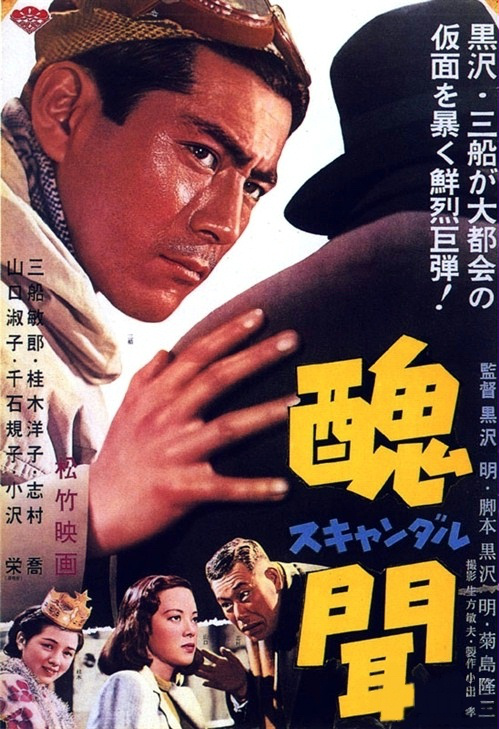
Scandal
(Sukyandaru, Shūbun)
Direction: Akira Kurosawa
Screenplay: Akira Kurosawa, Ryūzō Kikushima
Cinematography: Toshio Ubukata
Music: Fumio Hayasaka
Asst. director: Yoshitarō Nomura
Studio: Shochiku
Genre: drama
Cast: Toshirō Mifune, Yoshiko Yamaguchi, Yōko Katsuragi, Noriko Sengoku, Eitarō Ozawa, Takashi Shimura, Shinichi Himori, Kōji Mitsui, Ichirō Shimizu, Fumiko Okamura, Masao Shimizu, Tanie Kitabayashi, Sugisaku Aoyama, Kokuten Kōdō, Kichijirô Ueda, Bokuzen Hidari
#6 on the Kinema Junpo list
A tabloid reporter photographs a painter and a famous singer, then fabricates an article about their supposed romance. The painter decides to take the magazine to court.
Commentary: Scandal is the only production Kurosawa made for the Shochiku studio, known above all for films by such classics of Japanese cinema as Yasujirō Ozu, Kenji Mizoguchi, and Mikio Naruse. Although the film is decidedly inferior to the three preceding works of the director and to Rashomon — which followed it and premiered in the same year — it is still worth attention. It continues to sketch a picture of the post-war Japanese reality of the time, though it chooses to venture closer to the upper social strata and to the subject of the growing influence of glossy magazines in shaping the minds of the masses who read them.
The film was conceived by Kurosawa as an expression of protest against the rising aggression of the public media, which were abusing their privileges, showing no concern for the lives of the people they wrote about, and showing no respect for their privacy. Kurosawa also believed that the tabloid press’s abuse of power was symptomatic of post-war Japan’s obsession with freedom of speech. Unfortunately, this is a phenomenon that the director does not fully succeed in portraying.
The reason for this is that once Kurosawa introduces the characters of the corrupt lawyer Hiruta and his daughter who is ill with pneumonia, he shifts his focus away from the problem of the media and towards the question of humanity — and humaneness towards Hiruta himself. Kurosawa himself acknowledged that the production developed narratively in a direction he had not originally intended to take.
7/10
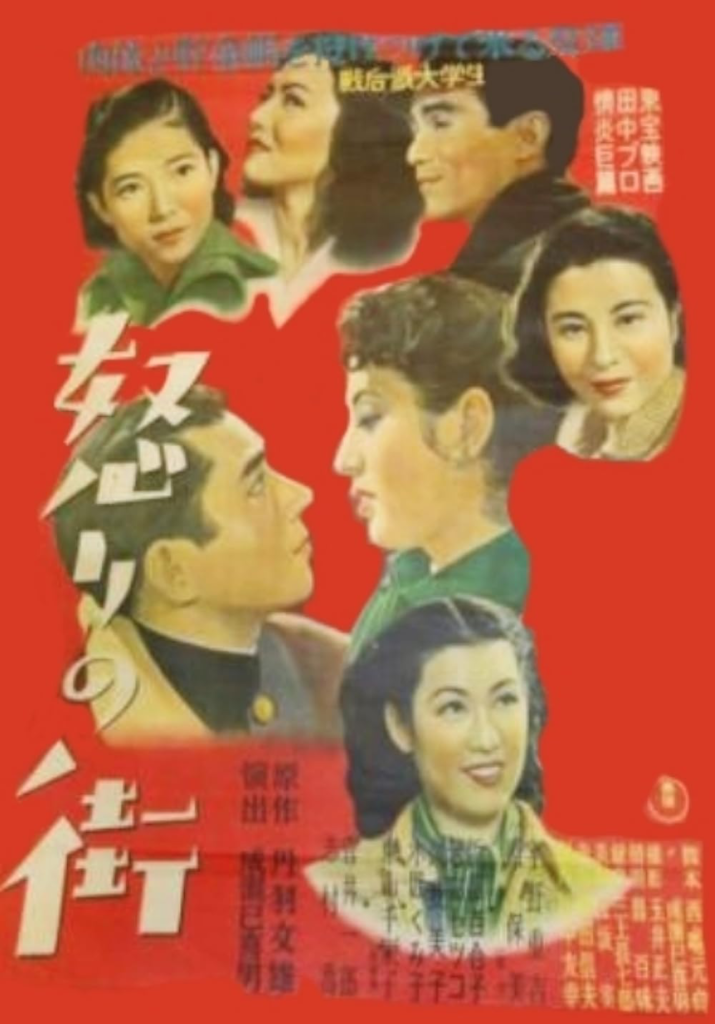
The Angry Street
(Ikari no machi)
Direction: Mikio Naruse
Screenplay: Mikio Naruse, Motosada Nishikame
Cinematography: Masao Tamai
Music: Nobuo Iida
Asst. director: no info
Studio: Tanaka Production
Genre: drama, romance, noir
Cast: Jūkichi Uno, Yasumi Hara, Yuriko Hamada, Setsuko Wakayama, Yoshiko Kuga, Mayuri Mokushô, Takashi Shimura, Ichirō Sugai, Kan Yanagiya, Mitsue Tachibana, Mie Asô, Chieko Higashiyama, Sachiko Murase, Teruko Kishi, Isao Kimura
#8 on the Kinema Junpo list
Sudo and Mori are students who make money by conning wealthy women in dance clubs. While one of them wants to leave this life behind, the other sinks ever deeper into a criminal underworld.
Commentary: The year 1950 is widely regarded as the beginning of the finest period in Mikio Naruse’s career, a period that came to an end with the director’s final production in 1967.
Although The Angry Street follows two friends, the greater part of the story is devoted to Sudō. Both young men are initially presented as morally negative characters, but it quickly becomes clear that they are heading in opposite moral directions. Sudō gradually loses himself in his own wickedness, making him a more interesting figure than his friend Mori, who slowly abandons his bad habits and resolves to lead an honest life. Their stories are told through a heavily simplified plot. Sudō exploits the girls he encounters, causing them suffering, until he meets a woman more experienced than himself. His descent into greed is underscored by his involvement in increasingly serious criminal activities; beyond defrauding women, he soon tries his hand at the black market and drug dealing. His moral collapse is further illustrated by his frequent casual sexual encounters, his delight at his grandmother’s death, and his complete indifference to the fate of his closest family.
Unfortunately, the portrayal of Sudō is one of the production’s more significant weaknesses. Yasumi Hara simply cannot find his footing in the role of a self-assured seducer. His permanently mournful expression and plaintive tone of voice are entirely at odds with his aggressive and remorseless approach to life. The resolution of his storyline is also somewhat disappointing. Mori’s arc, meanwhile, suffers from the implausibility of his transformation into a good person. After just a single conversation with Sudō’s sister — the beautiful and traditionally moral Masako — an old love is suddenly rekindled in him, steering him straight onto the path of righteousness.
It is worth praising the director, however, for his very deft navigation between the dramatic, romantic, and criminal threads, with their clear references to the stylistics of film noir. The Angry Street presents viewers with a panorama of the country composed of popular clubs that turn out to be dens of iniquity, narrow alleyways where dirty business is conducted, horse races, and criminal hideouts lurking just beyond the sight of respectable society. Beyond its obvious similarities to noir, the film’s focus on troubled and immoral youth also makes it something of an informal precursor to the taiyōzoku genre.
7/10
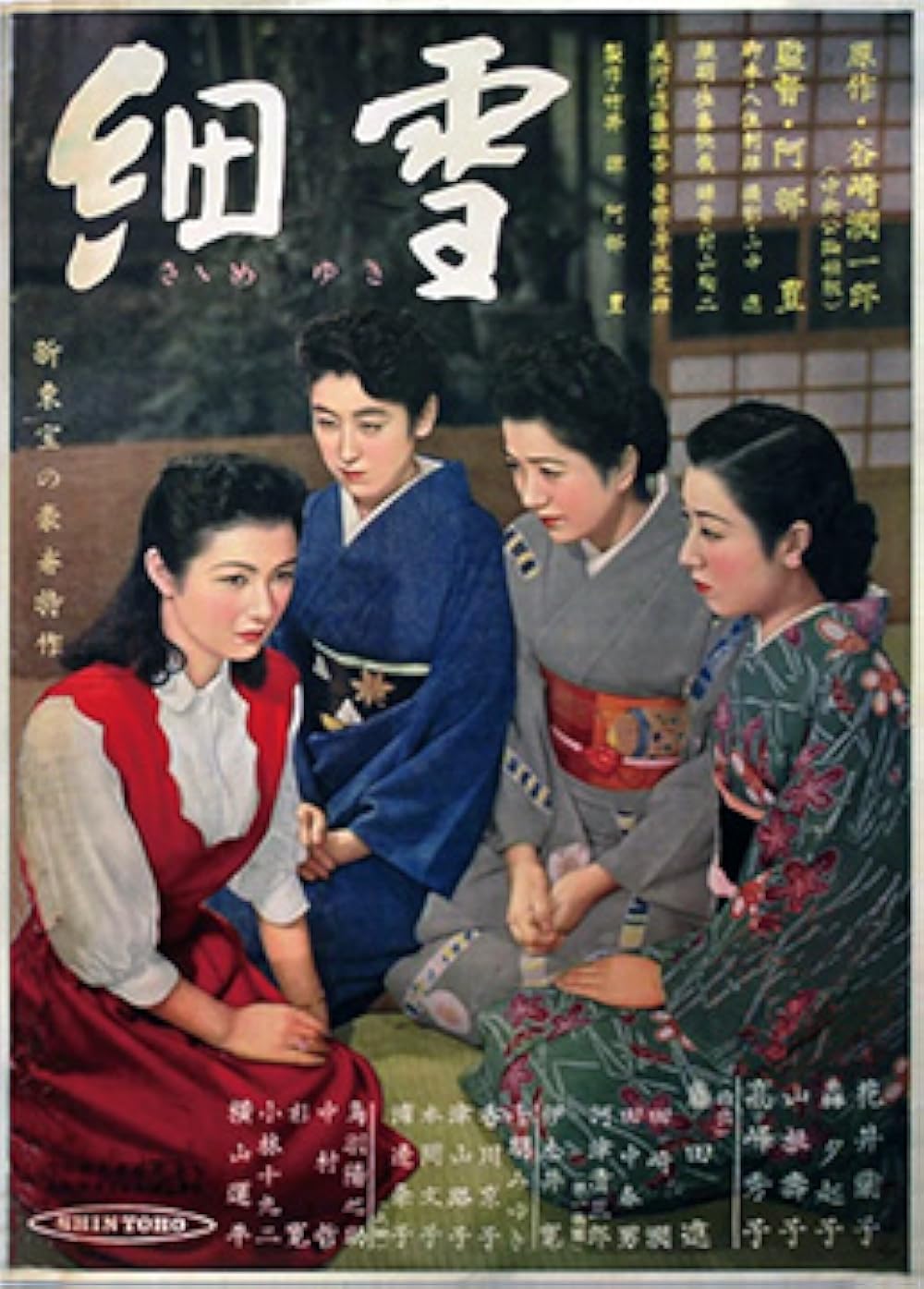
Snow-Flake
(Sasameyuki)
Direction: Yutaka Abe
Screenplay: Toshio Yasumi
Cinematography: Susumu Yamanaka
Music: Fumio Hayasaka
Asst. director: no info
Studio: Shintoho
Genre: drama
Cast: Ranko Hanai, Hideko Takamine, Yukiko Todoroki, Hisako Yamane, Kan Ishii, Seizaburō Kawazu, Haruo Tanaka, Jun Tazaki
#9 on the Kinema Junpo list
The story of four sisters facing various hardships in 1937.
Commentary: The film is based on Jun’ichirō Tanizaki’s novel published under the same title and serialized in 1943–44. Using the four Makioka sisters as its lens, Snow-Flake presents different approaches to life. The eldest of the characters is a kind of guardian figure, while the younger sister played by Hideko Takamine develops into a femme fatale who, driven by her love of comfort and luxury, leads two men by the nose — and in doing so drags not only them but herself down to moral and physical ruin. The third woman suffers the loss of her beloved, killed in the war, while the last was born of their father’s extramarital relationship and consequently lives far removed from her sisters, in an entirely different world.
In keeping with the popular themes of Japanese productions of the time, this film too presents the conflict between tradition and modernity, treating the latter with a degree of demonization that reveals the fear it inspired in some. Today the film commands attention primarily for Hideko Takamine’s vivacious performance and for a series of scenes set during a great flood, in which the filmmakers create a surprisingly effective atmosphere of danger and uncertainty, keeping the viewer in suspense. These scenes were produced at a cost of over 38 million yen, making Snow-Flake the most expensive film in the history of Japanese cinema at the time. On a symbolic level, the great flood can be read as a catastrophe reflecting the collapse of order within the sisters’ household. It was also certainly an opportunity for Shintoho — a young studio founded in opposition to Toho’s internal policies — to present itself as capable of producing spectacular films that could compete with the very best.
7/10
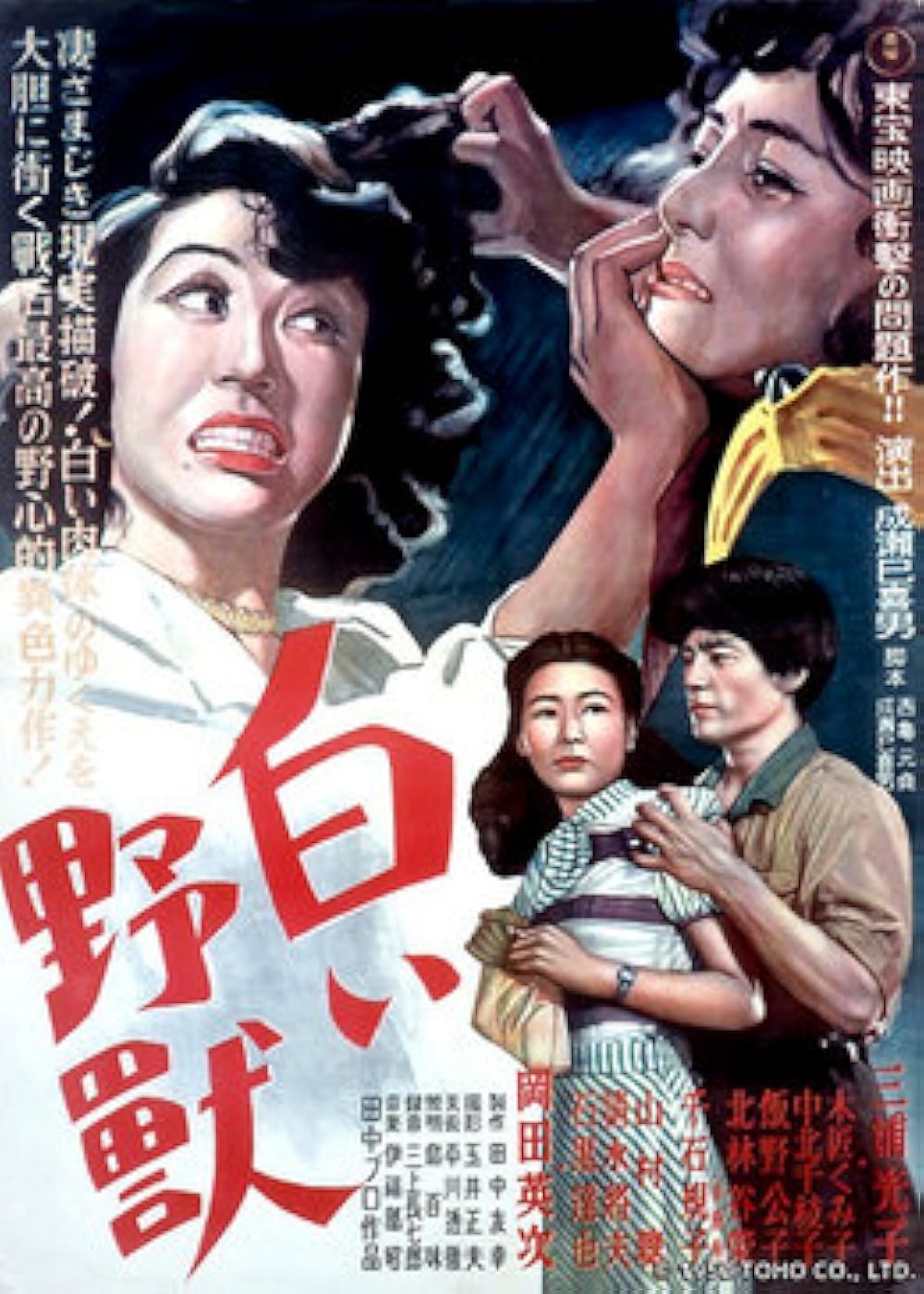
White Beast
(Shiroi yajū)
Direction: Mikio Naruse
Screenplay: Mikio Naruse, Motosada Nishikame
Cinematography: Masao Tamai
Music: Akira Ifukube
Asst. director: Masayoshi Kawanishi
Studio: Tanaka Production
Genre: drama
Cast: Mitsuko Miura, Sō Yamamura, Eiji Okada, Kimiko Iino, Chieko Nakakita, Mayuri Mokushô, Noriko Sengoku, Masao Shimizu, Tatsuya Ishiguro, Taizō Fukami
A film set in an institution for prostitutes suffering from venereal diseases, unwanted pregnancies, and failed relationships.
Commentary: White Beast is a rather atypical film not only in the context of other Japanese productions from the early 1950s, but above all within Naruse’s own filmography. While it is a classical drama that foregrounds the attitudes of women in post-war Japan — sketching a somewhat schizophrenic morality tale in the process — at times the production comes closer to exploitation cinema, with the women-in-prison (WIP) genre at the fore. Nearly all the hallmarks of that genre are present: a group of women confined in an institution, an immoral guard, the use of sexual themes, and scenes of women fighting one another. The only thing missing is any attempt to escape.
The film tries to present prostitution as something reprehensible, but ultimately fails to convey the negative moral implications of practising — or enjoying — the profession, offering syphilis as its sole negative consequence. Naruse comes closest to a more substantive commentary when he focuses on the supporting characters: a very young girl who has become pregnant, and a woman whose beloved returns to her after the war, only for her past to cast a shadow over any possibility of continuing their relationship. Unfortunately the first problem plays a minor role in the film; the pregnancy is presented as a trivial inconvenience with an “easy” and pragmatic solution in the form of an abortion. The second storyline is handled somewhat better, but its weight is greatly diminished following a brutal attack by the man who — unable to bear her past — nearly kills his beloved. This deeply traumatic event is brushed aside in the very next scene, when the institution’s director — the voice of reason and wisdom in White Beast — declares that the man surely regrets what he did and that the act should not in any way affect the continuation of their relationship.
A further problem the production grapples with is its attempt to assign blame for the women’s prostitution. The patriarchal authority — represented here by a government official delivering a speech at the institution — as well as other, lesser characters, such as the aforementioned would-be killer, make it abundantly clear that the fault lies with the women themselves. They are accused of taking pleasure in immoral behaviour, of decadence, of abandoning values, and so on. Other characters, however, argue that it is men who are responsible for the existence of prostitution, and that were there no demand for sexual services — including among the upper classes from which the government official himself hails — the problem would not exist. There is also mention of the fact that many women were simply forced into the profession against their will; the extremely high levels of unemployment (particularly among women) and the grinding poverty of post-war Japan meant that for many, prostitution was the only alternative to starvation. Unfortunately, none of these perspectives on the root causes of prostitution is explored in any depth.
Naruse and Nishikame therefore fail to convincingly portray the protagonist’s journey towards accepting that her chosen profession is wrong. Unable to demonstrate why it is immoral, the filmmakers ultimately resort to a cheap device: infecting the protagonist with syphilis. This conveniently pretextual resolution, far removed from any genuine moral deliberation, in a sense confirms both the impossibility of finding an easy answer to the questions raised and the possibility that there may be nothing wrong at all with some people simply preferring a particular kind of work.
6/10
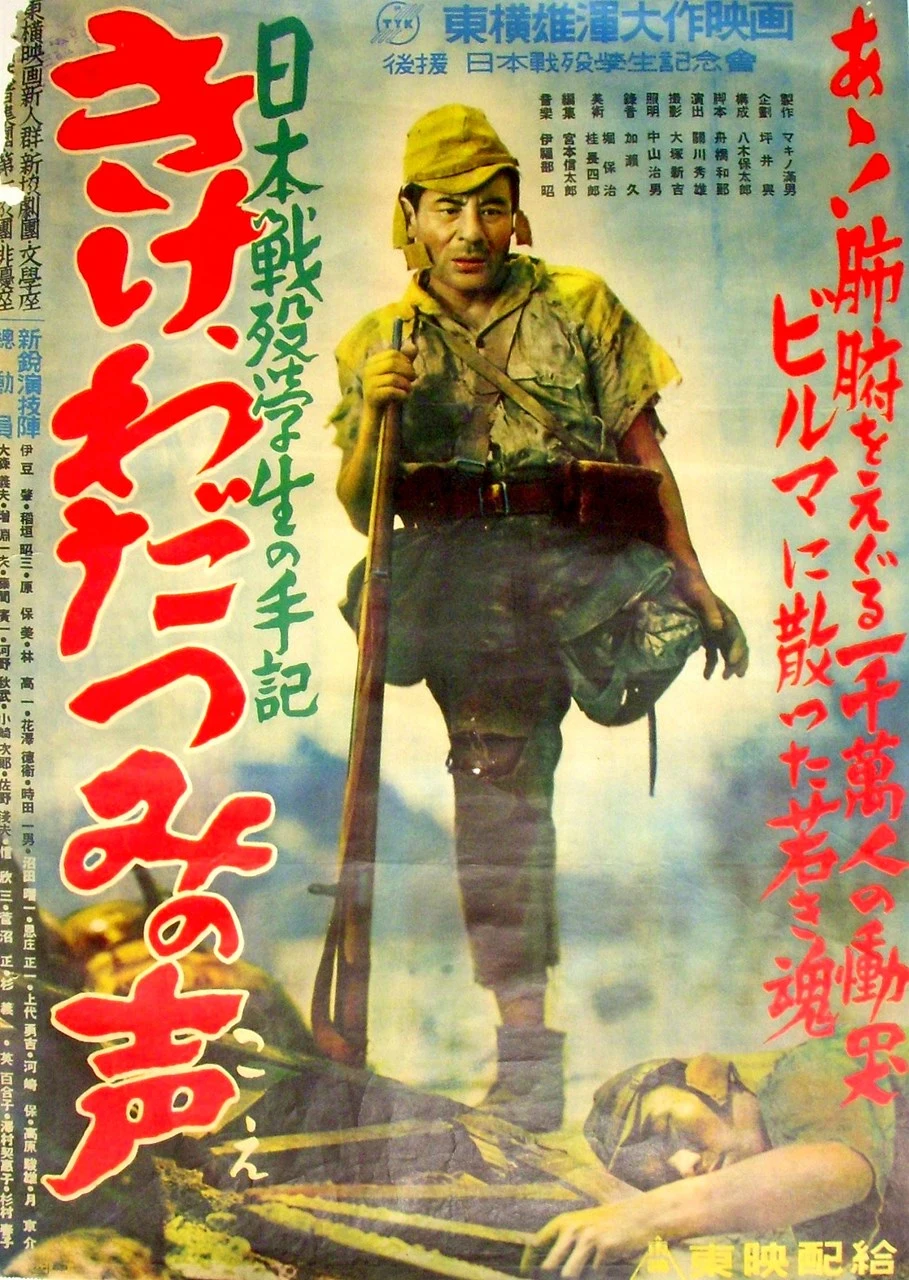
Listen to the Voices of the Sea
(Kike wadatsumi no koe: Nippon senbotsu gakusei shuki; lit.: Listen to the Voice of the Sea: From the Diaries of Japanese Students Who Died in the War)
Direction: Hideo Sekigawa
Screenplay: Kazuo Funahashi
Cinematography: Shinkichi Ōtsuka
Music: Akira Ifukube
Asst. director: Tadahiro Ozawa, Ryōsuke Nagashio
Studio: Toyoko Eiga
Genre: drama, war
Cast: Hajime Izu, Yasumi Hara, Akitake Kôno, Kinzō Shin, Haruko Sugimura, Yuriko Hanabusa, Yōichi Numata, Yukichi Kamishiro, Kôichi Hayashi, Kyosuke Tsuki, Toshio Takahara, Kazuo Tokita, Tokue Hanazawa, Yoshio Ōmori, Shozo Inagaki, Tamotsu Kawasaki, Yoshikazu Sugi
A story based on the diaries of young soldiers, recounting their ordeals and deaths during the Second World War.
Commentary: Kike wadatsumi no koe is a collection of writings by Japanese students who were conscripted into the army and died during the Second World War. The collection was published in 1949, during the period of the country’s occupation. The occupying power — the United States — responded very favourably to all manner of anti-war publications, particularly those which — like Kike… — contained sharp criticism of high-ranking military figures. The publication therefore met with particular approval from the authorities of the time.
The film based on these writings has a clearly anti-war message and focuses largely on the criticism of military commanders who abuse young soldiers, surround themselves with comfort, avoid combat, and convince their subordinates — represented here by students and a university lecturer — that their sacrifices are necessary for the survival of the Japanese empire and its “sacred” emperor. In this way the production condemns both the cynicism of those in power and the widespread phenomenon of bullying within the army, the victims of which were especially the younger and more pacifistically inclined soldiers.
Listen to the Voices of the Sea focuses on young people forcibly conscripted into the army, portraying them in a truly tragic light as the flower of the nation — uprooted and sent to war and death by a state that chose to discard rather than nurture them, and a death devoid of any meaningful purpose at that. Interjections in French, present in the dialogue of the young characters, further underscore their refinement and their symbolic status as an intelligentsia destroyed by military power. They are thus presented as entirely innocent people — unsullied victims rather than cruel perpetrators. Hence, even when they commit morally reprehensible acts, the film’s logic dictates that they should not be held responsible for them; they were, after all, merely instruments in the hands of a higher authority. The young people are treated here as a collective tragic hero, meeting a noble, martyred death, but also the more prosaic fates of hunger and disease. This means that — despite its anti-militarist message — the production ultimately presents Japanese soldiers as victims rather than aggressors, which amounts to an overly simplified and morally convenient portrait of the army. It condemns the officers, the imperial ideology, the abuse of soldiers, and the destruction of the intelligentsia — but in doing so treats the country’s wartime aggression primarily as a tragedy of Japan itself.
6/10

Author of “Panorama of Hong Kong and Taiwan Cinema”, a lover of Asian cinema, action films, and space voyages aboard the starship Enterprise. He once studied Polish philology, and later became a citizen of the NSK State in Time. He has published in Kinomisja, Ekrany, Kultura Liberalna, Torii, Dwutygodnik Kulturalny, and others.