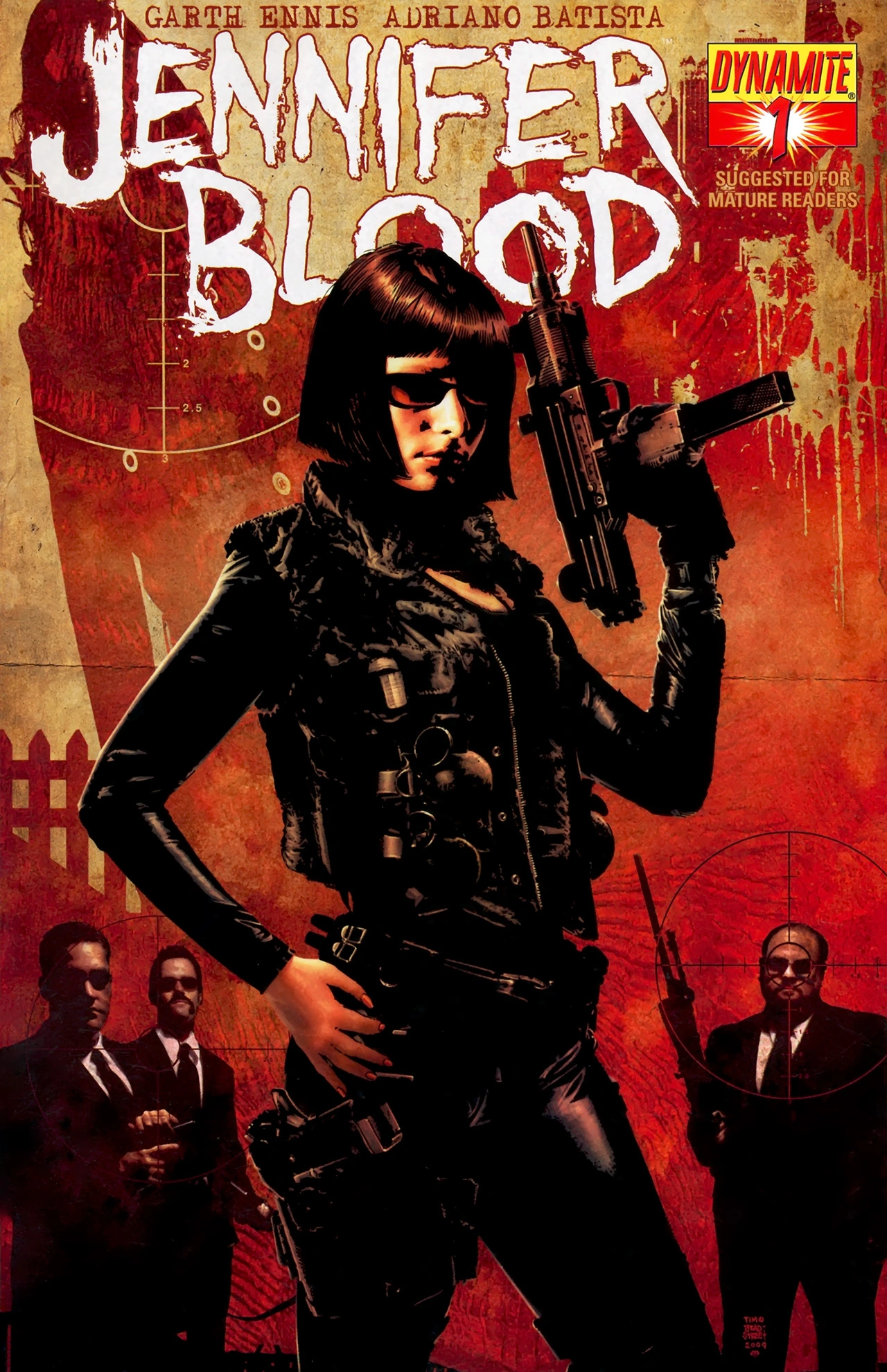
Jennifer Blood #1–6
(Dynamite Entertainment, February–November 2011)
Writer: Garth Ennis
Art: Adriano Batista (#1–2), Adriano Batista and Marcos Marz (#3), Marcos Marz i Kewber Baal (#4), Kewber Baal (#5–6)
Colours: Romulo Fajardo Jr. (#1–4), Inlight Studios (#5–6)
Lettering: Rob Steen (#1–6)
- Issue One: War Journal
- Issue Two: My Heart Will Go On
- Issue Three: Born to Run
- Issue Four: Three Little Girls From School Are We
- Issue Five: Dogfight
- Issue Six: Just To Watch Him Die
Jennifer Blood
#1: War Journal
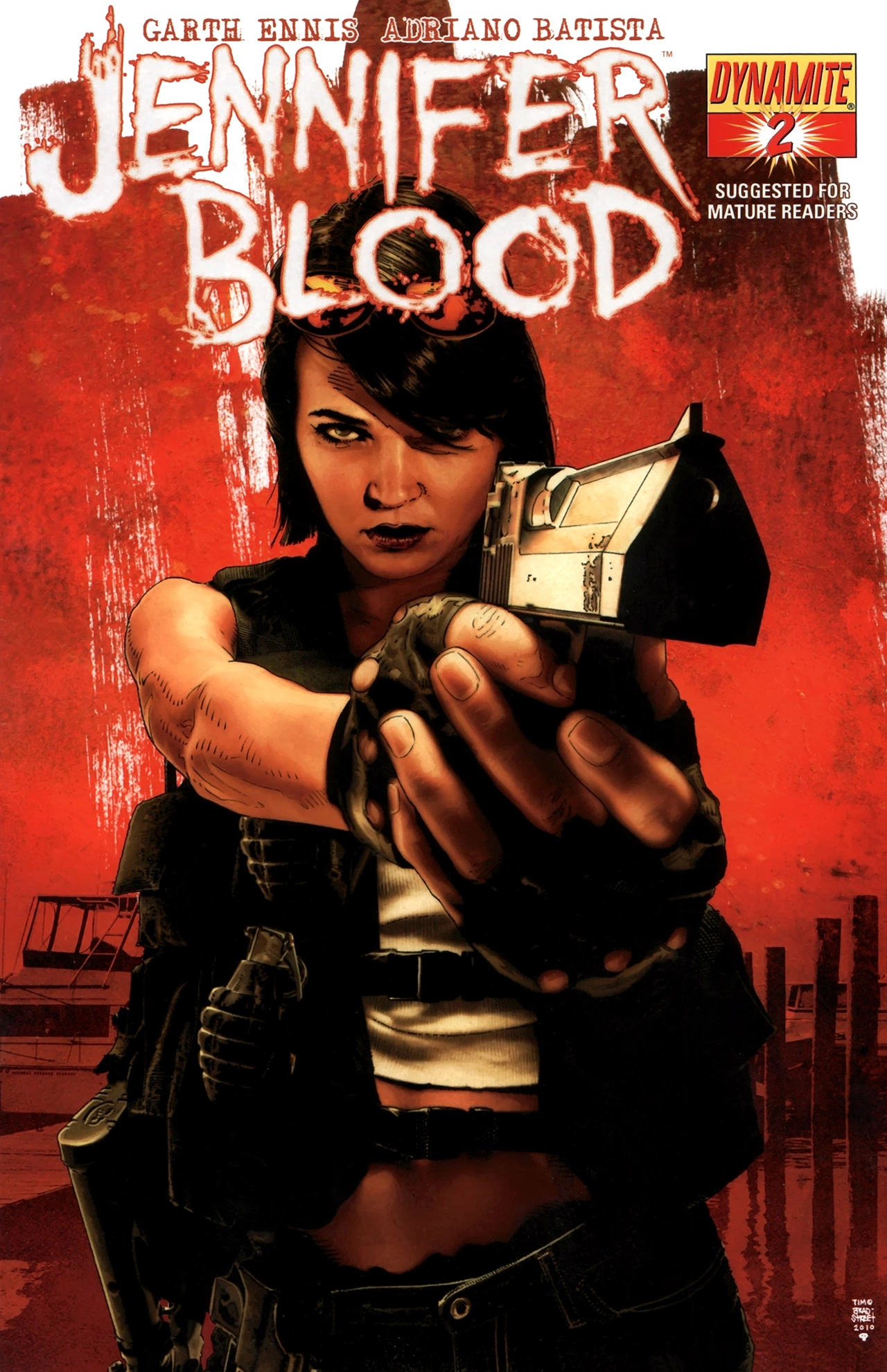
Jennifer Blood, promoted in the media as ‘the Punisher of suburbia’, was created at a time when Garth Ennis was writing increasingly dark stories in the pages of Crossed, Battlefields, The Boys and Wormwood. In his own words, he felt like writing a gruesome, pitch-black and brutally violent comedy. The series therefore begins from a position of absurdity and violence rather than ethical reflection on any particular subject.
The title of the first issue is, of course, the first major joke. War journal is one of the concepts most strongly associated with the Punisher, and even the title of a long-running Marvel series. After his famous work with Frank Castle, Ennis therefore takes the masculine archetype of the comic-book vigilante and places his ‘war journal’ inside a purple-and-pink diary decorated with butterflies. The diary itself is one of the comic’s principal narrative devices. Jennifer writes in it about all manner of aspects of her life: a blouse that came out badly in the wash, environmentally friendly cleaning products, her children’s schoolwork, dinner, buying ammunition and dismembering people. She describes everything in exactly the same tone, immediately revealing that even extreme violence is simply part of her everyday routine.
Her attitude towards violence is also emphasised by her recurring sigh of ‘Honestly’, used to express minor irritation at things such as noticing a stain on the ceiling or botching the disembowelment of someone. Her behaviour is simultaneously grotesque, darkly comic and rather macabre. It establishes that we are dealing with a person who regards even extreme brutality with indifference, which is important because Jennifer Blood is not merely the story of a bestial murderer.
It is also a story about a woman attempting to combine her work—in this case, killing gangsters—with domestic responsibilities, children and marriage. The first six issues of the series, constituting Ennis’s entire run, were collected under the title A Woman’s Work Is Never Done, which itself emphasises the writer’s approach to the subject. The comic is designed to bring together two radically different worlds: exaggerated violence and the boring life of the sunny suburbs. Within all this, Blood emerges as a kind of administrator. She is constantly planning and continually evaluating her own performance, grading both her domestic work and her murderous activities.
An important aspect of the first issue is therefore the fact that the protagonist genuinely likes her family life. She is not a desperate housewife or a woman trapped in an unwanted relationship by her husband and children. Her husband, Andrew, is in fact a likeable man: decent, perhaps a little dull, but also an almost perfect opposite to Jennifer’s nocturnal existence. Her family is therefore not something against which she rebels, but something intended to provide her with shelter after the massacres she secretly commits. She verbalises this herself: ‘Let the day be the day, and the night be the night.’
As the reader might expect, however, such a division proves impossible. In a not particularly surprising development, Ennis shows her violent side gradually bleeding into her family life. She keeps weapons hidden beneath the house, gives her children Valium so that they will not wake up when she goes hunting and, more importantly, an insult she receives during the day causes her to return at night in her Jennifer Blood persona and kill the man who offended her. Contrary to her own words, she is therefore incapable of keeping the two halves of her life separate.
It is precisely this murder, crossing the boundary between ‘night’ and ‘day’, that becomes one of the comic’s most important and disturbing events. Jennifer takes her car to a mechanic, who behaves disgustingly towards her: he touches her without permission, calls her a ‘good girl’, and is clearly using his position to harass and sexually molest his female employee. In short, he is an example of male entitlement. Jennifer returns at night and brutally murders him.
On one level, this obviously functions as a macabre revenge fantasy: a woman no longer has to tolerate sexual harassment or paternalism. Yet it is impossible to deny that the punishment is wildly disproportionate to the offence. This, in turn, demonstrates that Jennifer possesses no normal moral scale. She does not kill only when someone represents a lethal threat, but also because someone has humiliated her. What is more this scene does not transform her into a feminist avenger. Her actions seem to be motivated by personal impulses rather than ideology. All the more so because—as we soon discover—her crusade against gangsters is not driven by a desire to purge the city of criminals, but by a revenge whose precise nature has yet to be revealed at this stage.
When we first meet Jennifer, however, she is not a supremely capable super-assassin. Ennis clearly positions her as someone who is not yet fully experienced and is still developing her skills. She performs inadequate reconnaissance, for example, and fails to anticipate additional security. At the same time, it is equally clear that she is not a complete beginner: she already owns a collection of weapons and knows how to use them effectively, understands the need for reconnaissance and so forth. Her greatest assets in combat are brutality, initiative and luck. There is, of course, a considerable amount of bending realism here, but Ennis’s entire world is exaggerated and grotesquely macabre, so not every fortunate coincidence—fortunate for Blood, at least—produces a negative impression.
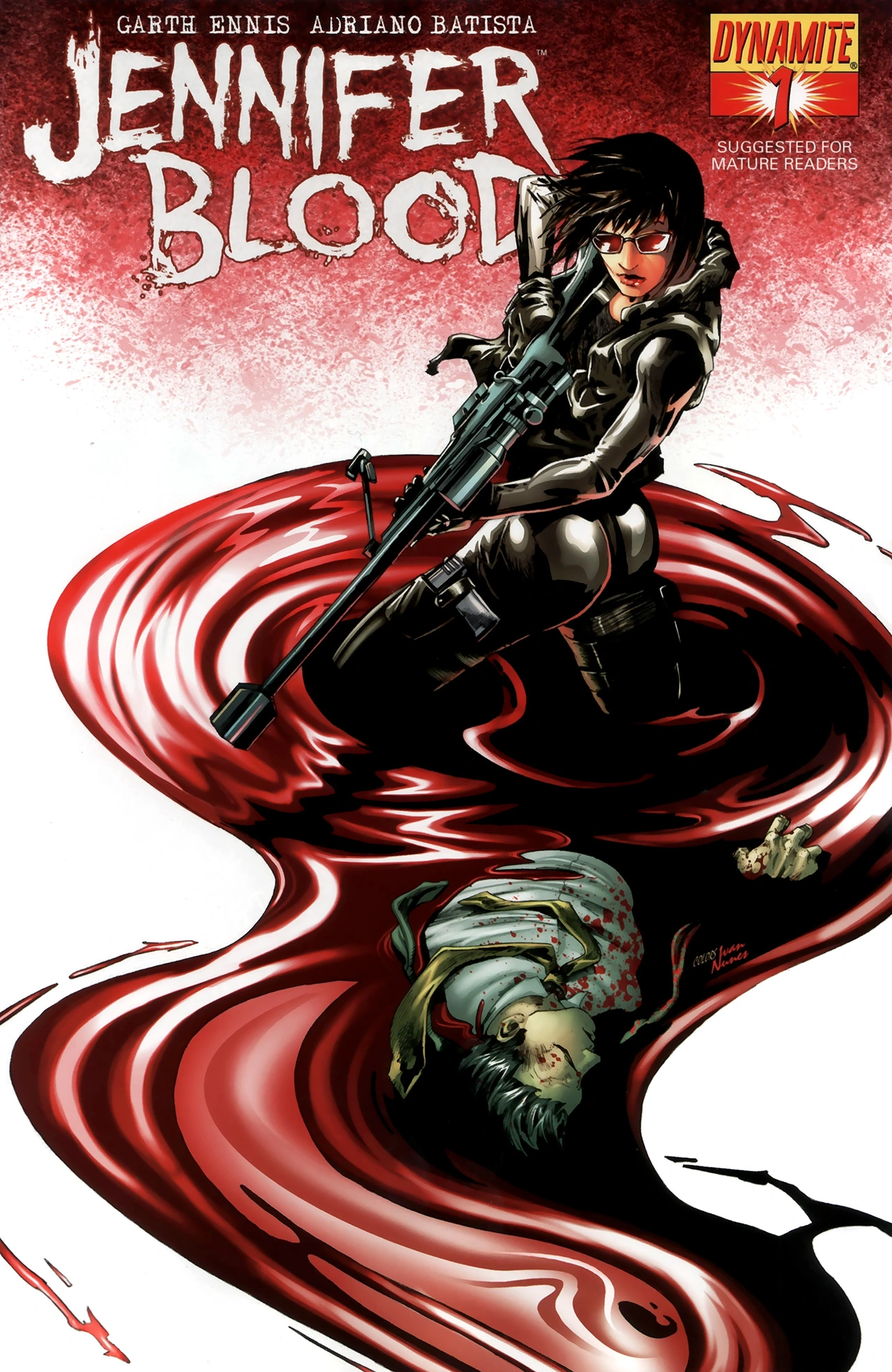
An interesting aspect of the comic, one that accompanies all six issues of Ennis’s run, is its approach to the male gaze. Batista draws Jennifer almost permanently as a pin-up: tight leather clothing, plunging cleavage, shots emphasising her buttocks, garters and countless poses designed to display her body. The design sketches included at the end of the issue are even less ambiguous in this respect. It is difficult to pretend that this is accidental, particularly when Ennis himself says in the accompanying interview that he wanted to have fun with ‘guns, violence and beautiful women’.
The scene in which attackers corner the protagonist beside her car is particularly interesting in this context. Blood deliberately allows them to stare at her breasts, saying: ‘Titties. Take a good look. You know you want to.’ She then exploits their gaze as a distraction. It is almost a textbook example of turning the male gaze against the men themselves: a woman weaponises their own objectification of her.
The problem—or contradiction—is that the comic asks the reader to look at Jennifer in exactly the same way as the men in the scene beside the car. We therefore have, simultaneously, a woman controlling male desire and an erotically oriented depiction of a woman created primarily for a heterosexual male audience.
The comic’s most immediately appealing idea undoubtedly remains that of ‘a housewife by day, the Punisher by night’. It is simple, but unquestionably intriguing, particularly because Jennifer Blood is written with remarkable consistency and approaches domestic chores and mass murder in essentially the same manner.
At the same time, many of the themes and ideas raised by the comic—taking the law into one’s own hands, murdering the mechanic, drugging one’s own children, Blood’s sadistic enjoyment of torture and killing—invite further reflection and uncomfortable questions. For now, however, Ennis treats them almost exclusively as dark gags.
Art
The contrast between Jennifer Blood’s two lives is continued through the colour palette. Her home is dominated by warm beiges, pinks and softer lighting. Jennifer by night, meanwhile, is enclosed within blacks, reds and navy blues, punctuated by orange explosions. During the fight scenes, the page layouts also become more jagged and diagonal.
Batista is considerably better at drawing grotesquerie than subtle scenes or facial expressions. His faces can be exaggerated, his anatomy occasionally stiff, and his choreography is not always clear. On the other hand, mangled gangsters, blood, explosions and the contrast between the beautiful Jennifer and hideous men suit him perfectly. This is, in itself, somewhat ideological: the visual world of the comic positions us on her side. She is beautiful; the men—with the exception of Andrew—are grotesque.
Bonus Observations
- Andrew, Blood’s husband, wants to go and photograph a peregrine falcon that he saw while duck hunting. This may simply be a random piece of dialogue, but it seems too precisely placed to be entirely accidental. Andrew is observing a bird of prey while a ‘predator’ of whose existence he has no idea is living under his own roof.
- In the beauty-salon scene, Jennifer reads Guns & Ammo and becomes irritated by discussions about 9mm, .38 and .45 ammunition. This is not merely information establishing that she knows her weapons. It is a reference to the broader world of American gun culture: debates about stopping power, magazine capacity, Glocks, Berettas, SIGs, Heckler & Kochs and so forth.
Jennifer Blood
#2: My Heart Will Go On
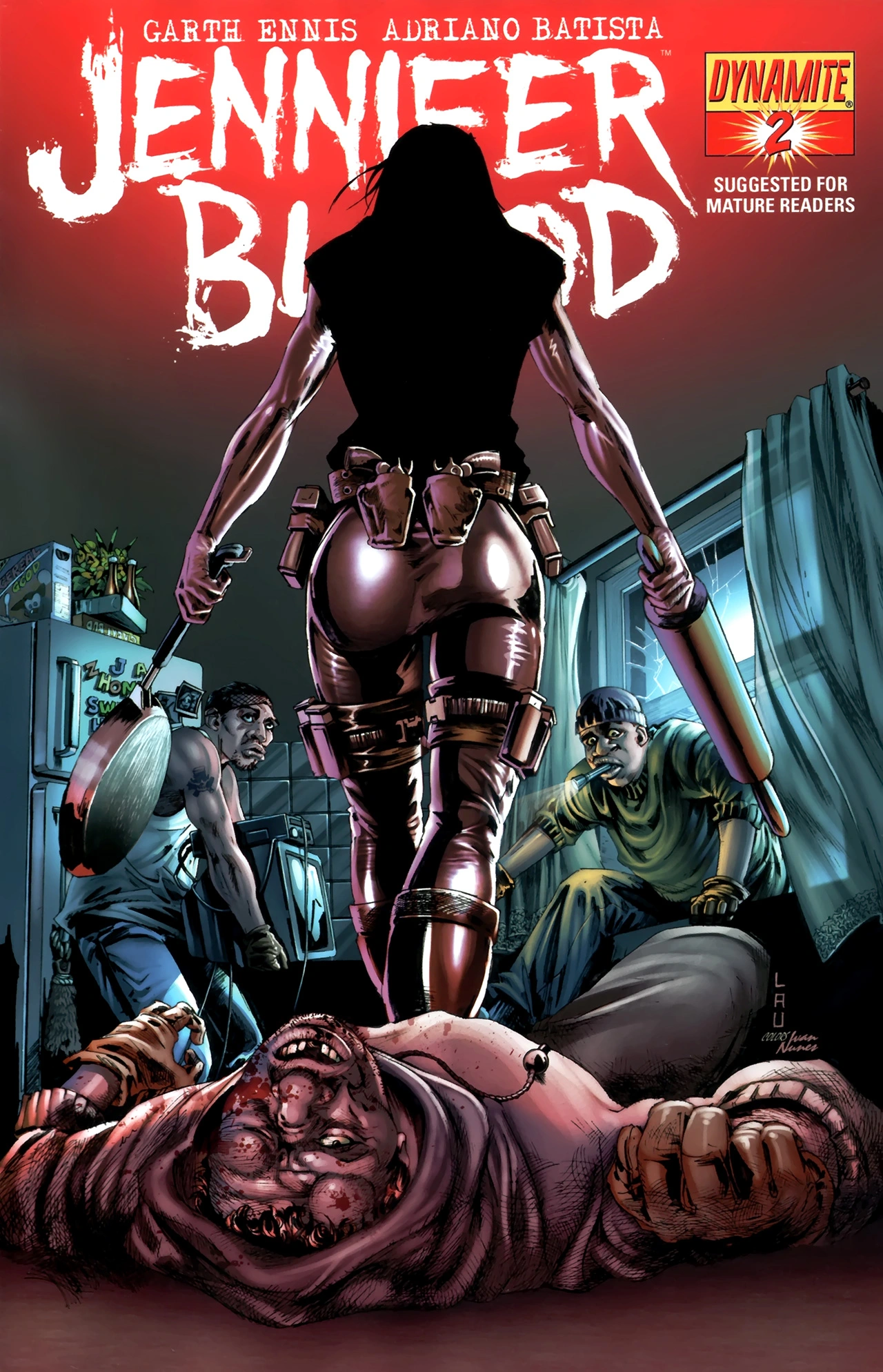
The title of the issue comes from Céline Dion’s famous song from Titanic. The very first page confirms the reference, functioning as a brutal parody of James Cameron’s film. Standing naked at the bow of a yacht are an obese man and an attractive woman. The man, however, is clearly abusing his partner. In other words, Ennis creates a violent—both physically and sexually—parody of a classic romantic film.
Alongside its maritime grotesquerie, the second issue continues the motif of the ‘day’ and ‘night’ sides of Jennifer’s life bleeding into one another. She uses her husband’s binoculars for reconnaissance, forgets to prepare lunch, and television news reports about her massacre bring the violence she has committed—although for now only symbolically—into her home.
Ennis also develops several other motifs introduced in the first issue. As a result, this second encounter with the series feels less fresh, but provides a more fully developed portrait of both the protagonist and the world around her. We see, for example, Jennifer creating ‘recipes’ for mass murder, written in the style of cookery recipes. This idea serves two purposes. Firstly, it functions as part of Jennifer Blood’s characteristic black humour. The stereotype of a woman cleaning up after a man is extended into cleaning up men’s corpses.
Secondly, it further develops the psychological portrait of the title character. Jennifer continues grading her own work, assigning herself scores on a ten-point scale for particular tasks. In the process, however, she reveals herself as someone almost entirely devoid of morality. When she drugs her children, for example, what she evaluates in her diary is not whether she should be doing such a thing or whether it is morally acceptable, but whether she administered the correct dose to ensure that they would not wake up during her nocturnal activities. She evaluates fights with her opponents in exactly the same way: in terms of how efficiently she kills, rather than how many people she has killed. This pushes Blood even further away from any possibility of treating her as a positive character.
I think this is therefore a good point at which to pause and consider the symbolism of her alias. Jennifer Blood is obviously not the character’s real name, but an identity she adopts when she puts on a tight outfit and wig to murder and torture her enemies. During the day, while living her carefree family life, she is Jen Fellows. In this context, ‘Blood’ is a simple way of inspiring fear in her enemies, but also a kind of expression of her own violence and sadism.
Blood is also connected with blood ties—with family. Jennifer has two families. There is her new family: her husband Andrew and their two children, Alice and Mark. And there is her old family: the gangsters she calls her uncles. Her mission is to destroy her biological family so that she can—at least in theory—preserve her new one. Yet if she had never attacked her uncles in the first place, her current family would not be in any danger at all. This therefore suggests that her actions are motivated by her own desire for revenge—and for killing—and that she is lying to herself about her true motivations.
Her alias also gradually rises to the level of a symbol, even a legend. In the second issue, the protagonist uses the blood of those she has defeated to create the words JENNIFER BLOOD. Much like the classic superhero motif of Batman’s bat or the Punisher’s skull, she too creates a symbol designed to strike fear into the hearts of her enemies: the word Blood itself, written in the blood of the people she has murdered.
The second issue also confirms how difficult it is to interpret Blood in feminist terms. The two people featured on the comic’s opening page are Steve, the gangster Jennifer is hunting, and Renee. We know very little about Renee, except that she most likely lived in an environment saturated with sexual violence. Men talk about her as if she were merchandise, sexually humiliate her, and there is even a suggestion of past pimping. Renee herself says that she had to provide sexual services in order to survive. When Jennifer finally catches Steve, Renee virtually begs her: ‘I didn’t know about it, I had nothing to do with it.’ We do not know whether she is lying, and neither does Blood. But Blood does not care in the slightest and allows her to die. For the protagonist, what matters is her mission and her own sense of pride. If someone has treated her badly or has simply happened to find themselves too close to her enemies, she has no qualms about killing that person regardless of their sex.
Art
Batista still has a tendency towards grotesque faces and occasionally rather stiff anatomy, but the maritime setting suits him very well. Particularly effective are the nocturnal blues and greens contrasted with the yacht’s orange lighting, the images of Jennifer’s silhouette while swimming and infiltrating the vessel, the large underwater page, Jennifer Blood’s bloody flag and the sniper shots presented from an extreme distance.
The tonal symmetry also works well here. The beginning is bright, sunny, almost holiday-like and sexual, while the second half descends into night, water and darkness. The most striking image, however, is the full-page illustration of Steve and Renee underwater. Batista transforms their deaths into something almost romantic, bringing the Titanic parody full circle.
Bonus Observations
- In one scene, Jennifer talks to her husband about their son. Andrew suggests that Mark may be autistic. Leaving aside the fact that Ennis approaches autism in a stereotypical and—to put it gently—amateurish manner, the scene functions as another expression of the fact that Jennifer is performing a role even within her family life and is not being honest. She thinks badly of her own son while being fully aware that doing so makes her a bad mother: ‘Of course I’m a terrible mother for even thinking that…’ Jennifer understands social norms, but is incapable of truly existing within them. No matter how much she lies to herself, her family life is simply another mask.
- The issue introduces the neighbour Jack, whom the protagonist interprets as a threat. He is also someone who observes Jennifer, continuing the motif of pervasive surveillance established across the first two issues of the series.
- The comic’s approach to the male gaze remains unchanged. The story tells us, for example, that men objectify Renee. At the same time, the comic itself presents her primarily through large breasts, sex and revealing clothing. Is it therefore genuinely criticising sexual objectification, or merely allowing bad men to say aloud what the comic itself is doing visually? The answer is: both.
Jennifer Blood
#3: Born to Run
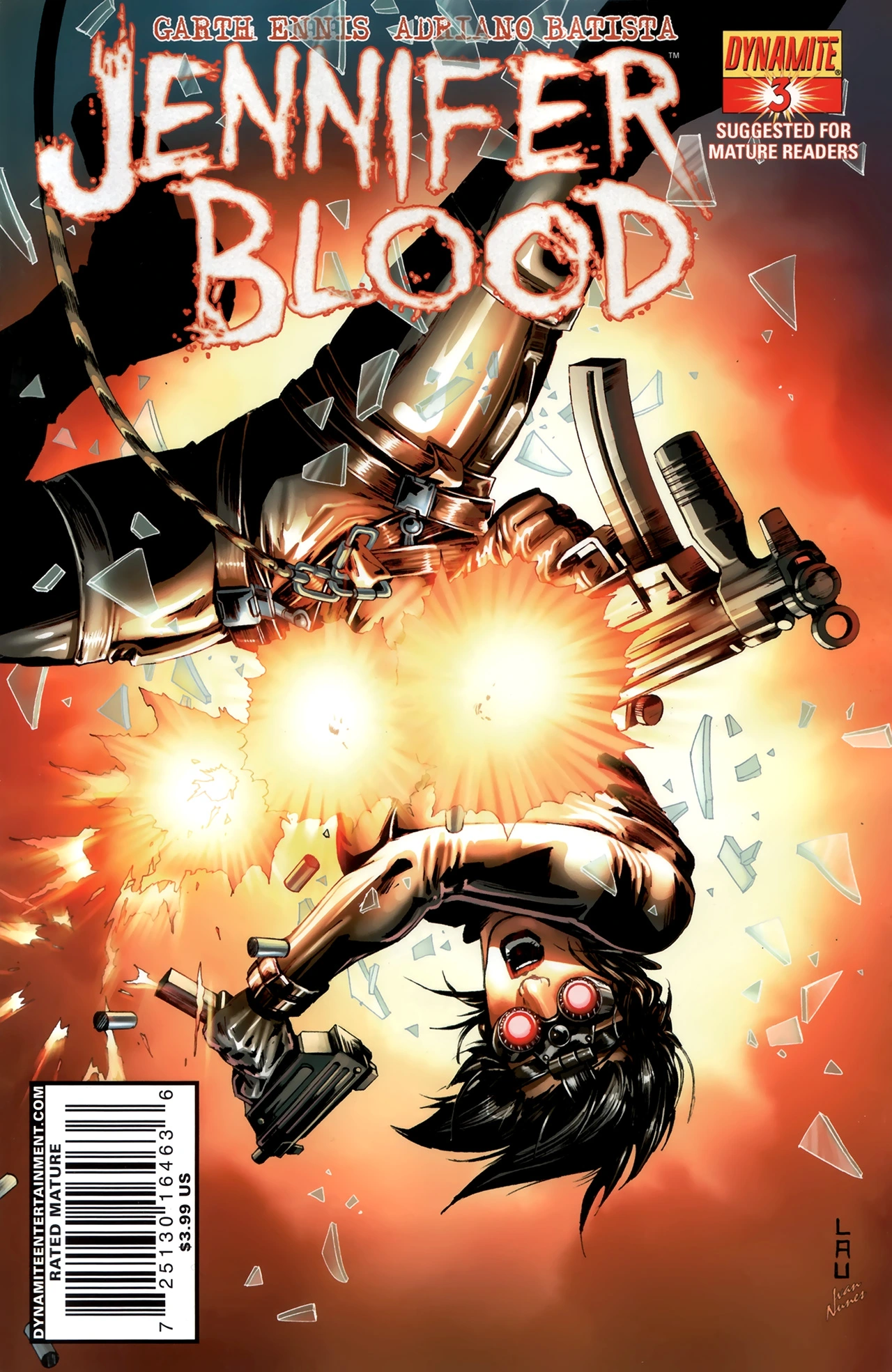
The title of the issue most likely refers to Bruce Springsteen’s song, which is about escape and cars, but also juxtaposes two sides of life: day and night, much like Jennifer’s own existence is divided. Yet she is not the one trying to escape here. The fugitive is Nick, the third of the uncles hunted by the protagonist. He considers himself cleverer than the others, gets into a car and flees along back roads towards Canada. But can he outsmart Blood? And is the family SUV really better than a sporty, ‘masculine’ car?*
The confrontation with Jack, Jen Fellows’s new neighbour, is particularly interesting. Unsurprisingly, he turns out to be yet another rotten man: misogynistic, crude and eager to harass women. The problem is that during a neighbourhood gathering the protagonist cannot simply kill him. She therefore takes the opposite approach and slips into the role of a stereotypical woman, pretending to be frightened by a mouse. This draws other people into the room and, at least temporarily, restrains Jack’s advances.
Ennis continues the motif of observation and of adopting roles in order to deceive those who are watching. Andrew watching birds and Jennifer watching gangsters have already become recurring elements of the series. Now Jack’s voyeurism is added to them.
He is a classic example of the kind of man who watches pornography, interprets women’s smiles as sexual invitations and believes they should beg him for sex and thank him if he deigns to agree. His sexual and voyeuristic impulses eventually lead to a genuine violation of Jen Fellows’s privacy when, one night, he sees her dressed as Jennifer Blood.
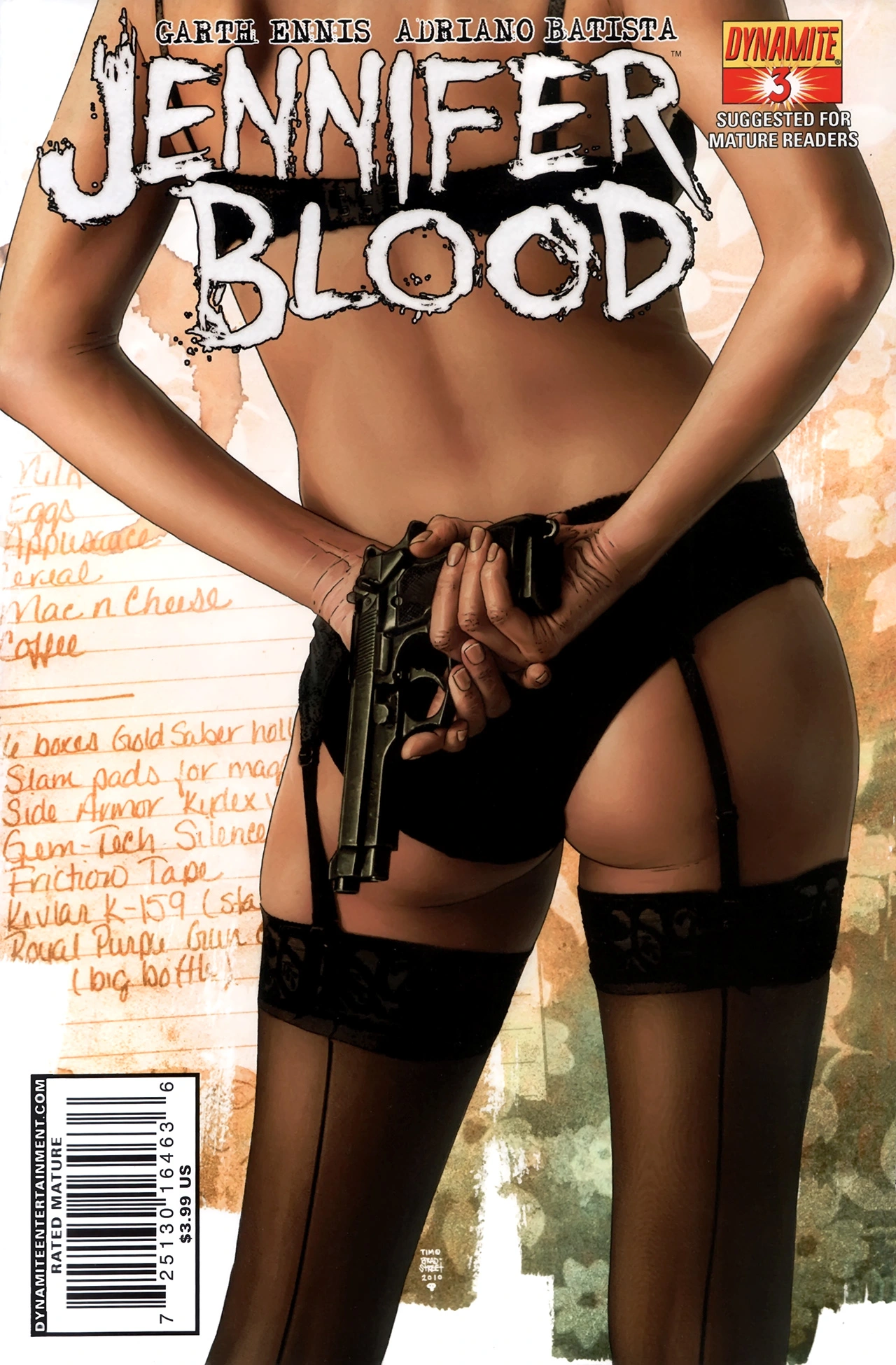
But, as before, the comic simultaneously shows us a disgusting man reducing the protagonist to a sexual object while selling the reader essentially the same perspective. One of the issue’s covers literally focuses on Jennifer’s buttocks as she poses in nothing but lingerie and stockings, with a pistol between her legs. The discrepancy between the comic’s marketing and its actual content can therefore become rather grotesque, particularly in the third issue, which critically depicts Jack’s pornographic hobby.
Another person looking through women—although this time through female assassins—is Pete, another of Jennifer’s gangster enemies. He hires a group of girls called the Ninjettes to help him. They are presented as attractive young women in stylised schoolgirl-ninja costumes. This is an obvious fetishisation of teenage imagery, drawing upon the pop-cultural image of the Japanese schoolgirl combined with the Western stereotype of the ninja. In the case of the Ninjettes, however, the parodic nature of the group is clearly visible, mocking their sexualisation while simultaneously exploiting it.
The third issue also advances the main plot considerably, particularly the storyline concerning Jennifer’s relationship with her biological family and her mission of revenge. I will not spoil the surprise for anyone—although the idea is hardly especially original—but I will mention that it involves the possible existence of a third, earlier identity belonging to the woman. This storyline, which will hardly come as a major surprise either, begins to show that Jennifer and the uncles she is hunting are not actually so different from one another.
As one would expect from Ennis, the comic also contains plenty of gore. In another burst of creativity, Jennifer leaves yet another message for her enemies, this time not in blood but in intestines. Besides functioning as part of the black humour permeating the world of Jennifer Blood, each such act increasingly reveals the title character as a serial killer constructing her own legend.
Art
The artwork in this issue is by Adriano Batista and Marcos Marz, which probably explains some of the differences in faces and anatomy. The comic still does not feature especially subtle facial expressions or naturalistic depictions of its characters. Quite the opposite: at times they are grotesquely exaggerated.
Compositionally, however, the third issue is quite successful. The opening image of Jack’s enormous black silhouette looming over Jennifer effectively conveys his intrusion into her private space. Jennifer’s fantasy of killing Jack is submerged in red, like Jennifer Blood momentarily breaking through the floral-patterned dress of Jen Fellows. The sequence in which Nick is observed uses binocular-shaped panels. After Nick’s accident, both he and the subsequent frames are turned upside down: his world has literally been overturned. And the sequence involving Jack, moving from the pornography on his screen to the window containing Jennifer’s silhouette and finally to her face, is an effective way of showing how the gears in his mind operate, as well as conveying the violation of her privacy without the need for dialogue.
Bonus Observations
- In a 2011 interview, Ennis said that one of the inspirations behind the comic was Weeds—a television series in which a suburban housewife leads a secret criminal life—and that he wanted to apply a similar structure to the murderous Blood.
- Jennifer genuinely likes her neighbour Emily. Yet she consciously avoids becoming friends with her so as not to endanger her murderous activities. Her secret deprives her of the possibility of forming friendships, once again confirming that the identity of Jen Fellows is largely a performance that requires constant suppression and makes genuine relationships with anyone impossible.
- Through Nick, the comic introduces a reference to antisemitism, Nazism and the Second World War, suggesting that the consequences of the war continue to affect the contemporary world and even the Blute family Jennifer is hunting.
*Yes—if it has been converted into a combat vehicle. Then the symbol of suburban motherhood can effortlessly ram straight through a masculine automotive fantasy.
Jennifer Blood
#4: Three Little Girls From School Are We
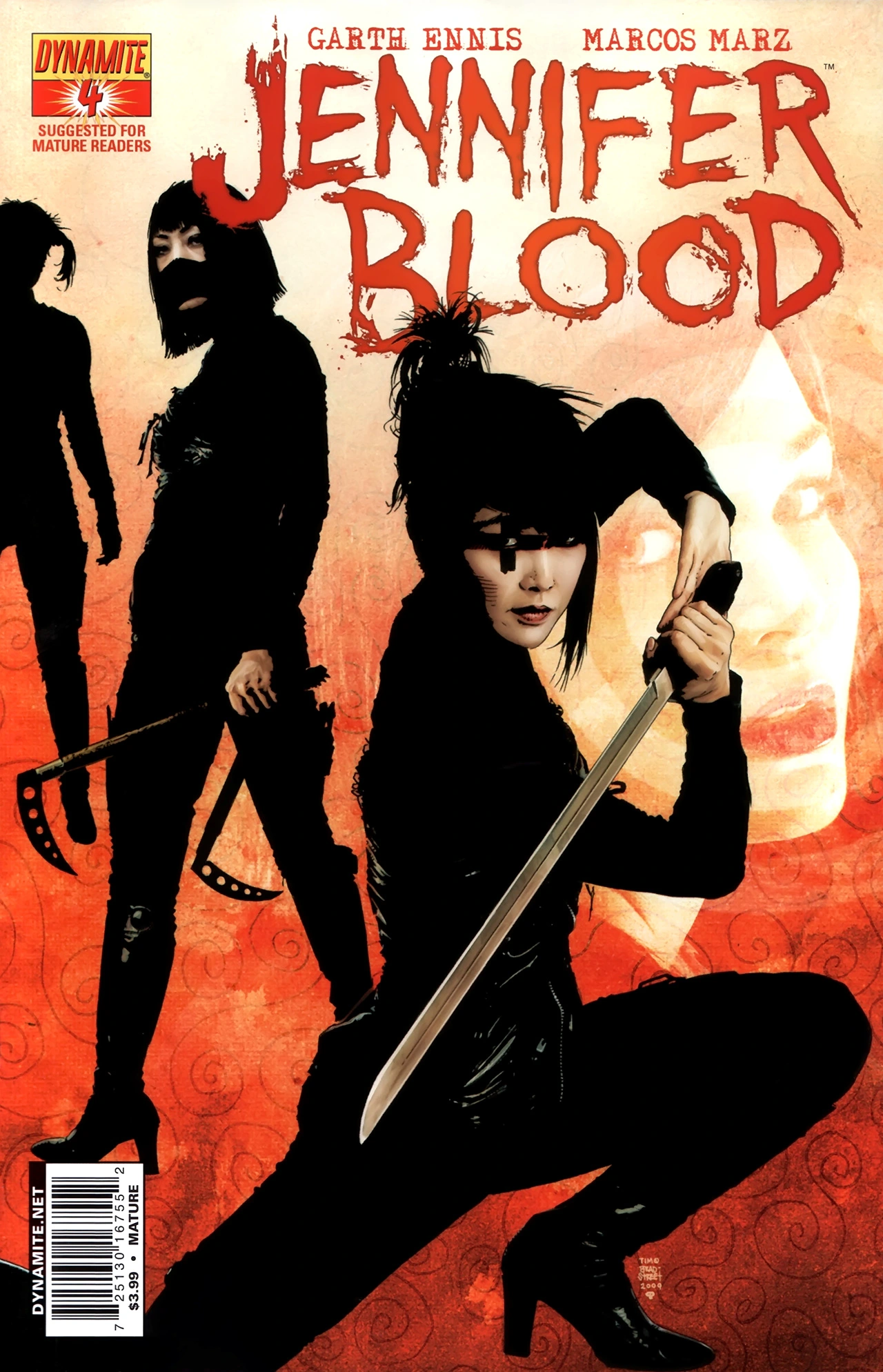
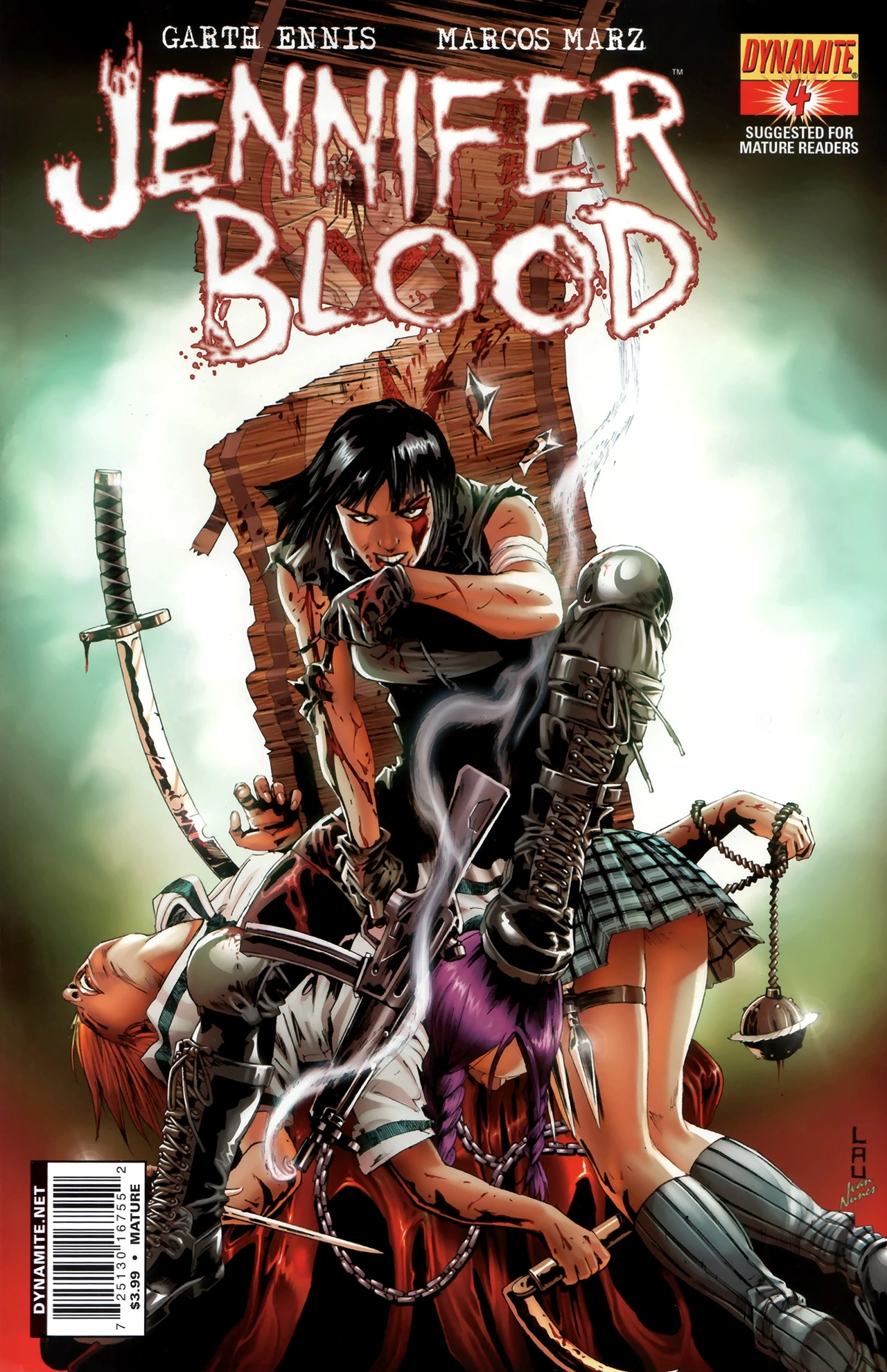
The title of the next issue alludes to ‘Three Little Maids from School Are We’ from Gilbert and Sullivan’s 1885 The Mikado, a trio sung by Yum-Yum, Pitti-Sing and Peep-Bo. The Mikado was a Western fantasy of Japan. Gilbert used an exotic, imaginary Japan as a vehicle for satirising the society and institutions of Victorian Britain. Its pseudo-Japanese names, costumes and imagery later became classic examples of Orientalist stereotyping.
Ennis refers to this through the Ninjettes, the group introduced in the previous issue. His trio consists of Kiki, Suki and Taki, who wear sexualised school uniforms and ninja masks and speak to clients in a bizarre form of ‘Japanese English’. When they are alone, however, they speak normally as Kelly, Chelsea and Skyler. The girls consciously perform a Western stereotype of Japan—explicitly calling it ‘racial stereotyping’ and ‘racist, sexist bullshit’—because the image sells extremely well.
It is not difficult to see that Ennis is mocking blind fascination with Japanese pop culture and its fetishisation. He also includes quite a few references to The Mikado in his presentation of the Ninjettes. In dialogue, they say ‘yummy, yummy!’, most likely an allusion to Yum-Yum. They also talk about a list of people to kill, which may be a reference to Ko-Ko, the Lord High Executioner in The Mikado, who has his own list of people to be eliminated. In other words, Ennis presents Japan in Western media as a marketing costume rather than an expression of any sincere interest in the country.
The Ninjettes also constitute, to some extent, a variation on Jennifer herself. They too exploit female stereotypes for their own purposes, possess alternative sexualised alter egos and consciously manipulate the people around them.
More than a variation on Jennifer, however, the Ninjettes are part of the comic’s grotesque world. It contains the circuit, a network connecting freelance killers with potential employers. Within this marketplace, Jennifer operates independently. Interestingly—and in a typical example of Ennis’s black humour—the girls decide to become contract killers because they want to earn their own money rather than live on their parents’ allowances while waiting for access to their trust funds. They are therefore three privileged young women from wealthy families who kill in the name of economic independence. This may be satire on capitalism, but also on modern entrepreneurship. The Ninjettes speak the language of young people launching a start-up. In this world, morality does not matter; what matters is a catchy brand and profit. And the fact that their business happens to involve murdering people? That is apparently completely irrelevant.
Yet Ennis manages to extract even more from the Ninjettes. Their confrontation with Jennifer Blood reveals different approaches to feminism.
The girls recognise the sexism of pop culture, society and so forth, and decide to reproduce it, monetise it and exploit it for their own benefit. Jennifer, meanwhile, believes that an emancipated woman does not need male indulgence or sexual manipulation—an attitude that is somewhat hypocritical on her part—but should simply be better at her job than men are.
More importantly, however, in terms of the presentation of the title character, Ennis makes it increasingly difficult to read her as a feminist heroine taking revenge upon the patriarchal order. Such an interpretation was already problematic—see Renee’s death—but in the fourth issue Blood deliberately breaks a promise made to another woman and kills her in cold blood once she is no longer useful. Jennifer is dishonest, possesses no sense of honour and feels no solidarity with other women. For her, everything is simply another tool in her mission to exterminate anyone she perceives as an enemy.
The fourth issue also reveals to the reader the protagonist’s original—and perhaps only genuine—identity. Once again, I will not spoil the surprise, but it is worth mentioning that this provides final confirmation that the Jen Fellows persona was never entirely real, apart from her feelings for her husband and children.
The comic also contains references to Willard Motley’s novel Knock on Any Door and Nicholas Ray’s 1949 film adaptation, as well as to Gladiator, before ending with the return of the male gaze in the form of Jack. Paradoxically, sexual objectification becomes a means of discovering the truth. But what if the truth does not bring liberation?
The fourth issue also continues the motif of Jennifer’s physical problems. Being a mother and wife by day and a serial killer by night is finally beginning to result in physical exhaustion, concentration problems and errors of judgement. These problems affect not only her mission but also her everyday life, further demonstrating that keeping her two identities separate is impossible.
Art
The fourth issue appeared after a break of approximately four months and constitutes something of a visual reset. In my view, it is also the point at which the series itself became more interesting.
Batista had a heavier line, grotesque faces and somewhat clumsy anatomy, but his violence was effective. Marz, with Baal’s inks, uses clean contours and smooth faces, giving Jennifer greater elegance while also turning her even more decisively, on a visual level, into a ‘pin-up girl’. But I have already discussed the male gaze at length, so I will not repeat myself too much.
One might ask whether the new artist is better. Personally, I find the artwork clearer while also being more detailed, which is a major advantage for me. Unfortunately, this does not translate into the depictions of violence. Batista was more exaggerated, which suited the grotesque world created by Ennis more effectively.
Bonus Observations
- The comic mocks the Ninjettes’ weapons, such as their katanas. The girls have absolutely no chance against Jennifer, which functions as a critique of the use of bladed weapons in pop culture, where a warrior with a sword can often defeat opponents armed with considerably more effective weapons. It is a classic example of the demythologisation of pop-cultural tropes that Ennis enjoys so much.
- For the first time, Jennifer asks herself whether drugging her family is wrong. She immediately reassures herself, however, that compared with torture, disembowelment and murder, it is not really that terrible. On the other hand, during the day she often proves to be a caring mother.
- We learn in this issue that the patriarch of the Blute crime family handed people over to the Germans during the Second World War and was involved, to some extent, in pogroms. Some contemporary members of the family also display antisemitism, while one of the gangsters Jennifer fights is named Goldhagen. Given the Nazi and Jewish context, the surname is probably not accidental. Daniel Jonah Goldhagen wrote the famous and highly controversial 1996 book Hitler’s Willing Executioners: Ordinary Germans and the Holocaust, which deals, among other things, with the participation of ordinary Germans in the murder of Jews and the significance of antisemitism. I cannot be certain that Ennis is actually referring to him, but there is a good deal to suggest that he is.
Jennifer Blood
#5: Dogfight
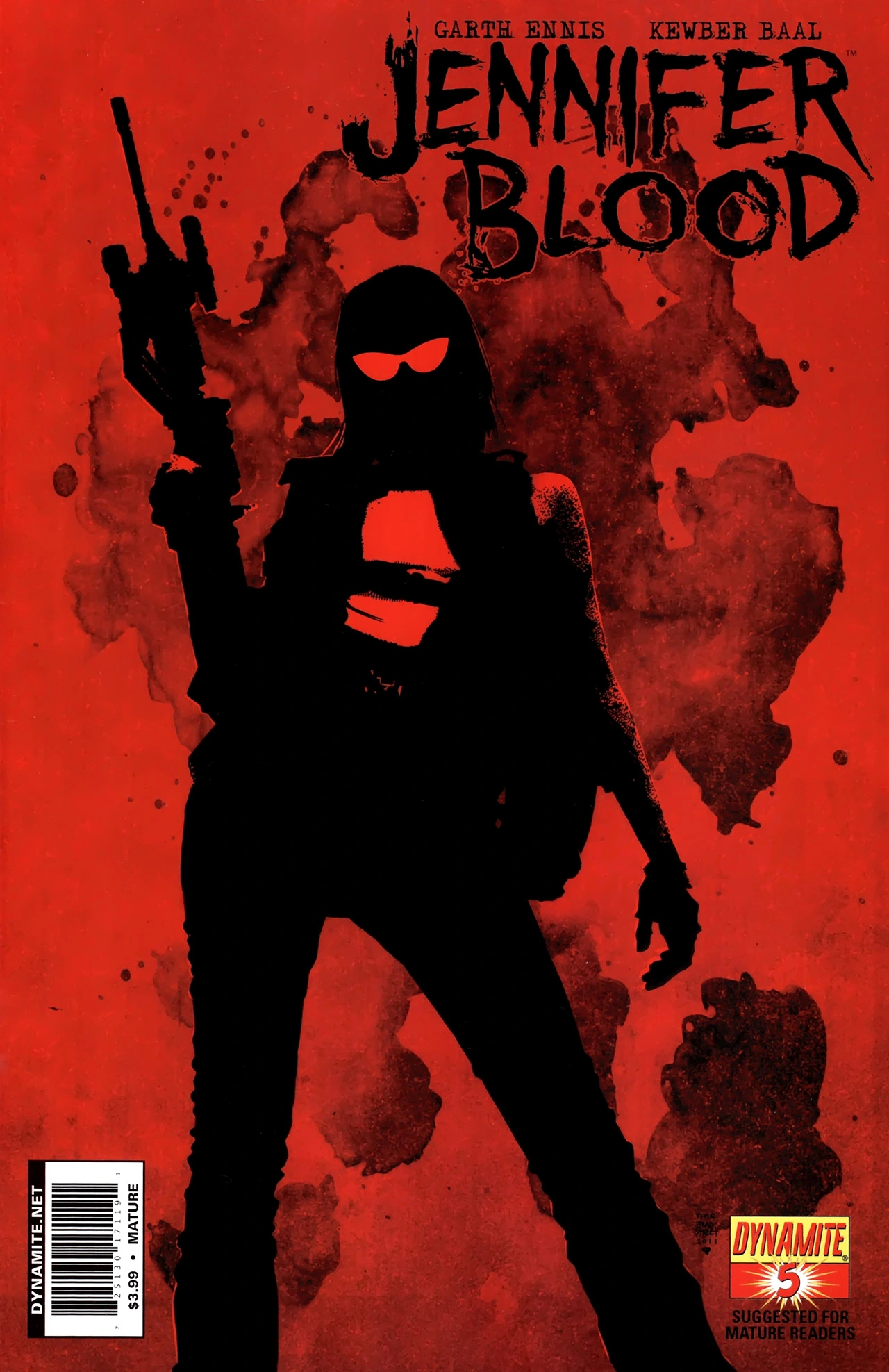
Jimmy—another of Jennifer’s uncles—runs dogfights. In other words, he turns dogs into killing machines. The Blutes, meanwhile, operate like a brutal pack, while Jennifer herself was also trained to become a killing machine, completing the allegory contained in the title. In the penultimate issue of the first story arc, and of Garth Ennis’s run as a whole, the violence reaches its peak.
Alongside the violence, Jennifer’s exhaustion also intensifies, causing her mind to drift into memories and allowing readers to learn more about her past. Among these revelations is an explanation for her obsessive desire to keep her two worlds separate: night and day, violence and family. In reality, the idea did not originate with Jennifer at all, but with her mother. The protagonist, despite fighting against her family, is therefore a product of it and ultimately incapable of freeing herself from its influence. This is perhaps the bleakest—if entirely predictable—idea in the comic. Jennifer’s behaviour begins to resemble a classic mechanism of repeating family trauma: a person attempts to construct the opposite of their childhood, yet unconsciously reproduces its structure. This also opens the door to the theme of intergenerational inheritance of violence and casts a shadow over the future of Jennifer’s own children.
The fifth issue is also interesting because Jimmy is the first of the uncles to fight the protagonist psychologically. When the confrontation finally takes place, Ennis transforms it into a session of family psychoanalysis conducted by an absolute monster. This, in turn, is tied to the final explanation of what—and whom—Jennifer is avenging. The closer she comes to the end of her mission, the more she sinks into blind fury and the less she pretends that killing does not give her sadistic pleasure. Even keeping her diary begins to seem like an unnecessary activity.
Until now, the diary has served to impose order upon chaos: describing, evaluating and rationalising her own actions. But the rage and violence of her confrontation with Jimmy cannot be converted quite so easily into another report on a job completed.
Issue five is the most moving and emotionally affecting instalment so far, particularly during the flashback depicting the life of Jennifer’s mother and her uncles, above all Uncle Pete, whom she has reserved as her final target. Ennis presents a fairly complex picture of life within a Mafia family, where even the victims are not entirely innocent. It is a world devoid of innocence, while simultaneously functioning as a warning that once someone enters a life of crime, it becomes impossible to keep the home untouched by it.
As a result, Jennifer Blood is no longer merely a story about a woman leading two lives. It is also a story about inherited violence, family mechanisms of repression, and an attempt to build an ideal family using precisely the same psychological tools that destroyed the previous one.
Art
This is the first issue drawn entirely by Kewber Baal. His style works much better here: it is heavier and makes use of deeper shadows. Jimmy looks powerful and ugly, the dogs feel genuinely animalistic, and the massacre depicted in the flashback can be visually repellent.
The transitions in colour also work well. The past is desaturated for most of the issue, almost archival in appearance, while the present-day revenge burns in oranges and reds.
Bonus Observations
- The strange sexualisation continues. One panel, for example, depicts an addicted, psychologically broken woman who was probably sexually abused. Yet the artwork exposes her naked body in a highly eroticised manner. The comic frequently discusses sexual violence, objectification and male domination while simultaneously sexualising women in its visual language. In issue five, this feels considerably more uncomfortable than it did with the Ninjettes, because the context is no longer comedic.
- Jack continues spying on Jennifer. Except that now he is doing it professionally.
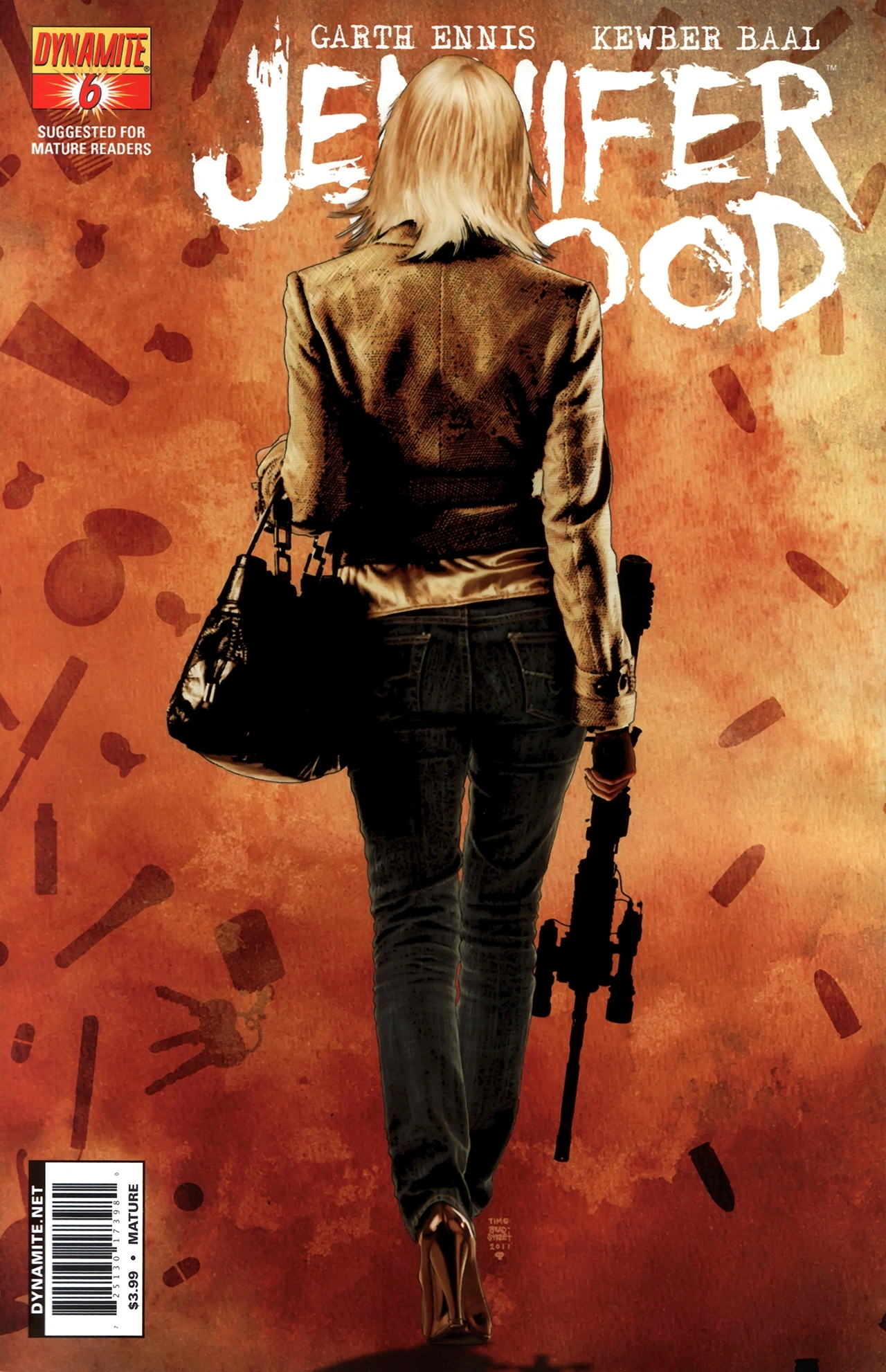
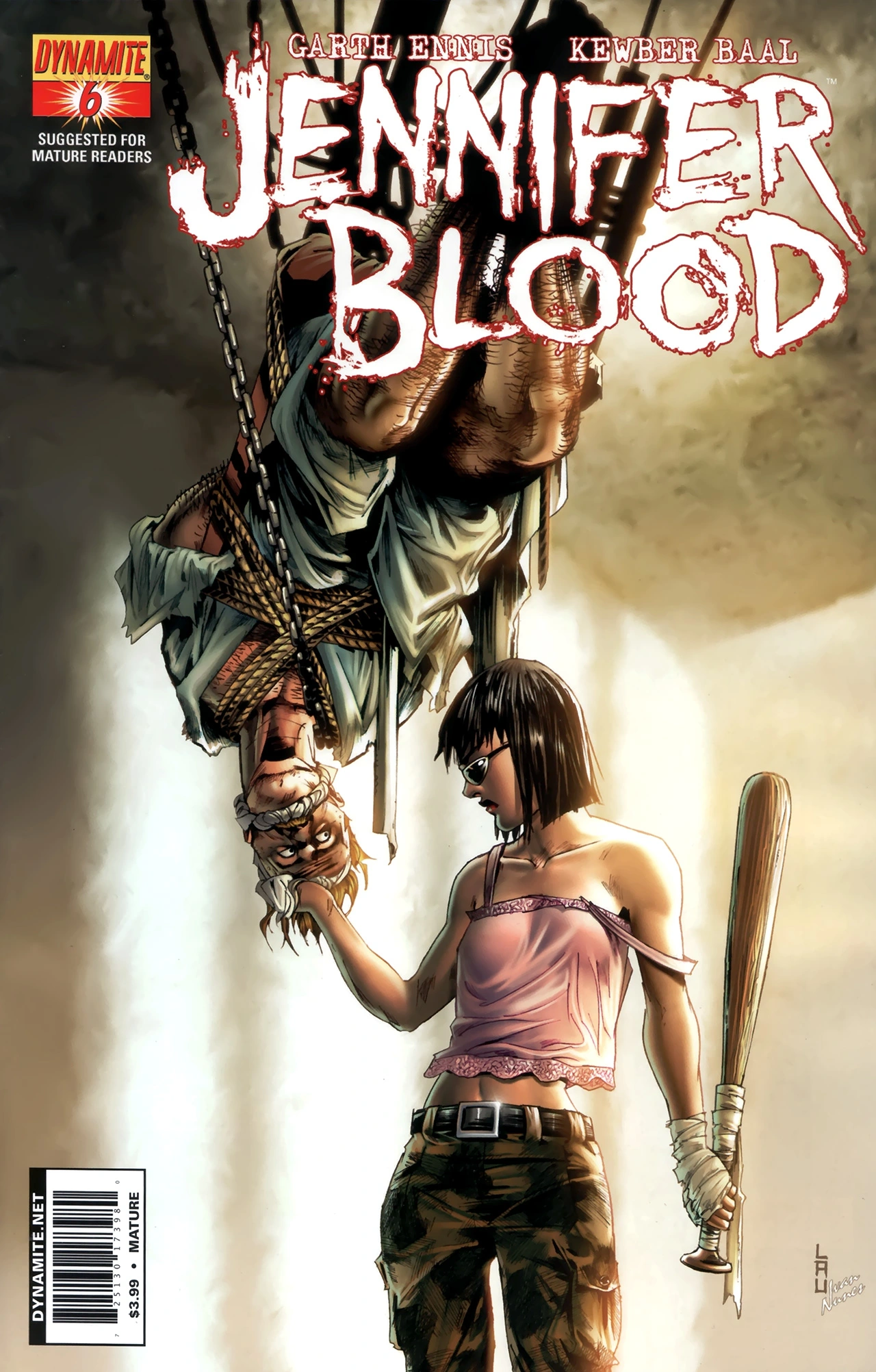
Jennifer Blood
#6: Just to Watch Him Die
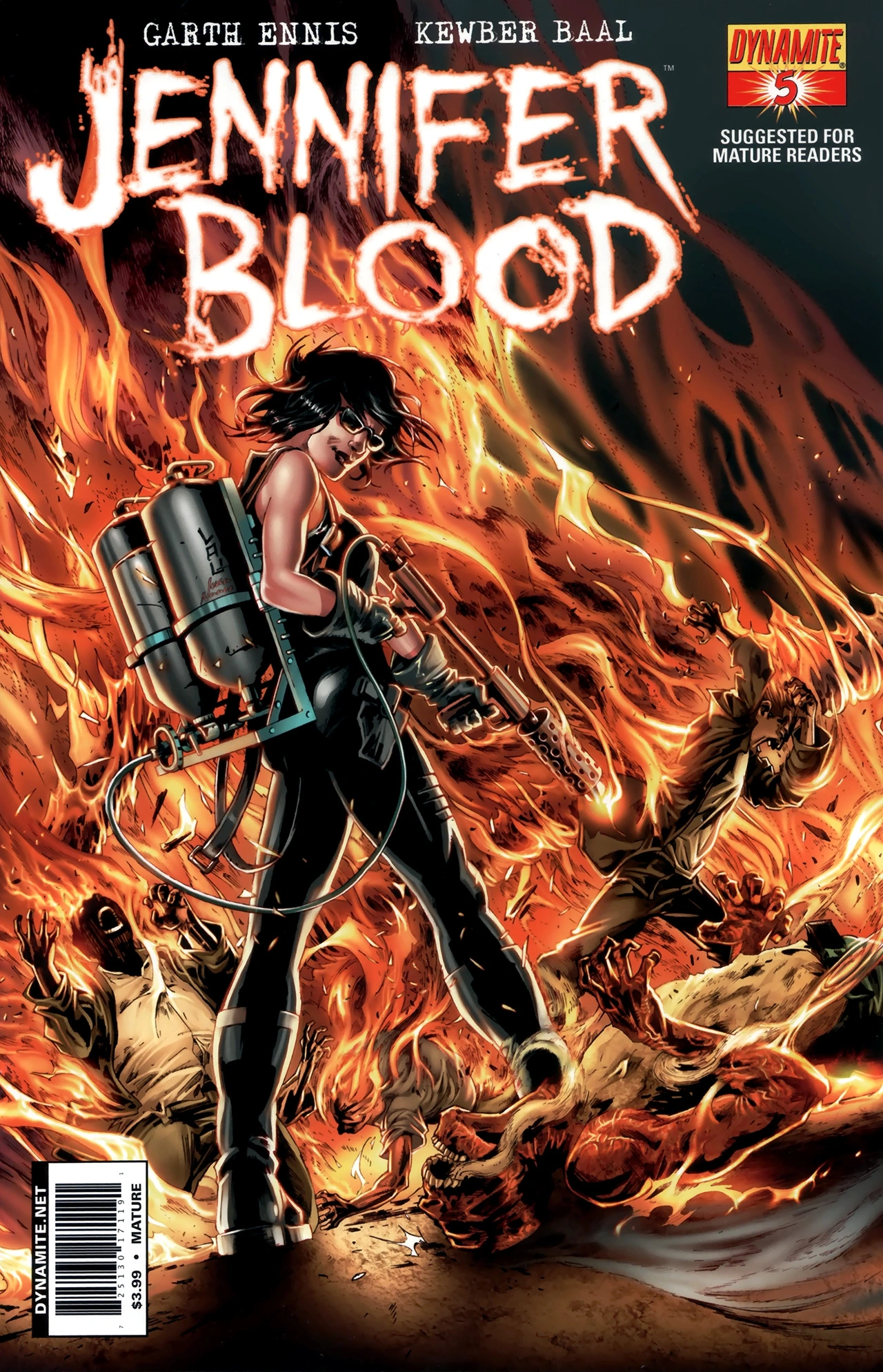
The quotation used as the title of the final issue of Garth Ennis’s story comes from Johnny Cash’s Folsom Prison Blues. The murderer in the song admits that he killed a man simply to watch him die. Jennifer Blood, meanwhile, deliberately prolongs her victim’s death so that he does not die too quickly. Before that can happen, he has to listen to the protagonist’s autobiography.
A large part of the issue functions as an inversion of a deathbed confession. Traditionally, a dying person confesses before death; here, Jennifer tells a dying man the story of her own past, her training, her entry into a life of killing, meeting her husband and creating a family as Jennifer Fellows. On one level, this fills in the remaining gaps in her past for the reader. On another, it completes the portrait of a protagonist who—despite what she may think—has never truly separated herself from her biological family. She still wants to boast about her achievements to its last surviving member, even though she intends to kill him afterwards.
Ennis presents the Mafia family as a kind of social vampire, draining symbolic blood from society. The metaphor is rather heavy-handed—he literally places the origins of the Blutes on the Hungarian-Romanian border—but it is effective.
It also connects with the broader motif of blood that has been present throughout the series, beginning with its very title. In doing so, Ennis reinforces the significance and power of blood ties, which the comic has gradually emphasised more and more strongly. The fact that Jennifer does what she does is therefore not evidence that she has separated herself from her biological family. Quite the opposite: the more desperately she has tried to free herself from them, the more closely she has come to resemble them.
This also completes her portrait as a person with a profoundly distorted morality, something further reinforced by several events shown in flashback. In this context, the revenge she has undertaken begins to look less like the true reason she started killing than an acceptable justification for her desire to murder. Jennifer Blood simply enjoys killing and torturing people. This means that the series can easily continue even after the deaths of her uncles. How Jennifer will rationalise her next murders therefore becomes an interesting question and provides a reason to continue reading.
Ennis also deconstructs another convention. He does not present a classical escalation of threat: across these six issues Jennifer does not face progressively more dangerous opponents. Quite the opposite. The only real escalation—apart from the escalation of violence itself—concerns her ability to kill. By the final issue, she has become so good at what she does that she dispatches her enemies more easily than in any previous instalment. This is somewhat disappointing because there is no genuinely suspenseful final confrontation, but at the same time it provides an enjoyable reversal of familiar comic-book and action-film conventions.
The issue also brings Jack’s storyline to a parodic and brutally grotesque conclusion. Practically naked from the waist down, with his hairy backside and genitals exposed, he attacks Jennifer with the intention of raping her, apparently interpreting her nocturnal costume as some kind of fetish wear. In other words, a man who has spent his time objectifying and sexualising women is himself exposed to ridicule, presented as a caricature and humiliated. His misogyny makes him predictable and extraordinarily easy to destroy.
Yet, as befits a comic so full of ambiguity, Jennifer’s treatment of him also reveals the moral ambivalence of this world. On the one hand, she knows that Jack has a child and a wife—and that his marriage is not actually unhappy—so she does not simply want to kill him. On the other hand, she does not hesitate to destroy his life so completely that the consequences will inevitably affect his family in a traumatic and highly public manner. Even when the protagonist is capable of mercy or empathy, she is perfectly willing to push them aside whenever they conflict with her goals. Whether she is Jennifer Blood or Jen Fellows, she therefore remains someone prone to extreme violence and eager to rationalise even her worst actions.
The comic actually contains very few positive characters, but when they do appear, they are ordinary people. People like Andrew Fellows: a boring suburban man who works in accounting and watches birds. He is honest, decent and contributes something positive to society. Nor does he need violence or misogyny in order to be entirely secure in his masculinity, which can be read as a jab at stereotypically aggressive, sexually dominant masculinity that exists largely to conceal emotional and intellectual inadequacy.
But will that be enough to survive life with a woman whose division between ‘night’ and ‘day’ has ceased to function? That is a question for the series’ future writers to answer.
Art
Visually, Baal makes excellent use of Pete as the issue’s immobile focal point. He is frequently shown upside down, lying down, framed from above and diminished in relation to the standing Jennifer. Even the title page shows his face inverted while he is being injected, immediately signalling that the balance of control has been completely reversed. Once, the family controlled Jennifer’s life. Now it cannot even control the moment of its own death.
The red ‘family portrait’ page is also excellent. Jennifer stands in black at the centre while the dead Blutes appear around her. It is a family portrait made from corpses, confirming that although she has physically removed her family, she continues to carry them with her psychologically.
Conclusion
The comic possesses a considerable number of undeniable strengths, but it is certainly not going to appeal to every reader. Ennis exaggerates his world to an extreme degree. It is filled with sadists, gangsters, sexual predators, antisemites, contract killers, human traffickers, dogfights, corrupt representatives of the law and so forth. Ordinary people exist only on the margins. As a result, for six issues we wallow in moral filth: exaggerated, grotesque and frequently distasteful. Here, traumatic childhoods or sexual abuse can sometimes become little more than an introduction to another bloody or erotically charged sequence, while our guide through all of it is a psychopath who believes her actions are justified and whom the comic expects us to support. Personally, I cannot say that I liked Jennifer in the slightest, and this contributed to my overall dislike of the series. Even so, I have to admit that the comic contains a considerable number of strengths and intriguing ideas.
There is, after all, a consistent structure built around inherited violence, performance, the male gaze, gender roles and even care work and class divisions. On the other hand, there are also scenes of people vomiting blood and intestines being used to write messages; nor can we avoid idiotic sexual predators, enormous amounts of juvenile gore and the excessive sexualisation of female characters. As someone who enjoys horror films and low-budget action cinema, I was not bothered by the excessive violence of the world itself. What did bother me at times was the way Ennis used that violence—particularly when grotesquerie and shock began to dominate the characters or the more serious themes that the comic itself had previously introduced.
How would I rate these first six issues? I would probably settle on 6/10. But I completely understand higher ratings.
Author of “Panorama of Hong Kong and Taiwan Cinema”, a lover of Asian cinema, action films, and space voyages aboard the starship Enterprise. He once studied Polish philology, and later became a citizen of the NSK State in Time. He has published in Kinomisja, Ekrany, Kultura Liberalna, Torii, Dwutygodnik Kulturalny, and others.